
- 01
The situation
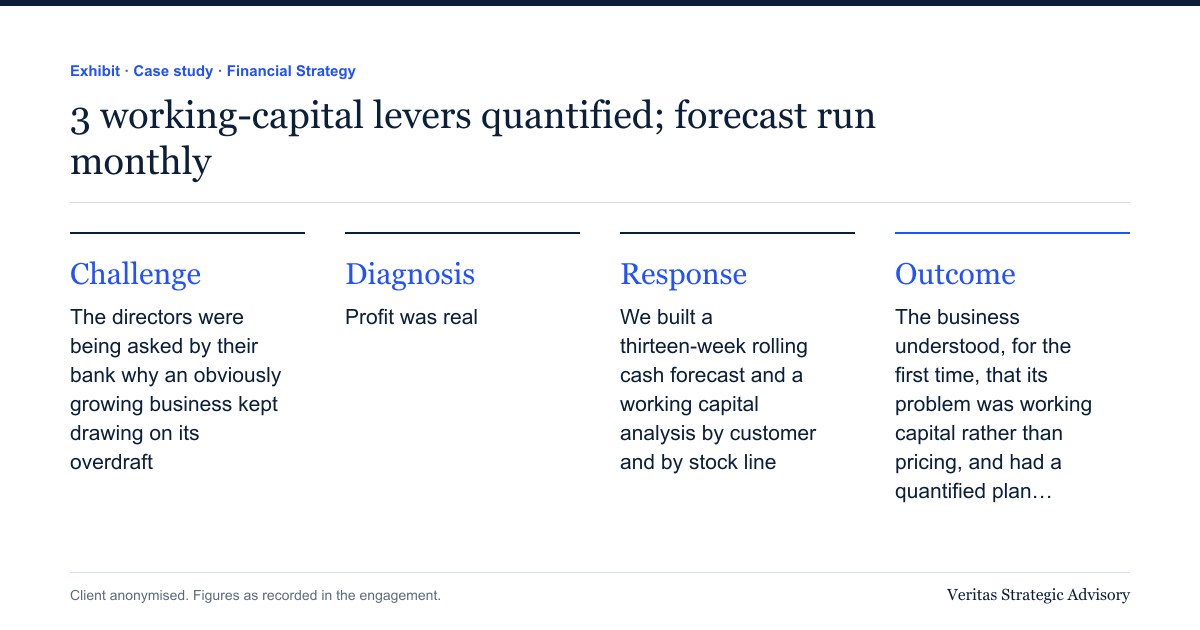
The directors were being asked by their bank why an obviously growing business kept drawing on its overdraft. The books were clean, the auditor had raised nothing, and profit on paper was healthy. Nobody in the business could explain where the money was going. The working assumption was that a competitor was undercutting them on price.
- 02
What we found
Profit was real. Cash was trapped. Stock had grown faster than sales because purchasing was ordering to a volume discount rather than to demand. Debtor days had drifted from an assumed 45 to an actual 78, with three large customers responsible for most of the drift. Supplier terms had never been renegotiated after volumes tripled. The overdraft was not funding growth; it was funding the gap between paying suppliers and collecting from customers.
- 03
What we did
We built a thirteen-week rolling cash forecast and a working capital analysis by customer and by stock line. We modelled the cash effect of three changes: tightening credit terms on the three slow-paying accounts, moving purchasing to a demand-based reorder point, and renegotiating supplier payment terms on the strength of the increased volume. We produced the numbers the directors used in both the customer conversations and the supplier negotiation, and set up a monthly cash review the finance team now runs itself.
- 04
What changed
The business understood, for the first time, that its problem was working capital rather than pricing, and had a quantified plan for each of the three levers. The forecast is now maintained in-house and reviewed monthly.
The lesson
A profitable business can still run out of cash. Profit is an opinion formed at year end; cash is a fact measured every week. If your revenue is rising and your bank balance is not, the answer is almost never price.