- Depreciation the bank claimed on leasehold property, in NPR
- 26,88,831
- Depreciation the Large Taxpayers' Office allowed, in NPR
- 4,47,297
- Taxable income the bank declared, in NPR
- 9,08,77,065
- Taxable income the tax office fixed, in NPR
- 9,57,60,612
Almost every business in Nepal that operates from rented premises spends money on them. Partitions, false ceilings, counters, wiring, flooring, glass fronts, vaults and air-conditioning ducts are paid for by the tenant, and they stay behind when the lease ends. For a bank with a branch network, this is a routine and large item. The tax question is simple to ask and easy to get wrong: into which depreciation class does that spending go?
The answer decides how quickly the cost comes back as a tax deduction. This case shows a dispute over exactly that, and it shows something equally useful for practice: how a directive, a circular and a return-filing date interact.
The case in outline
The taxpayer was Siddhartha Bank Ltd, which sought a review of the final tax assessment. The assessing office was the Large Taxpayers' Office. The case is reported at pages 99 to 104 of the Institute of Chartered Accountants of Nepal's compilation of Supreme Court decisions on the VAT, Income Tax, Customs and Excise Acts.
The bank had declared taxable income of NPR 9,08,77,065. After the office amended the assessment on 2067.3.30, the taxable income was fixed at NPR 9,57,60,612. The Inland Revenue Department reviewed the matter on 2067.5.31, and the Revenue Tribunal decided it on 2069.3.20 in the bank's favour on the point discussed here. The Supreme Court upheld that decision.
The difference between the two taxable income figures is NPR 48,83,547 on simple subtraction. The judgment does not attribute all of that to the depreciation point, and this article does not claim it does. Several items were in dispute. What this article covers is the depreciation of leasehold property.
The numbers on the leasehold claim
The bank claimed depreciation on leasehold property of NPR 26,88,831. The Large Taxpayers' Office was willing to accept only NPR 4,47,297. The gap is NPR 22,41,534, and that is the amount the dispute turned on for this issue.
The reason for the gap was not a quarrel about whether the money had been spent. It was a quarrel about class. The office took the position that the assets the bank had put into rented premises should be placed in class A of Schedule 2 of the Income Tax Act, 2058, the class for buildings and similar structures, which depreciates slowly. The bank had treated them as class E, the class for intangible property, where the cost is written off according to the period of the lease or right.
This is a common pattern in assessments. The cost is not questioned, the business purpose is not questioned, and the claim is cut purely because the asset is assigned to a different box in the schedule.
What the bank argued
The bank's position, as the judgment records it, was that these were improvements to premises held on lease. It did not own the land or the building. What it had paid for would stay with the landlord when the lease ended. Its right to enjoy those improvements was therefore limited to the lease term, and writing them off over that term was the natural result.
What the tax office argued
The office's position was that the bank had in substance built or fitted out structures, and structures belong in the building class. It relied on a circular of the Inland Revenue Department dated 2064.11.13 and placed the assets in class A.
What the Court decided, and why
Improvements on leased premises are temporary
The Court's first step was factual and practical. Improvements made on leased premises are temporary in nature. They are tied to the lease. The business decides what to do with its premises and what fittings to put in them, and the tenant's right in those fittings ends with its right in the premises.
This matters because the schedule's classes follow the character of the asset. A building the owner holds indefinitely is a different economic thing from a set of fittings the tenant will lose access to on a known date.
The IRD's own directive points to class E
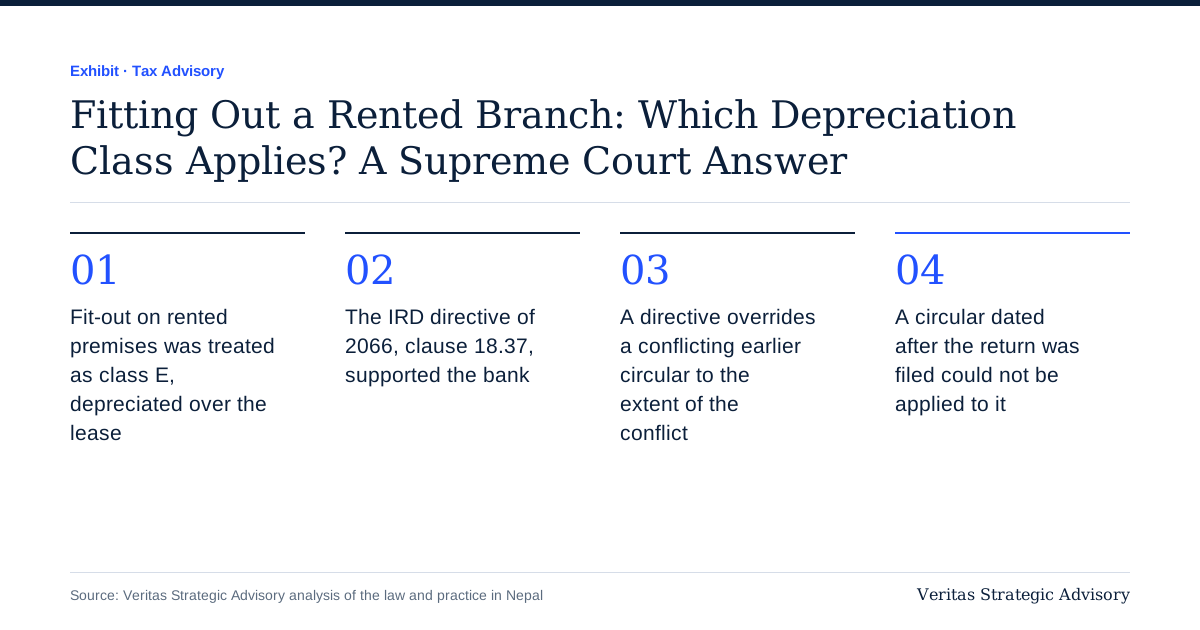
The second step carries the most weight. The Court looked at the Income Tax Directive, 2066, issued by the Inland Revenue Department. Clause 18.37 of that directive deals with structures built on leased land or premises and places them in class E, to be depreciated according to the lease agreement.
In other words, the tax administration's own guidance, on the point the bank had followed, agreed with the bank. The office's position could be supported only by a different, conflicting circular.
The directive overrides a conflicting circular
The third step is the rule on conflict. Clause 1.3.8 of the same directive provides that where earlier circulars conflict with it, they stand invalid to the extent of the conflict. The Court applied that. The circular of 2064.11.13, whatever it said, could not be used to override the directive's treatment of leasehold structures.
The circular could not reach back to the filing date
The fourth step is about time. The bank's return had been filed on 2063.09.30. The circular the office relied on is dated 2064.11.13, which is after the return was filed. The Court held that it could not be applied backwards to a return already filed. A taxpayer files on the basis of the law and guidance that exist when the return is submitted.
Taken together, these four points explain the outcome. The assets were temporary improvements, the administration's own directive classed them as class E, the directive prevailed over the conflicting circular, and the circular post-dated the return in any event.
What this decision does not settle
A careful reader should keep several limits in view.
First, the judgment is about the facts of one bank and one assessment year. It does not say that every fit-out cost on rented premises is class E. A tenant who pays for something that is a separate, movable asset, such as a free-standing generator or loose furniture, should look at the class that fits that asset on its own terms.
Second, the case was decided under the law and directive in force at the time of the return. The directive's number, the clause numbering and the depreciation classes have been reorganised over the years. Anyone relying on this decision today needs to check the current Schedule 2 and the current directive, and should not copy the class letters or the clause number from this article.
Third, the figures above are as printed in the reported judgment. This article reads them as they appear, and where the case is cited in a return or reply, the original report should be consulted.
Fourth, this article does not state depreciation rates. The rates attached to each class, and the way an intangible's cost is spread over its life, have changed with successive Finance Acts, and they must be checked for the income year at hand.
How a business with rented premises should keep its records
Nothing in this section comes from the judgment. It is practical advice drawn from the structure of the dispute.
Keep the lease agreement with the cost file for the fit-out. The lease term is the number the whole class E treatment depends on, so a missing or unsigned lease is the first thing an assessor will notice.
Separate fit-out costs by type. Fixed improvements that stay with the premises should be listed apart from movable assets, so each can go to its proper class.
Record the date the return is filed alongside the guidance relied on. This case was won partly on dates, so the date of any circular or directive you relied on, compared with the filing date, is part of your file.
Keep a note of the directive clause you followed. If the office later cites a circular, you can point to the clause and the conflict rule.
When a lease is renewed or extended, record how the remaining cost is to be treated, and record the decision when you make it.
An illustrative example
This is a made-up example and uses no figures from the case. A company rents a floor for five years and spends NPR 50,00,000 on partitions, flooring and wiring. If these are treated as a leasehold improvement written off over the five-year lease, the annual deduction is a level amount over five years, subject to what the schedule and the Finance Act of the relevant year provide. If instead the assessor places the same cost in a slow-depreciating building class, the deduction in each of the early years is much smaller, and the company is left with a large unrecovered balance when the lease ends. The tax cost of that difference is paid in the early years, in cash, which is why the classification fight is worth having.
Our view
The case is a good reminder that tax disputes about classification are often won on the administration's own documents. The bank did not win by arguing that the law ought to be generous. It won because the Inland Revenue Department's directive already said what the bank had done, because the directive's conflict clause protected it from a contrary circular, and because the circular was dated after the return.
For advisers, the working lessons are plain. Read the directive, not only the circulars. Check dates. Keep the lease, the cost breakdown and the clause reference together. And when a claim is cut by a large margin without any question about the spending itself, ask first which classification rule the office has applied and whether the administration's own guidance says something different.
For businesses, the lesson is to make the classification decision deliberately when the fit-out is capitalised, and to write down why. A short note made at that time is worth more than a long argument made years later.
Frequently asked
Does this mean all rented-premises fit-out is class E?
Not automatically. The case concerned improvements and structures tied to the lease. Separate movable assets should be assessed on their own character, and the current schedule must be checked.
Can a later circular change how a return already filed is treated?
In this case the Court held that a circular dated after the return could not be applied to it. A taxpayer should still check the position for any other circular and any later change in the Act itself.
What if the lease is short or has no fixed term?
The judgment turns on depreciation according to the lease agreement. A lease without a clear term makes the write-off period uncertain, so it is best to settle the term in writing and keep the document.
Why did the office allow only NPR 4,47,297?
The judgment records that the office placed the assets in class A. It does not set out the arithmetic behind the smaller figure in the passages this article relies on.
Can I cite this case in my own reply to a notice?
You can, but cite the original report, check that the directive and schedule are still the same for your year, and have the facts match closely.
Sources and limits
Source: the compilation of Supreme Court decisions on the VAT, Income Tax, Customs and Excise Acts, published by the Institute of Chartered Accountants of Nepal, pp.99 to 104 (Siddhartha Bank Ltd leasehold property depreciation). Figures were checked by enlarging the printed pages. The Supreme Court's own decision date and case number are not recorded in this article and should be taken from the original report. Clause numbers refer to the Income Tax Directive, 2066, as quoted by the Court. Depreciation rates and class definitions have changed over time and are deliberately not stated.
General information only, not advice.