
- dividend withholding tax
- 5%
- offices involved
- 4
- banking trail from day one
- 1
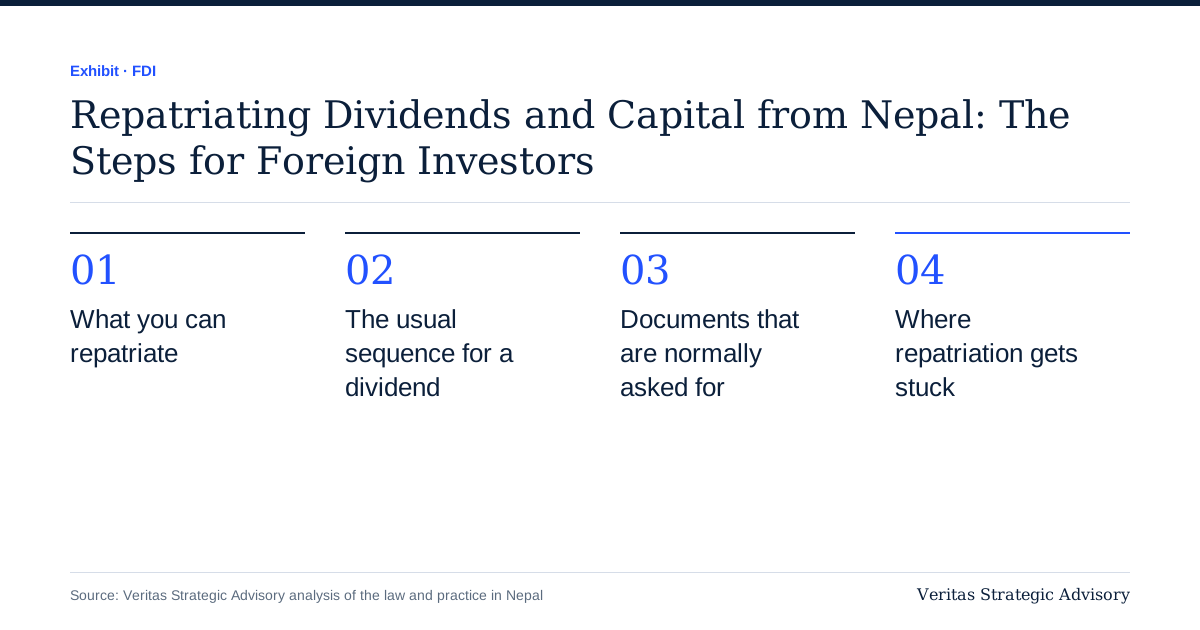
What you can repatriate
Dividends declared out of audited profit.
Sale proceeds when you sell some or all of your shares.
Proceeds of liquidation after the company is wound up.
Principal and interest on a foreign loan approved by NRB.
Royalties and fees under an approved technology transfer agreement.
The right depends on the money having come in through the banking system and been recorded against your approval. Investment brought in any other way cannot be sent back out.
The usual sequence for a dividend
Board and AGM approve the dividend on audited financial statements.
Withholding tax is deducted and paid to the IRD: 5% as a final tax, or the treaty rate if a double tax avoidance agreement applies and its conditions are met.
The approving body is notified or gives its recommendation: the Department of Industry or the Investment Board, as applicable.
The application goes through a licensed commercial bank with NRB approval or under the rules NRB has delegated to banks. In recent years NRB has eased this route.
The bank converts and remits the amount to the investor's account abroad.
Documents that are normally asked for
Foreign investment approval and any amendments
Proof of inward remittance (the bank's foreign exchange certificates)
Share register certified by the Company Registrar
Audited financial statements and the auditor's report
Board and AGM minutes approving the dividend
Tax clearance certificate and proof of withholding tax paid
For treaty rates: a tax residency certificate from the investor's home country
Requirements change with NRB circulars and the bank's own checklist, so confirm both before filing.
Where repatriation gets stuck
The inward remittance was never recorded against the approval, or arrived as a loan when it was approved as equity.
Accumulated losses: dividends can be paid only from distributable profit.
Unresolved tax: an open assessment can hold up the tax clearance.
Different names and amounts across the approval, the share register and the bank records.
Build the file correctly from the first remittance. See FDI approval versus realisation and our FDI service.
A worked example: from board decision to bank transfer
A foreign parent holds 80% of a Nepali private company. The company earned NPR 3 crore after tax in the year and the board proposes to distribute NPR 1.5 crore. Illustrative figures only.
Distributable profit check. Retained earnings after tax are NPR 4 crore, so there is room. The company confirms it has no accumulated losses that would block the payout and that statutory reserves are in place.
Board and AGM. The board recommends NPR 1.5 crore. The AGM approves it, and the minutes record the amount, the record date and the per-share figure.
Tax deduction. The company deducts 5% dividend tax on the foreign shareholder's share. The parent's share is 80% of NPR 1.5 crore, which is NPR 1.2 crore, so tax withheld is NPR 6 lakh and the net due to the parent is NPR 1.14 crore. The company deposits the tax and files the withholding return. If a tax treaty applies and the documents support it, a lower rate can be claimed.
File assembly. The company gathers the approval, inward remittance proofs, the share register, audited accounts, the minutes, proof of tax paid and any clearance the bank requires.
Application. The company applies through its commercial bank, which checks the file against the investment approval and the central bank's rules.
Remittance. The bank converts rupees to the currency of the remittance and sends the money to the parent's account abroad, with the supporting reporting.
The money moves in weeks when each document is already in order. It takes months when the company is looking for the original remittance advice or discovers that the share register at the Registrar shows a different holding.
The three records that decide whether repatriation works
The inward remittance record. Every rupee of foreign investment should be traceable to a foreign exchange credit advice from a bank, issued when the money came in and linked to the investment approval. If a shareholder paid in cash, through a third party or into the wrong account, the link is broken and repatriation of that amount may be refused.
The approved investment record. The approval states the amount, the form (equity or loan), the sector and any conditions. Amounts brought in beyond the approval, or in a different form, need regularisation before they can be sent back. See FDI approval versus realisation.
The share register. The register at the company, certified by the Company Registrar, must match the approval and the remittance records. Transfers and increases of capital that were not recorded cause mismatches; see share transfer and capital increase.
If any of the three is weak, repair it before you declare a dividend. A repatriation application is the wrong time to discover an old error.
Other routes out of Nepal
Dividends are the most common route, but not the only one.
Sale proceeds. A foreign investor who sells shares to a Nepali or foreign buyer may repatriate the proceeds after capital gains tax is paid and the transfer is recorded; the buyer's payment route and the valuation both matter.
Liquidation proceeds. After the company is wound up and its tax settled, the surplus may be repatriated. See company liquidation and closure.
Loan repayment. Principal and interest on an approved foreign loan are remitted under the approved schedule; see foreign loans and the NRB approval.
Royalties and technical fees. Payments under an approved technology transfer or licence agreement follow the terms of the approval and the tax rules; see the Nepal–India treaty and withholding rates.
Management or service fees to a parent are not dividends. They are expenses subject to withholding, transfer pricing and substance checks; see transfer pricing explained.
Mistakes that block or delay a transfer
Paying a dividend from capital or from a loss-making year, which the law does not allow.
Declaring a dividend without taxes paid, so the tax clearance is refused.
Late AGM and annual filings, which stop the Registrar from certifying the register.
Treating a shareholder's loan as equity or the reverse, so the approval does not match.
Using an agent's account for inward remittance.
Ignoring the currency of the original investment and the exchange rate the bank will use.
No tax residency certificate where a treaty rate is claimed.
Waiting until the parent needs the cash instead of building the file during the year.
A yearly routine for foreign-owned companies
After each inward remittance, collect the credit advice and update the register and the approval record.
Every quarter, reconcile the investment record to the bank and the Registrar.
Before the AGM, check the distributable profit and the tax position.
After the AGM, deduct and deposit the dividend tax and file the return.
Assemble the repatriation file in the same month, and submit through the bank.
Keep a repatriation log with dates, amounts and the bank's reference numbers.
We help foreign-owned companies build and keep this file, and we review the position before a dividend is declared. See FDI support and the FDI approval guide. NRB and bank checklists change, so confirm the current requirements before you apply.
Questions people ask
Do we need NRB approval for every dividend? Recent NRB measures have eased the process, and many cases now go through the commercial bank on the basis of the investment approval and the documents. The exact route depends on the current circular and the bank's checklist, so ask the bank for its list before the AGM, not after.
Can a dividend be paid in instalments or in kind? A cash dividend is the normal route for repatriation. Bonus shares are not cash and do not leave the country. If you plan a mixed distribution, check how each part is treated for tax and for repatriation.
What if the shareholder is a company in a treaty country? A lower withholding rate may be available if the treaty gives it, the shareholder is the beneficial owner and a tax residency certificate is provided. Without the documents, the domestic rate applies. See the treaty guide.
How long does the bank take? Reports mention periods of about two weeks from a complete application, but a file with missing items will take as long as it takes to fix them. Plan a month and treat anything faster as a bonus.
What happens if the company has accumulated losses? Distributions are restricted. Offset against reserves and the legal limits on distribution must be checked before the board recommends a payout.
Can we repatriate profit in a year when we made a loss? Not as a dividend from that year's profit. Past retained earnings may allow it, subject to the law and to the tax position.
Is the company or the shareholder responsible for the withholding? The company deducts and pays the tax and is liable if it does not. It should provide the shareholder with a certificate.
What if the investor sold shares to another foreign investor? The transfer needs the appropriate approval and registration, and capital gains tax is due. The buyer's inward remittance and the register must show the change.
A pre-dividend checklist
Distributable reserves confirmed by the audited accounts.
No unresolved tax assessment that would block clearance; see tax clearance.
Share register and Registrar records agreed.
Inward remittance advices located for every tranche of investment.
Board and AGM minutes drafted with the amount and the record date.
Tax rate decided, with treaty documents ready if relevant.
Bank checklist obtained and compared to the file.
Funds available in the company's account in the right currency or convertible.
A named person responsible for the application and for chasing the bank.