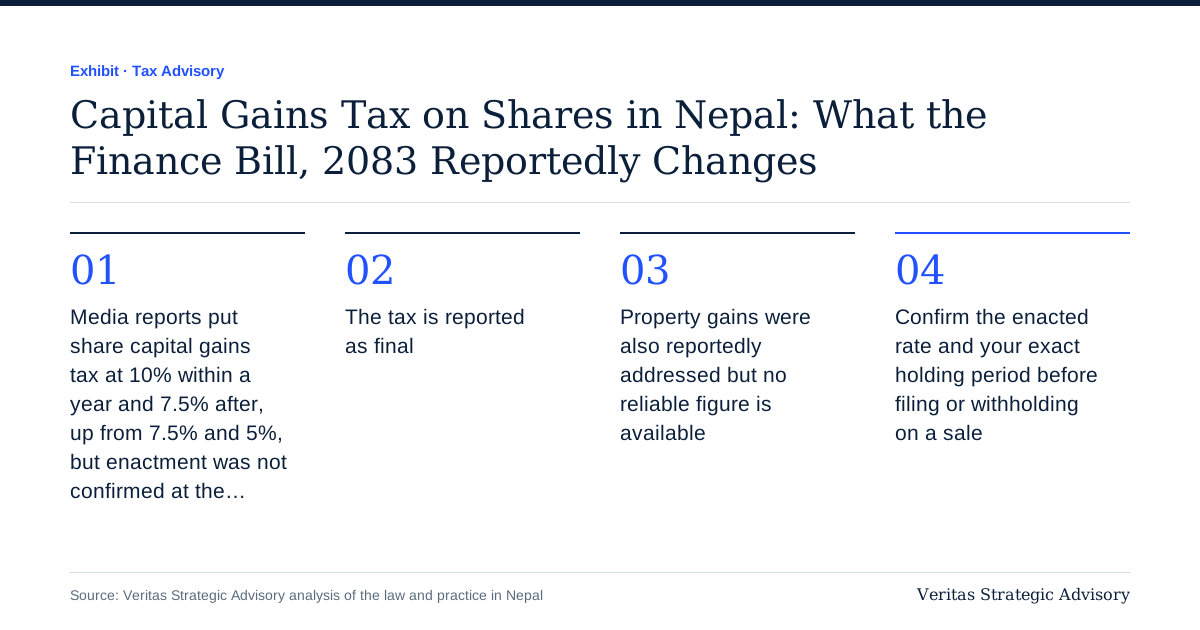
- Reported rate within one year of holding
- 10%
- Reported rate after one year of holding
- 7.5%
- Previous rate within one year (reported as superseded)
- 7.5%
- Previous rate after one year (reported as superseded)
- 5%
Every year the days around the federal budget speech produce the same pattern. A headline runs with a new tax rate, a WhatsApp group forwards it as fact, and by the time the formal Act is published half of Kathmandu's finance teams have already adjusted their spreadsheets. Most years that costs nothing. Some years, when a Bill gets amended before passage or the effective date shifts, it costs a filing made on the wrong number.
This year the reported change concerns capital gains tax on the sale of shares. If the figures reported in the press hold, it is a meaningful increase, not a cosmetic one, and worth planning around. But "if it holds" is doing real work in that sentence, and it deserves more than a shrug.
What is being reported
Coverage of the Finance Bill, 2083 describes capital gains tax on share sales moving as follows:
Shares held within one year: 10%, reported as up from 7.5%.
Shares held for more than one year: 7.5%, reported as up from 5%.
The tax is described as final, meaning it is not an advance payment adjusted later against total income; once withheld or paid, that is the end of the liability on that gain.
We have not been able to confirm from the Bill text or an official Inland Revenue Department notice that this has actually been enacted. Property capital gains were also reportedly addressed in the same Bill, but the figures circulating for property were inconsistent between sources, so we are not repeating a number here. If you deal in property gains, that uncertainty is a reason to wait for the Act, not a reason to assume nothing changed.
Why "reported" and "law" are not the same thing
A Finance Bill goes through a process before it becomes the Finance Act: introduction, discussion, possible amendment, and passage. Rates reported at the time a budget speech is given do not always survive unchanged to the final Act, and the effective date is sometimes different from the date most people assume. Nepal's tax history has examples of both.
Three things can happen between a reported rate and your tax return:
The rate in the Bill is amended before passage.
The effective date is not the date of the budget speech, but a later date tied to the Act's commencement.
A transition rule applies the old rate to transactions already in progress, such as a sale agreement signed before the change.
None of that is unusual. It is simply why a professional treats a press report as a planning signal, not as a number to put in a return.
What to do with a reported rate change
If you are planning a share sale and the sale is not urgent, the reported increase is a reason to get the transaction's tax position settled before you act, not after. Confirm the current enacted rate, confirm your holding period precisely (the one-year line is not negotiable once you are a day on either side of it), and get the computation checked against the Act in force on the date of disposal, not the date of the budget speech.
If you have already sold shares this year, do not assume either rate applies until the position is confirmed. Keep your sale documents, the purchase cost records, and the holding period calculation ready, so that whichever rate turns out to govern, you can compute the liability correctly without reconstructing records under time pressure.
If you are a company withholding tax on behalf of a selling shareholder, withholding at a rate that later turns out to be wrong creates a reconciliation problem for both sides. Wait for confirmation of the enacted rate before changing a withholding process that is currently working correctly.
A worked illustration
The figures below are illustrative only, built on the reported rates, not a client case, and not a statement that these rates are currently in force.
A resident individual bought shares for NPR 20,00,000 and sells them for NPR 32,00,000, a gain of NPR 12,00,000.
If sold within one year of purchase, and if the reported 10% rate is confirmed in force at the time of sale: tax of NPR 1,20,000, as a final tax.
If sold after one year of purchase, and if the reported 7.5% rate is confirmed in force: tax of NPR 90,000, as a final tax.
Under the rates reported as superseded, the same gain would have produced NPR 90,000 (at 7.5% within one year) or NPR 60,000 (at 5% after one year). The difference is the kind of number that changes whether a sale makes sense this quarter or next, which is exactly why the timing of confirmation matters.
How to read a budget report before you act on it
A short checklist turns a headline into something you can plan around. Run through it every time a tax change is reported, not only this one.
Where did the number come from? A newspaper summary of a budget speech is one step removed from the Bill, and the Bill is one step removed from the Act. The closer your source is to the Act or an Inland Revenue Department notice, the more weight it deserves.
Is it a Bill or an Act? A Bill can still change. Ask whether it has been passed and published, and read the version that was actually passed rather than the version that was introduced.
What is the effective date? It is often not the date of the speech. Some changes apply to transactions on or after a stated date, and some to income of a stated year. The difference decides which of two nearby sales is taxed at which rate.
Is there a transition rule? Ask what happens to a sale agreement signed before the change but completed after it, and to a gain that accrued over years but is realised once.
What does the rate apply to? A rate stated for "share sales" may not distinguish listed from unlisted shares, resident from non-resident sellers, or individuals from companies. Do not assume a single rate covers every seller until the text says so.
Is the tax final? A final tax closes the liability on that gain. A non-final tax is adjusted later against total income. The two lead to different cash and filing positions.
None of these questions needs a lawyer to ask. They need the habit of asking before a number goes into a spreadsheet.
The holding-period line in practice
The reported structure turns on one year. That makes the holding period the single most valuable fact in the file, and it is also the one most often reconstructed from memory.
Work it out from documents, not recollection. For shares bought in several lots, each lot has its own purchase date and therefore its own holding period, so a single sale can straddle the line. A person who bought some shares eleven months ago and some two years ago, then sells a mixed quantity, has two different gains at two different rates, and which lots are treated as sold first matters. Before a sale, list each lot with its date, quantity and cost, and decide, with advice if needed, how the lots are to be matched to the shares being sold.
Bonus shares and rights shares add a further layer. Their acquisition date and their cost for tax purposes are not always what an owner assumes, and the treatment can differ between the two. We are not stating a rule here, because the point is that this is exactly the kind of detail to confirm against the Act in force before the sale rather than after it.
A second worked illustration: the sale that straddles the line
The figures below are illustrative only, built on the reported rates, and are not a statement that those rates are in force.
A resident individual holds two lots of the same company's shares.
Lot A, bought 14 months ago: 1,000 shares at a total cost of NPR 5,00,000.
Lot B, bought 8 months ago: 1,000 shares at a total cost of NPR 8,00,000.
The investor sells both lots for a total of NPR 18,00,000. Treating each lot on its own facts, the gain on Lot A depends on its sale value, as does the gain on Lot B, so assume the sale value is split NPR 7,00,000 for Lot A and NPR 11,00,000 for Lot B.
Lot A gain: NPR 7,00,000 less NPR 5,00,000 = NPR 2,00,000. Held more than one year, so at the reported 7.5% the tax is NPR 15,000.
Lot B gain: NPR 11,00,000 less NPR 8,00,000 = NPR 3,00,000. Held less than one year, so at the reported 10% the tax is NPR 30,000.
Total reported tax: NPR 45,000.
Under the rates reported as superseded, the same two gains would give NPR 10,000 on Lot A at 5% and NPR 22,500 on Lot B at 7.5%, a total of NPR 32,500. The increase is NPR 12,500 on this sale, and most of it comes from Lot B sitting on the short side of the line.
The practical point is not the arithmetic. It is that four more months of holding Lot B would have moved it to the lower rate, which is the kind of decision that is worth taking deliberately, with the dates on the table, instead of discovering it at filing time.
What to put in the file before any share sale
A sale file that can survive a question years later contains the following.
The contract note or transfer document for the acquisition of every lot, showing date, quantity and price.
Evidence of any bonus or rights shares, with the date they were issued and how their cost was determined.
The sale contract note or transfer document, showing date, quantity and price, and the identity of the buyer.
The brokerage and other transaction costs, and a note of whether the computation deducts them, since that decision changes the gain.
A written holding-period calculation, lot by lot, dated and signed off by the person who prepared it.
A copy of whichever source you relied on for the rate, whether a notice or the Act, with the date you consulted it.
Proof of payment of any tax, and of the filing, where one is required.
Keeping this on the day of the sale takes minutes. Reconstructing it later, when a query arrives, takes weeks and is sometimes impossible.
Our view
In our view, the sensible response to a reported rate change is neither to ignore it nor to act on it. Build the transaction as if the higher rate will apply, because planning for the less favourable outcome rarely hurts you if the rate turns out lower, and protects you if it does not. But do not file, withhold, or restructure a transaction specifically to beat a rate that is not yet confirmed law, because a rushed sale timed around an unconfirmed number is itself a decision made on incomplete information.
Our practical preference, where a sale is genuinely discretionary and the client can wait a short period without commercial cost, is to wait for the Act or an unambiguous official notice before finalising. Where the sale cannot wait, for reasons of counterparty timing or funding need, we would compute the position under both the reported new rate and the current rate, disclose both to the client in writing, and proceed on the basis that whichever rate the Act confirms, the computation has already been checked.
We would not advise a client to accelerate a sale purely to lock in the old, lower rate before an unconfirmed change takes effect. Doing so on the strength of a news report, without knowing the actual effective date the Act will set, can just as easily land on the wrong side of the transition rule.
Frequently asked
Has this rate change actually come into force?
We could not confirm that from the Bill text or an official notice as of this writing. Confirm the current position with the Act or an IRD notice before relying on either the old or the reported new rate.
What counts as "within one year" for the holding period?
The period runs from acquisition to disposal. Being a single day on either side of the one-year line moves you between the two rates, so compute the dates precisely rather than estimating.
Does the final tax description mean I never have to think about it again?
It means the tax withheld or paid on the gain is not adjusted later against your other income. It does not remove the need to compute it correctly, keep records, or confirm which rate applied to your specific transaction.
Is the property capital gains rate changing too?
The Finance Bill, 2083 was also reported to touch property gains, but the figures we found were inconsistent between sources, so we are not stating a number. Treat any property rate you see quoted the same way: unconfirmed until the Act or an official notice says otherwise.
Should I delay or accelerate a planned share sale because of this?
That depends on your specific facts and cannot be answered in general terms. What we would say generally is that accelerating a sale purely to beat an unconfirmed rate change carries its own risk, since the eventual effective date may not match what today's reports assume.
General information only, not advice.