- reported paid-up capital
- NPR 20 million
- money streams to separate
- 3
- licence from DoFE
- 1
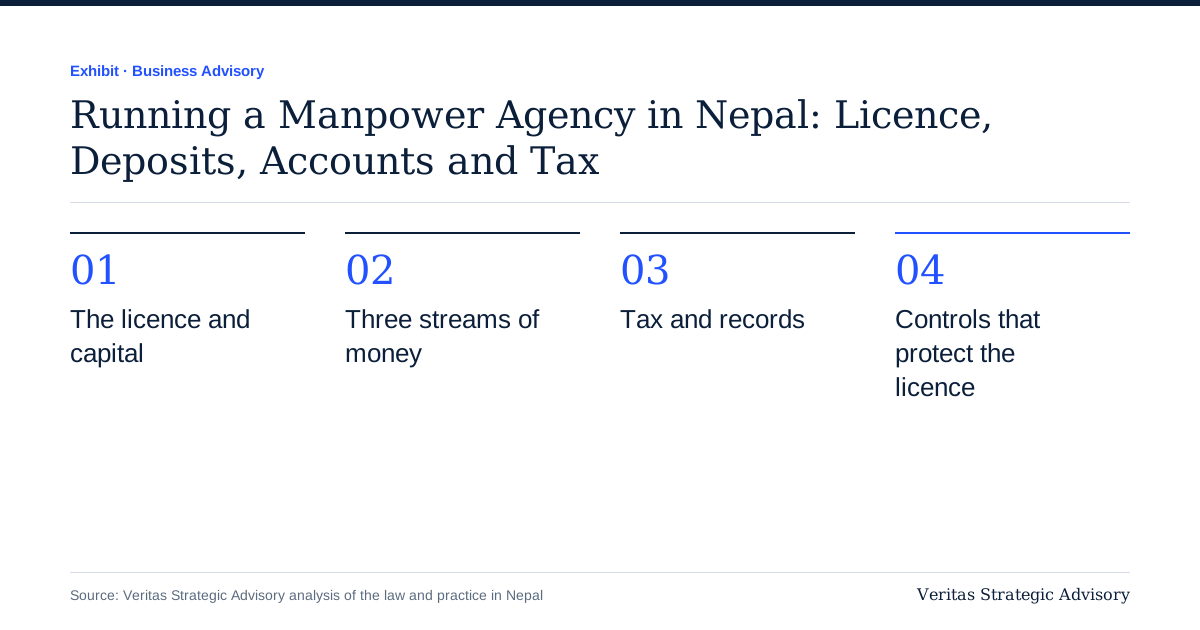
The licence and capital
Structure: a private limited company with the required capital paid in through a bank.
Documents: company registration, PAN or VAT, directors' details and a clean record, premises, and the application to the Department.
Security: a deposit or bank guarantee as the law and the Department require. Reported amounts range from NPR 20 million to 60 million depending on volume, and have been under review; check the current figure.
Amounts, volumes and rules change, so rely on the Department's current notice.
Three streams of money
| Stream | What it is | Treatment |
|---|---|---|
| Agency service charges | The agency's own income | Revenue, with tax and VAT as applicable |
| Employer-paid costs and recruitment fees | Costs recovered or paid for the worker | Follow the Act's limits on what a worker can be charged |
| Deposits and guarantees | Security held with the regulator or a bank | A separate asset, not an expense |
Mixing these is the root of most compliance issues. Record each stream in its own ledger and reconcile them to bank accounts.
Tax and records
Income tax on the agency's profit at the corporate rate; see corporate tax rates.
TDS on rent, salaries and fees, with the deposits and returns up to date; see TDS rates.
Foreign currency receipts through banks, with documents for each inflow.
Payroll and SSF for the agency's own staff; see SSF compliance.
A worker file for each placement: contracts, approvals, payments, complaints.
Controls that protect the licence
A fee schedule that follows the Act, and a refusal to take anything above it.
Receipts for every payment from a worker, in the agency's name.
A monthly bank reconciliation with the deposit and guarantee tracked.
A complaints register and records of how each case was settled.
An annual compliance check before the licence renewal.
A licence can be suspended or cancelled for breaches, and unrecorded payments are the usual cause. We set up the ledgers and controls and prepare the renewal file. See bookkeeping and internal audit.
A worked example: one placement, start to finish
An agency places a worker with an overseas employer. The following illustrative sequence shows the money and the records at each stage.
Demand letter and approvals. The overseas employer issues a demand and the agency obtains the government approvals the Foreign Employment Act requires. The file contains the demand, the power of attorney, the employer's details and the permission.
Recruitment. The agency advertises, interviews and selects the worker. It records the selection and the worker's documents.
Contract. The worker signs an employment contract that meets the Act's minimum terms, and the agency keeps copies.
Fees. The worker pays only what the Act and the Department allow, and the agency issues a receipt in its name for every payment. Costs the employer is required to bear are billed to the employer.
Insurance and orientation. The worker takes the required insurance and training. The agency keeps the receipts and certificates.
Labour permit and travel. The agency obtains the permit and the worker travels. The file shows the ticket, the visa and the permit.
Service charge from the employer. The agency invoices the overseas employer for its service charge, and receives it in foreign currency through a bank.
Follow-up. The agency records any complaints from the worker and how they were resolved, and keeps contact records during the contract.
Close. At the end of the contract, the agency records the closure and any outstanding matters.
The same worker file should be able to answer an inspector's questions about each of these steps without searching through boxes.
The ledgers an agency needs
| Ledger | Contents | Why it matters |
|---|---|---|
| Service income | Charges from foreign employers by placement | The agency's revenue, tax and VAT analysis |
| Worker receipts | Amounts received from workers, by worker and by head | Proves compliance with the Act's limits on what workers pay |
| Pass-through costs | Insurance, training, tickets, visas and permits paid on behalf of workers or employers | Separates the agency's costs from recoverable amounts |
| Security deposit and guarantee | The licence deposit or bank guarantee | An asset held with a regulator or bank |
| Foreign currency | Receipts and conversions, with bank advices | Evidence for foreign exchange and tax |
| Complaints and settlements | Cases, amounts and outcomes | Supports the licence and responds to inspections |
Without separate ledgers, an agency cannot show how much it earned, how much it held for others and whether it charged workers properly.
Tax and compliance details
Income recognition. Service income is recognised when the service is delivered, which can differ from when cash arrives. Prepare a policy and follow it.
VAT. The treatment of services to overseas employers can have a specific VAT position, and the agency may have local supplies as well. Review the rules for your activities; see VAT registration in Nepal.
TDS. Rent, staff fees and contractors are subject to deduction; see TDS rates.
Foreign exchange. Keep every bank advice, and reconcile receipts to placements. Unexplained credits are an invitation to a query.
Payroll and SSF for the agency's own employees; see SSF compliance.
Annual compliance. The licence is renewed and the Department can inspect the files, the accounts and the premises. Prepare annually, not at the last minute.
Red flags that put the licence at risk
Collecting fees from workers above the allowed amounts or without receipts.
Sending workers without the required approvals or contracts.
Not resolving worker complaints and compensation claims.
Recording worker payments in a personal account.
A security deposit or guarantee that has expired or been reduced.
Misleading advertising about jobs or salaries.
Poor records on insurance and welfare fund contributions.
Subcontracting recruitment to unlicensed agents without control.
A single serious breach can bring suspension or cancellation, and the cost of rebuilding after that is greater than the cost of prevention.
Questions people ask
Can an individual run an agency? The Act requires a company structure for licensed agencies, as reported by advisers. Confirm with the Department.
How do we handle money held for a worker? Do not mix it with the agency's funds. Record it in a pass-through ledger, hold it in a separate bank account where practical and return or apply it as the law allows.
What should an inspector find? A file for each worker, receipts for each payment, ledgers that reconcile to the bank, a clear record of complaints and a current licence and security.
What if a worker complains? Respond promptly, record the case and follow the process the law provides. Delay causes escalation.
Can we grow into other services? Training, documentation and consulting are possible, but each has its own rules and tax position.
We set up the ledgers and controls, prepare for inspections and the licence renewal and support the agency's finance function. See bookkeeping, internal audit and virtual CFO. Deposit amounts, capital rules and procedures change, so confirm the current ones with the Department of Foreign Employment.
Planning the agency's finances: working capital and growth
A manpower agency's cash cycle has features that surprise new owners. Costs such as advertising, recruitment, medical tests, documentation and travel for staff come early, while service charges from foreign employers come after the worker has started, and sometimes late. The agency also holds a large security deposit or guarantee that ties up capital. A business that does not forecast cash can run out of money even when placements are growing.
Build a placement-level budget. For each type of placement, estimate the direct costs, the service charge, the timing of each and the expected rate of failure, such as workers who withdraw or are rejected. Multiply by the planned number of placements per month.
Forecast cash for twelve months. Include the security deposit, rent, salaries, advertising, taxes and the working capital needed for pass-through costs. Test a slow quarter, since demand from overseas employers can change with events abroad.
Watch the concentration. Depending on a few employers or one destination country is risky. Record each employer's share of service income and review it quarterly.
Plan for foreign exchange. Service charges received in foreign currency are converted at the bank's rate, and costs are in rupees. Track the effect of movements, and agree with employers on the currency and timing of payment.
Keep reserves. Complaints, compensation claims and legal costs can arise without warning. A reserve, and insurance where available, keeps one dispute from threatening the licence.
Choosing and managing sub-agents and partners
Many agencies work through local sub-agents and overseas partners. This creates control risks. Reduce them by:
Signing written agreements that state fees, responsibilities and compliance with the Act.
Paying only through bank channels against documented work.
Prohibiting sub-agents from collecting money from workers in their own names.
Visiting and auditing sub-agents, and keeping records of their activities.
Checking overseas partners' registration and track record, and recording each employer's details.
Keeping all worker documents in the agency's files, not with the sub-agent.
An agency is responsible under the Act for what its agents do on its behalf, so treat agent oversight as a core control, not an optional extra.