- reported rate for holding up to five years
- 10%
- tax treatments: gains and business income
- 2
- ledger per project
- 1
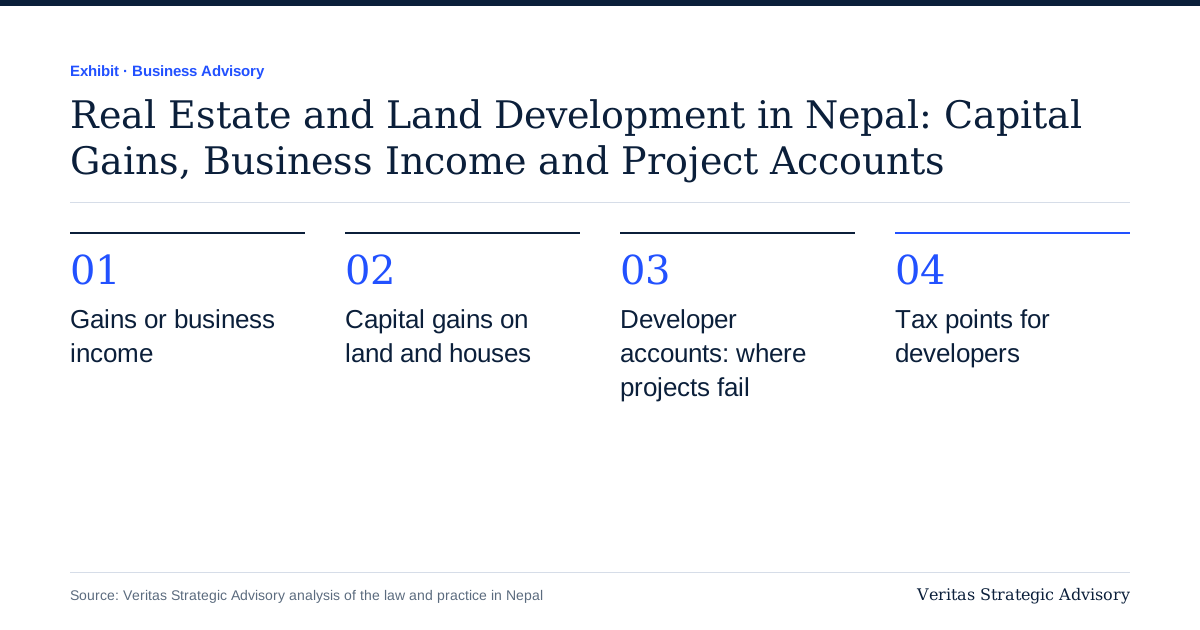
Gains or business income
| Capital gains | Business income | |
|---|---|---|
| Who | An owner selling property held as an investment or home | A person or company that buys and develops or trades property regularly |
| Taxed | On the gain at the capital gains rate, generally at transfer | On net profit at the income tax rate, with costs deducted |
| Costs | Purchase price, improvement cost and transfer expenses | Land, development, marketing, finance and overheads |
The line is a matter of fact: frequency, intention, development and how the books treat the property. A person who sells many plots in a year may be assessed as a business.
Capital gains on land and houses
The budget for 2083/84 raised the rate for property held up to five years from 7.5% to 10%, with the new rates from 17 July 2026, and a lower rate for longer holdings. Reports differ on the longer-holding rate, so use the IRD's schedule for the transfer date. Our property capital gains calculator applies the five-year rule. Transactions rushed before a tax rise should still be documented properly, because a purchase price not supported by evidence is questioned.
Gains can be exempt on the amount up to the government-assessed value in some development acquisitions. Check the specific provision.
Developer accounts: where projects fail
Project costing. Land, approvals, construction, interest and overheads by project, so margin per project is known.
Advance receipts. Customers' advances are liabilities until the unit is delivered; spending them on another project is how developers get stuck.
Revenue timing. Recognise revenue by the rules in the standard you follow, not when cash arrives.
Construction contracts and retention. See contract accounting.
Financing. Projects often rely on bank loans against land. See loan rescheduling if sales slow.
Land subdivision rules and local approvals affect timing and cost.
Tax points for developers
TDS on contractors, rent and professional fees; see TDS rates.
Depreciation on equipment and offices; see depreciation rates.
VAT on construction inputs and, where applicable, on sales; check the rules for housing and commercial units.
Valuation and registration values that differ from sale prices, and the questions they raise.
We build the project ledger, the cash forecast and the tax position. See financial advisory and modelling and virtual CFO. Rates and rules change by budget, so confirm before you transact.
A worked example: a small residential project
A developer buys a plot for NPR 4 crore and builds eight apartments. The project plan, in illustrative numbers, is as follows.
| Item | NPR crore |
|---|---|
| Land and registration costs | 4.0 |
| Design, approvals and permits | 0.3 |
| Construction | 6.0 |
| Bank interest during construction | 0.7 |
| Marketing and sales costs | 0.4 |
| Overheads allocated | 0.3 |
| Total cost | 11.7 |
| Sales: eight apartments at NPR 1.75 crore | 14.0 |
| Profit before tax | 2.3 |
The profit before tax is about 16% of sales. At the corporate rate of 25%, tax would be NPR 57.5 lakh, leaving NPR 1.725 crore. If sales are delayed by a year, the extra interest and overheads of, say, NPR 0.6 crore reduce profit to NPR 1.7 crore, and the margin to about 12%. If prices must be cut by 8% to sell, profit falls by another NPR 1.12 crore, to roughly NPR 0.58 crore. A project that looked healthy can become marginal with two moderate shocks.
Cash side. The developer pays for land at the start, spends on construction over 18 months and receives customer advances along the way. If advances are used to finish the construction, the project is self-funding. If they are used for the next project, it is not. The cash forecast, month by month, is the central tool; see profitable but short of cash.
Project accounting in practice
One ledger per project. Land, construction, finance cost, marketing and overheads are booked to the project. Shared overheads are allocated by a stated rule.
Customer advances. These are liabilities until the unit is delivered or revenue is recognised under the standard. They should sit in a separate bank account where practical, and the board should review their use.
Revenue recognition. The standard you follow determines when sales are recognised. Many developers recognise revenue on delivery or on transfer of control; others use stages. Pick a policy that fits the contracts and the standard, and apply it consistently; see NFRS applicability.
Inventory of unsold units. Unsold units are held at cost, with a test for net realisable value when the market weakens.
Finance costs. Interest during construction may be capitalised under the standard, with limits. Track it by project.
Cost to complete. Each month, update the estimate of remaining cost and compare it to the budget. Overruns flagged early can be managed.
Contractor accounts. Record retention money, advances and variations; deduct tax at source as the Act requires; see contract accounting, retention and TDS.
Land and approvals: where the hidden risks are
Title and encumbrances. Confirm ownership, mortgages and disputes before paying, and keep the documents.
Land use and zoning. Check what can be built and the approvals needed, since rules on subdivision and building have changed.
Valuation versus price. Registration uses government values, and the transaction price may differ. Document the real price and understand the tax consequences.
Payment trail. Pay through banks, and avoid cash for land, which creates problems in later tax audits.
Joint development. If a landowner contributes land in exchange for a share of the units, the tax and accounting treatment is complex. Take advice and put the arrangement in writing.
Boundary and access. Confirm road access and utilities.
Taxes at a glance for a developer
| Tax | Key point |
|---|---|
| Income tax | Profit from developing and selling is business income at the entity's rate |
| Capital gains | Applies to owners selling property as investors, at the rates in force on the date of transfer |
| TDS | On contractors, rent, professional fees and others |
| VAT | Treatment of construction inputs and unit sales needs review for each project |
| Registration and local taxes | Paid on transfer, by the buyer or the seller as agreed |
| Advance tax | Based on the estimated profit of the year |
Use the property capital gains calculator for an owner's sale. For a developer, build the tax into the project model.
Questions people ask
When does an individual become a developer for tax? When the activity is a business in substance: repeated buying and selling, development and a profit motive. A single sale of an inherited or long-held plot is usually capital in nature.
Can a developer defer tax by delaying the transfer? Tax follows the rules on when the income arises. Delaying transfers purely for tax is risky and can affect customers and approvals.
What if the buyer pays in instalments? Revenue timing depends on the contract and the standard, and the tax position follows the Act. Keep the schedule and the proofs.
What if a project stalls? Seek help early. Options include re-phasing, restructuring bank debt, bringing in a partner or selling part of the land. See loan rescheduling and restructuring a loss-making company.
How do banks look at developers? They examine project approvals, costs, pre-sales, the developer's track record and the cash flow. A model that ties to the books and shows downside cases is persuasive.
We build project ledgers and cash forecasts and review the tax position before you transact. See financial advisory and modelling, virtual CFO and business valuation. Rates and rules change each budget, so confirm them for the date of the transaction.
A due diligence checklist before buying land for development
Mistakes at this stage are the hardest to fix. Before you commit funds, check the following and record your findings in a file.
Ownership. The title documents, the history of transfers and the identity of every owner, including co-owners and heirs. Obtain written consent from all.
Encumbrances. Mortgages, court cases, tenancy rights and any claim by government or community bodies.
Land classification and use. The permitted use, the requirements for conversion and the approvals needed.
Building rules. Height, coverage, setbacks, parking and environmental requirements, and the local authority's approval process and fees.
Access and utilities. Road width and rights of way, water, power and drainage.
Site conditions. Soil, flood and earthquake risk, slopes and existing structures.
Market evidence. Recent prices for similar land and units, absorption rates and competing projects.
Costs. A bottom-up estimate for construction, finance, marketing and contingencies, and a timeline with realistic approval periods.
Tax. The tax on the purchase and on the sale, and whether the project will be structured as an individual, a firm or a company.
Finance. The bank's lending terms, the margin you need to provide and how pre-sale advances will be used.
Walk away if the answers are unclear. A good deal with clean title and approvals is better than a cheap one with open questions.
Reporting to lenders and customers
Developers deal with two groups who need information: banks and buyers. For the bank, produce a monthly report with progress against plan, costs against budget, sales and advances, and a cash forecast to completion. For buyers, be clear about the schedule, the payment terms and the specification, and issue statements for each payment received. Customers who feel informed are less likely to complain, and complaints are a source of delay and reputational damage in real estate. Keep a log of correspondence and agreed changes, since disputes often turn on who said what.