A large IRD assessment is rarely defeated by one clever argument. It is defeated by a documented, technically sound position, carried consistently from the first reply through review and, where needed, appeal. This article sets out that method: how a large assessment is unbundled, how the reply becomes the record the case is argued from, and what the written submissions need before counsel presents them.
The first thing to understand is that a large assessment is not one dispute. It is several unrelated disputes stapled together, and most of the work is separating them.
1. Unbundle the assessment before you answer any of it
Read the assessment order as a document, not a number. Every adjustment in it should go into a schedule with five columns:
| Adjustment | What IRD relies on | What kind of error it is | What proves the point | Realistic outcome |
|---|
Filling the third column is the real analysis. Almost every adjustment falls into one of four types of error, and each type needs a different reply.
| Type of error | Example | What the reply must do |
|---|---|---|
| Factual | Assessor treated a genuine expense as unsupported because the voucher was filed elsewhere | Produce the record, indexed to the adjustment |
| Legal | Wrong provision applied, or a correct provision read too widely | Quote the statutory language and show why the facts fall outside it |
| Computational | Same amount adjusted twice; interest run on the wrong base; wrong rate applied | Redo IRD's own arithmetic in a schedule they can check |
| Procedural | Notice defect, no real opportunity to respond, adjustment outside its time limit | Plead it, but never rely on it alone |
Procedural points can decide a case outright, but tribunals and courts prefer to decide on merits. Plead procedure and merits together, so a technical win never becomes the only ground.
2. What a large assessment usually decomposes into
The figures below are illustrative. They show the structure of a typical crore-scale assessment, not the client's numbers.
| Component | Illustrative amount (NPR crore) | How these typically fall |
|---|---|---|
| Disallowed expenses | 4.6 | Mostly evidence problems: strong when the contemporaneous record exists |
| Turnover added on estimate | 5.4 | Reconciliation problems: strong when sales can be tied to bank, VAT and stock records |
| Interest and additional charges | 2.4 | Derived: collapses when the tax underneath it goes |
| Total | 12.4 |
The third row matters for strategy. Interest and charges are not separate arguments. Winning the first two removes them automatically, so the effort goes into the two rows that carry them.
3. The reply to IRD is the record for everything after
The appellate stage re-reads what you said at the earlier stage. Every reply should be written as if a stranger will read it cold in a year.
Answer each adjustment individually. A general rebuttal at the top of the reply is read as avoiding the specifics.
Annex evidence and index it. "See attached" with forty unlabelled pages helps nobody. Each annex should say which adjustment it answers and which page proves the point.
Quote the law. State the provision, then the facts, then the conclusion. Do not paraphrase the statute from memory.
Concede what is indefensible, explicitly. A small, clean concession on a weak item buys credibility for the strong ones. Silence on a weak item looks like hoping nobody notices.
Never contradict an earlier position. Inconsistency is what the other side quotes back. Keep one master chronology of what has been said, when, and to whom, and check every new document against it.
4. From reply to appeal: writing for readers who know nothing of the file
At the appellate stage the audience changes. The bench has not lived with the file for two years. The written argument has to work for someone reading it cold, and it has to work for the lawyer presenting it.
Structure each ground as issue, rule, facts, conclusion. Every ground should stand on its own, so the bench can accept one and reject another without the argument collapsing.
Lead with the strongest ground, not the first chronologically.
Put every number in one reconciliation schedule that starts from IRD's own computation and ends at your figure, so the bench can check it by adding.
Separate roles. Counsel presents and answers questions. The technical writer prepares the argument note and the schedule, and anticipates the hostile questions: "why was this not disclosed earlier?", "why does this differ from last year's return?"
5. What actually decides the outcome
There was no single trick in the matter that ended at nil, and there rarely is. Four things did most of the work:
Documents that existed at the time of the transaction. Reconstructed files are visibly reconstructed. Contemporaneous ones settle arguments.
One coherent theory of the case, carried unchanged from the first reply to the last submission.
Proportionate effort. The two largest components got most of the work, not equal volume on every line.
Clean numbers. A schedule that reconciles to the assessor's own arithmetic removes any doubt about the figures and leaves only the law to decide.
6. The first 30 days after an assessment arrives
Note the review deadline on the day the notice is received. The statutory window for administrative review is short (30 days, as set out on our tax page), and the deposit requirement has to be planned for.
Freeze the narrative. Agree internally who says what to IRD, and nobody else says anything.
Do not "fix" the books to match the argument. Adjusting entries made after the assessment create the very inconsistencies you will later have to explain.
Appoint counsel early, and let them see the assessment before the first reply is drafted.
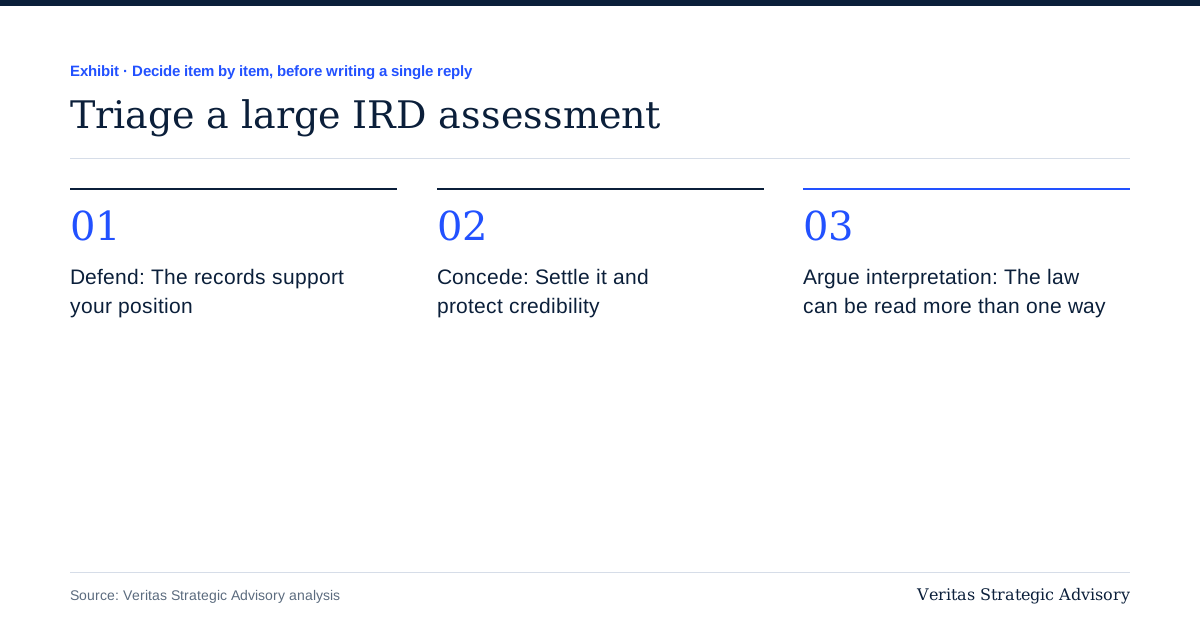
Sort adjustments into defend, concede and reserve before writing a word.
What this cannot promise
Some assessments deserve partial concession, and an honest review will say so at the start. The aim is to be confident about which positions will be defended, which will be conceded, and what each is worth, before anyone appears in front of IRD.
How Veritas Can Help
We review assessments, build the adjustment schedule, draft the IRD replies, and prepare the written arguments for appeal, working alongside the counsel who presents. Talk to our tax team as soon as an assessment arrives, because the earliest reply shapes everything after it. See also our tax consultant service.