- Taxable income fixed for 2064/65, in NPR
- 73,33,139.21
- Income the company declared for 2064/65, in NPR
- 31,28,176.22
- Taxable income fixed for 2066/67, in NPR
- 91,30,552.96
- Income the company declared for 2066/67, in NPR
- 27,49,679.96
A purchase invoice has a special place in the tax system. It is the paper that turns a cash outflow into a deduction, and for VAT it turns the supplier's tax into a credit. Because the paper is so valuable, there is a trade in paper that has no purchase behind it. Tax offices know this, and courts have had many cases to read.
This article looks at two judgments on the income tax side. They concern the same company, two income years and nearly identical facts. They are useful because the Court set out, in plain steps, what a taxpayer needs to show when the office says its bills are not genuine.
The two cases in outline
In both, the appellant was Shankar Oxygen Gas Pvt Ltd of Kathmandu, acting through an authorised director. The respondent was the Internal Revenue Office, Area 3, Lazimpat. A joint bench of Justice Cholendra Shamsher JBR and Justice Prakash Kumar Dhungana decided both on 2076 Poush 28. They are reported at pages 138 to 140 and pages 143 to 145 of the Institute of Chartered Accountants of Nepal's collection of Supreme Court decisions on income tax. The company had been given leave to appeal by an order of 2073.06.14.
| Case 164450 | Case 164453 | |
|---|---|---|
| Income year | 2064/65 | 2066/67 |
| Income declared | NPR 31,28,176.22 | NPR 27,49,679.96 |
| Income fixed by the office | NPR 73,33,139.21 | NPR 91,30,552.96 |
In each, the Internal Revenue Office issued a revised assessment on 2068.04.04. The Inland Revenue Department upheld it on 2068.08.22. The Revenue Tribunal, Kathmandu, upheld it again. The Supreme Court did the same and dismissed both appeals.
One detail should be noted for accuracy. In the first judgment, the Tribunal's decision is printed once as dated 2069.09.20 and once as 2069.07.20. The second judgment gives 2069.07.20 only. The article therefore treats the date as printed inconsistently in the first case and does not rely on either.
What the office found
The Court's account of the facts is the same in both cases, and it rests on the office's findings and the company's own answers.
The invoices the company had produced were for goods or services that, in the office's view, were never actually supplied. The company had been asked for contact details of the sellers. It could not give phone numbers or addresses of its suppliers' contact people, and when pressed, it said the parties could not now be contacted.
The company said it had paid by cheque, but when asked, it did not show which cheque went to which person or firm and how much. In the second case, the permanent account numbers it gave for two of its suppliers were said to be false, and the company did not argue otherwise before the Court.
The company had also, through its representative, admitted that it kept no stock book for the goods it said it had bought. The purchases appear to have been shown as expenses, with no record showing the goods coming into the store and going out for sale or use.
What the company argued
The company's counsel argued that the office had rejected all the expenses it claimed and had not given credit for business done through bank cheques and real trading. They said the whole record of the company's business lay in the tax office, which should have examined it. They argued that the Tribunal's decision was wrong and the office had acted unjustly in not recognising a genuine business.
The Court dealt with this in two ways: by the principle of burden of proof, and by looking at what the company had actually put in front of the office.
What the Court decided
The burden of proof
The Court started from a principle. When someone claims a deduction or exemption that the law allows, the burden of showing the grounds for it lies on the person who claims it. A taxpayer who wants an expense deducted must produce the papers and evidence needed to support that deduction. It is not enough to say that the full record sits in the office and should be consulted.
The Court noted that this taxpayer had made that very argument in writing and repeated it in its petition, and it did not accept it. It said the company had not shown it had met its burden.
The records were missing at the points that matter
The Court then went through the records and found them lacking at each link:
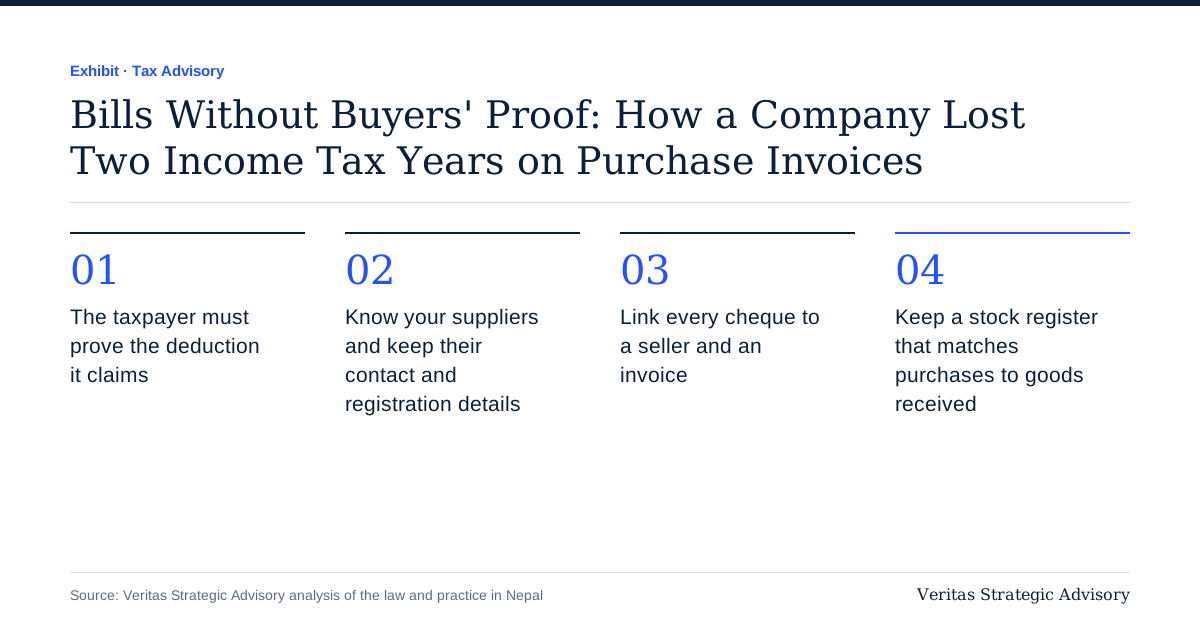
No stock book. The company's representative had accepted that no stock book was kept. When goods are bought for resale or use, they are expected to be recorded as coming into store. Treating a purchase as an expense without a stock record means the real purchase cannot be traced.
No supplier identity. The company did not give the phone numbers and addresses of the people it said it had bought from. The Court said that if the taxpayer says it bought the goods, it should be able to show the contact details of the seller.
No link from cheque to seller. Claiming payment by cheque is not enough. The company needed to show which cheque, from which bank, paid which person or firm and how much, with the bank record. It could have produced those records itself, with its reply to the office, in the Tribunal or in the Court, and it did not.
No answer on false account numbers. In the second case, the supplier account numbers given were said to be false, and the Court found nothing in the petition that said otherwise.
Assumption is not an answer
The Court also said that a taxpayer cannot say the office is wrong without grounds and reasons, and that a claim cannot be accepted on assumption alone. The burden to refute the office's finding lies on the taxpayer, and it must refute it with evidence.
The result
Looking at the unproven authenticity of the bills, the failure to give details of the sellers, and the failure to meet the burden, the Court found that the taxpayer had not shown the purchases were real. On the Court's reading, those bills had been made without real purchases. Under the Income Tax Act, 2058, the revised taxable income was properly fixed because the burden of proof had not been met. It upheld the Tribunal's decision on both years.
What the judgments do not say
The Court did not hold that every purchase from a small or untraceable supplier is false. Its conclusion rests on a combination of facts: untraceable sellers, no stock book, unlinked cheques and false account numbers.
The judgments, as printed, do not give a breakdown of how the revised income was computed. The difference between the declared and fixed figures is large in both years, but the passages used here do not show which expense heads made up the difference.
The case concerns the Income Tax Act, 2058, and its provisions as they stood for those years. Section numbers quoted in the judgments should be checked against the current Act.
What good records look like
This section is not from the judgments. It is a practical method that follows from the gaps the Court found.
Keep a supplier file for each regular supplier: registration or permanent account number, address, contact person, phone, and a copy of the registration certificate.
Maintain a stock book or register that matches purchases to goods received, with the date, quantity and location.
Link every payment. For each cheque, keep the bank statement line, the counterfoil, and the invoice number it pays. For electronic payments, keep the transfer confirmation.
Verify new suppliers before the first big purchase. Check the registration number against the tax office's records, and visit or call.
Match each purchase to its use. Goods bought should show up later as stock, production input or sale.
Reconcile quarterly. Purchases in the ledger, goods received in the stock register, and payments in the bank should tell one story.
An illustrative example
This example uses invented numbers. A trading company records NPR 40,00,000 of purchases from a supplier, supported by invoices. The payment was by cheque. If the supplier file has an address and phone, the stock register shows the goods received, and the bank statement shows the cheque cleared to the supplier's account, the purchase is documented at every link, and the office has little to challenge. If the company cannot say where the supplier is, has no register of goods received, and cannot link the cheque to the supplier, then the whole claim hangs on the invoice alone, and the office can say the invoice is a bare piece of paper.
Our view
The lesson of these two cases is that the invoice is where the proof begins, not where it ends. The office does not need to prove that a bill is fake in a criminal sense. Once it has raised credible doubts, the taxpayer must show the real transaction behind the paper.
The ease of the Court's reasoning is worth noting. It did not rely on any complicated reading of the Act. It applied the plain rule that a person who claims a benefit must prove the facts, and it measured the company's file against that rule.
For businesses, the best protection is boring: a stock book, a supplier file and bank-linked payments. For advisers, the first question when an office questions a purchase should be what records the client can produce today, not what argument to make.
Frequently asked
Does the tax office have to prove the bills are fake?
In these cases the Court placed the burden on the taxpayer to support the claim once the office had questioned the bills. This article does not suggest the office never needs evidence of its own.
Is paying by cheque enough?
Not by itself. The Court said the company needed to show which cheque went to which seller and how much, with the bank records.
What if a supplier has closed or moved?
The judgments turned on the company having no contact details and no other proof. A taxpayer in that position should assemble what it can: registration records, correspondence, delivery documents, stock entries and bank trails.
Does this concern VAT as well?
These two decisions are income tax decisions. The same weakness in records can affect VAT credit, as other decisions in this series show.
Are these decisions still current?
They were decided under the Income Tax Act, 2058, for 2064/65 and 2066/67. Check the current Act and any later guidance before relying on them.
Sources and limits
Source: the Institute of Chartered Accountants of Nepal's collection of Supreme Court decisions on the Income Tax Act, 2058, pp.138 to 140 and 143 to 145 (Shankar Oxygen Gas Pvt Ltd v. Internal Revenue Office, Area 3). All four income figures were checked by enlarging the printed pages. The Tribunal date of the first case is printed inconsistently, as noted. The detailed computation of the revised income is not given in the passages used.
General information only, not advice.