- Sales reduction the Court refused, in NPR
- 1,26,16,853
- Pre-operation expense the company kept, in NPR
- 3,50,769
- Time to apply to the tax office for lost or damaged goods, under VAT Rule 39Ka
- 30 days
- Date of the decision
- 2076 Poush 28
Every manufacturer of consumer goods knows the problem. Packets split on the way to the distributor, stock sits in a damp godown, biscuits and noodles pass their shelf life, and retailers send goods back. Some of that stock is genuinely worthless. The accounting temptation is to adjust the sales ledger and move on.
The tax law does not let the matter end there, and this case is a clear, costly example. It combines two Acts: the Value Added Tax Rules, 2053, and the Income Tax Act, 2058. A write-off that is perfectly sensible on the factory floor can fail on both.
The case in outline
The appellant was the Large Taxpayers' Office at Harihar Bhawan, Lalitpur. The respondent was Himalayan Snacks and Noodles Pvt Ltd of Naya Baneshwar, Kathmandu. A joint bench of Justice Ishwarprasad Khatiwada and Justice Sapana Pradhan Malla decided the matter on 2076 Poush 28. It is reported at pages 146 and 147 of the Institute of Chartered Accountants of Nepal's collection of Supreme Court decisions.
The Large Taxpayers' Office had made an assessment against the company. The Revenue Tribunal, Kathmandu, decided in the company's favour on 2067/02/04. The Large Taxpayers' Office then came to the Supreme Court. The judgment deals with two items: a reduction of sales for damaged or returned goods, and a pre-operation expense.
What the company said
According to the judgment, the company's counsel told the Court that the company had issued VAT invoices for the returned noodles and bhujia and had collected and deposited the tax. It said the noodles had been damaged, eaten by mice or affected by damp, and had been destroyed. It also argued that the disallowance was wrong because the loan amount in question had been invested in capital work.
In plain terms, the argument was that the goods were really lost, the tax side had been handled, and the figures in the accounts should be respected.
What the tax office said
Counsel for the Large Taxpayers' Office argued that if the noodles had really been damaged, there was no sign that they had come back. There was no record that goods broken in the course of trade had been put back into use. The taxpayer's documents had been examined, the office accepted the items it could allow as costs, and it had refused exemption on the sums that failed under the law. It asked the Court to set aside the Tribunal's decision and uphold the original assessment.
What the Court looked at
The VAT rule on lost and damaged goods
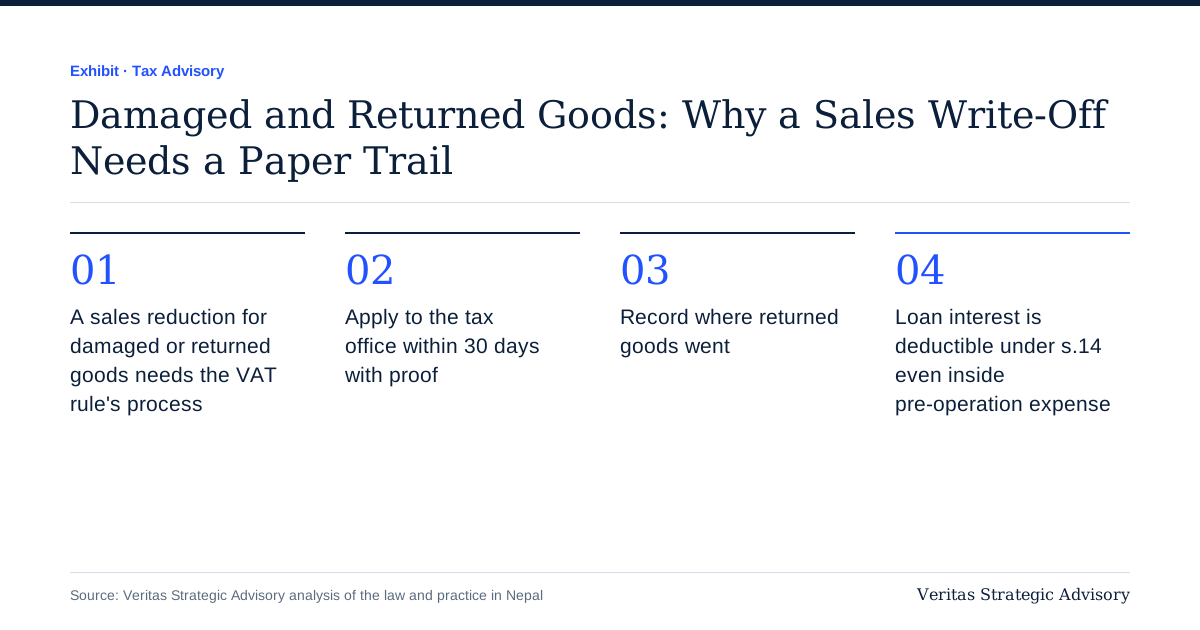
The Court began with the Value Added Tax Rules, 2053, rule 39Ka. It read the rule as dealing with goods that are lost through ageing, theft, accident or breakage, or whose life has expired so that they must be written off from stock or sold at a low price. In those situations the taxpayer must apply to the Internal Revenue Office within 30 days of the event, with proof, to adjust the tax paid on those goods. The department sets the procedure, and the taxpayer must go through inspection. If the inspection finds a real loss, the tax can be adjusted.
The reading matters. The rule does not stop a business from writing off a genuine loss. It sets the road by which the loss is to be established.
What was missing
On the facts of this dispute, the Court found that the road had not been followed. It listed what it did not find:
The process to establish that the noodles were damaged or unfit for use was not completed.
There was no record that the goods which came back were repacked and sold, shown through the business's own process.
There was no proof that the goods in dispute were re-produced and sold.
There was no purchase and sale agreement stating the time and conditions on which goods could be returned, though the tax office had pressed for one.
The fact that goods came back had not been recorded again. Without that record, the Court said, it could be said only that the stock was broken, stolen or past its life, and that is not enough.
The result on sales
The company had reduced its sales account by NPR 1,26,16,853 on account of the goods. The Court found that the office's decision to include this value in profit was proper. It held that, under s.7 of the Income Tax Act, 2058, the value reduced from sales was to be counted in profit or gain. It reversed the Tribunal's decision of 2067/02/04 and upheld the original assessment on this item.
The second item: pre-operation expense
The other dispute concerned NPR 3,50,769 shown as pre-operation expense. The office had treated this as a cost that could not be deducted. The amount included interest on borrowed money.
The Court looked at s.14 of the Income Tax Act, 2058, which allows interest on loans to be deducted as an expense, and said that the Tribunal's decision, which had not allowed the assessment to deny that deduction, was proper. It upheld the Tribunal on this item.
So the judgment is not a one-sided win for the revenue. On the same file, the company lost a very large claim and kept a small one. The difference lay in whether the law's own conditions were met and shown.
What this decision does and does not tell us
It tells us that a write-off of sales for damaged or returned stock is not self-proving. A ledger adjustment, however honest, does not substitute for the application, the inspection and the records the VAT rule contemplates.
It tells us that the tax office and the Court will look for the physical story: what happened to the goods that came back. Did they go back into stock? Were they repacked, reprocessed, resold, or destroyed under a record?
It does not tell us that damaged goods can never be written off. The Court's reasoning is that this company had not shown the process. A taxpayer that follows the rule and keeps the evidence is in a different position.
It also should not be read as a statement about the current text of the rule. The citations are to rule 39Ka of the 2053 Rules as the Court quoted it. The current rule's number, wording and time limit should be checked before any filing.
Finally, the printed report is a summary of the Court's reasons. The assessment's year and the full computation of profit are not stated in the passages used here, and this article does not guess them.
A practical checklist for manufacturers and distributors
Nothing in this section is quoted from the judgment. It is a working method drawn from the gaps the Court identified.
Decide the event. Is it a sales return, a breakage in the godown, an expiry, a theft or an accident? The treatment differs.
Calendar the 30 days. Where the rule applies, the time runs from the date of the event, so the application should be filed quickly.
Prepare a goods register. Each lot should show the product, quantity, batch, date and reason, with the signatures of the people who checked it.
Record where the goods went. Returned stock that is repacked, reworked or resold needs a trail from the return voucher to the later sale.
Put return terms in the distribution agreement, with the period and the conditions of return, so the commercial basis is clear.
Keep photographs and the inspection record, and keep the credit note and the VAT invoice reference together.
Reconcile at year end. The sales ledger, the stock ledger and the VAT returns should tell the same story.
An illustrative example
This is a made-up example with invented numbers. A snack company's distributor sends back 4,000 cartons that were stored badly and became damp. The company passes a credit note and cuts its sales by the invoice value. If it has applied to the tax office on time, recorded and photographed the damaged cartons, had them inspected and destroyed under a signed record, it can show a genuine loss. If it has done none of that and simply reduced the sales figure in its books, the office may treat the reduction as unsupported and add the value back to profit, which is what happened in the decided case.
Our view
The lesson is not that the Court is hostile to genuine losses. It is that a loss claimed against sales is a claim that the sale did not happen, or that its value has gone, and the person making the claim must prove the facts. The VAT Rules supply the method. A company that treats the method as optional will find that its accounts alone carry little weight.
For finance teams, the cheapest improvement is organisational: one person owns returns and damage, a standard pack of documents is assembled for each event, and the 30-day clock is visible. For advisers, the point to stress with clients is that the income tax and the VAT positions are linked. A weak VAT record can sink the income tax deduction as well.
The pre-operation item is a useful counterweight. Where the law says interest on a loan is allowed, a general suspicion about a head of expense is not a basis to deny it. The Court sorted the two items by reading the statute, not by sympathy.
Frequently asked
Can we simply issue a credit note for damaged goods?
A credit note records the commercial arrangement. This case shows that, for tax, the facts behind it must also be established under the VAT rule, and the income tax position follows the evidence.
What was the time limit in the rule?
As the Court quoted rule 39Ka of the 2053 Rules, the application is made within 30 days of the event. Check the current rule before relying on this.
Did the Court say the goods were not damaged?
It did not decide that. It held that the company had not shown the required process and records.
What happened to the pre-operation expense?
The Court upheld the Tribunal on NPR 3,50,769, because s.14 allows interest on loans as an expense.
Does this apply to retailers as well as manufacturers?
The reasoning concerns goods lost, damaged or expired and the way the loss is shown. The same logic is likely to matter for any seller, but each case turns on its facts.
Sources and limits
Source: the Institute of Chartered Accountants of Nepal's collection of Supreme Court decisions on the VAT, Income Tax, Customs and Excise Acts, pp.146 to 147 (Large Taxpayers' Office v. Himalayan Snacks and Noodles Pvt Ltd). The main amounts were checked by enlarging the printed page. The Court's reading of VAT Rule 39Ka is reported as the Court quoted it, and the current rule may differ. The assessment year is not stated in the passages used and is not given here.
General information only, not advice.