- Undistributed bonus the Court refused to add to income, in NPR
- 1,00,378.60
- Previous years' advance tax the company could not adjust, in NPR
- 1,94,722.33
- Bonus provision, in NPR
- 45,25,150
- Date of the decision
- 2077 Poush 27
A company that provides for staff bonus has made a promise of a particular kind. The money is set aside from profit for the employees, the Bonus Act fixes how it is to be shared, and the company then pays it out. In practice, not every rupee reaches an employee within the time allowed. Some employees cannot be traced, some entitlements are disputed, and some arithmetic is settled late.
What happens to the tax treatment of the leftover is a question that rarely gets attention until an assessor asks it. This decision answers it, and in the same judgment shows how easily a second, unrelated claim can fail for want of a precise reading of a section.
The case in outline
The appellant was The Oriental Insurance Company Ltd, acting through its chief executive. The respondent was the Large Taxpayers' Office at Harihar Bhawan, Lalitpur. A joint bench of Justice Dr. Anandamohan Bhattarai and Justice Sushmalata Mathema decided it in case no. 184552 on 2077 Poush 27. It is reported at pages 86 to 88 of the Institute of Chartered Accountants of Nepal's collection of Supreme Court decisions on the VAT, Income Tax, Customs and Excise Acts.
The company had filed its return for the fiscal year 2062/63 with taxable income of NPR 4,44,80,809 under s.96 of the Income Tax Act, 2058. The Large Taxpayers' Office asked for it to be corrected and fixed taxable income at NPR 21,20,25,281.06, in a decision of 2065.3.26. The Inland Revenue Department upheld that on review, and the Revenue Tribunal, Kathmandu, upheld it again (p.87, para 3).
The judgment does not set out every item that made up the difference. The issues the Supreme Court dealt with were these:
NPR 1,00,378.60 disallowed because bonus had not been distributed.
A claim to adjust NPR 1,94,722.33 of previous years' advance tax, which was refused.
A fee under s.120(Ka) of the Income Tax Act and interest under ss.118 and 119, which the company said had been imposed without a chance to clarify (p.87, para 4).
The bonus point
What the company said
The company's counsel described the position as follows. Of the bonus provision of NPR 45,25,150, a sum of NPR 37,62,752 had been distributed to employees. Of the remainder, the company said it had deposited 30 percent, NPR 2,28,719.40, in a national-level welfare fund on 2062.9.21, and the other 70 percent, NPR 5,33,678.60, in an employees' welfare fund on 2062.8.26.
Counsel then made two legal arguments. The Bonus Act's time for distributing bonus had passed, so disallowing a bonus amount computed under the law defeated the intent of both the Bonus Act and the Income Tax Act. And where bonus is not distributed, the Bonus Act, 2030, s.20 provides a punishment, enforced by the Labour Department, so the tax administration had no power to disallow the expense (p.86, para 1).
What the Court said
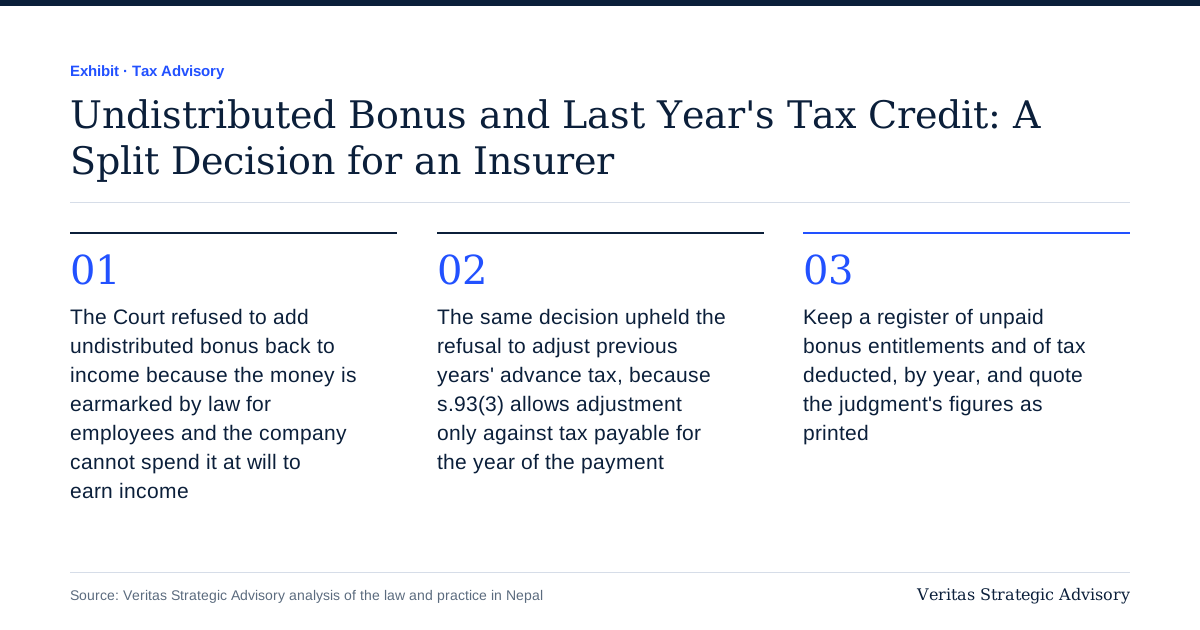
The Court looked at what had actually been disallowed. Of the NPR 45,25,150 provided for bonus, NPR 37,62,752 had been distributed. Of the remainder, NPR 2,28,719.40 had gone to a national-level welfare fund and NPR 4,33,400 to an institution-level welfare fund. The balance of NPR 1,00,378.60 had not been distributed. The Large Taxpayers' Office had disallowed it and added it to income, and the Tribunal had upheld that (pp.87 to 88, para 5).
The Court's reasoning on that balance is the part to remember. It said the law requires the remaining amount set aside as bonus to be spent for the welfare of the employees themselves. Because the company or institution cannot spend that amount at its own will to earn income, the amount cannot be said to be addable to income merely because it was not spent, or the bonus was not distributed, within the time the Bonus Act sets (p.87, para 5).
The Court therefore held that the disallowance, which it described as groundless, and the Tribunal's decision upholding it were not in order. They were reversed to that extent (p.88, para 5).
What we take from it
We read the reasoning this way, and it is our reading, not the Court's words. The Court looked at the nature of the money. A bonus provision is not the company's income in disguise. It is earmarked, by law, for employees. The company has no freedom to use it to earn income, so the fact that it sits undistributed for a while does not turn it into the company's profit.
The Court did not accept the company's wider argument that the tax administration has no power to disallow a bonus expense because the Bonus Act has its own penalty. It decided the point on the nature of the money, not on the division of enforcement powers between the Labour Department and the tax authority. We note that distinction because a reader might otherwise take the decision as authority that a tax office can never question a bonus provision. It does not say that.
The tax adjustment point
The second issue went the other way, and it is a good lesson in precision.
The company had claimed to adjust NPR 1,94,722.33 as advance tax deducted in previous years. The Large Taxpayers' Office refused. The Court turned to s.93(3) of the Income Tax Act, 2058, which as it quoted the provision says that a person from whom tax is deducted may claim an adjustment only against the tax amount payable in the income year in which that payment was made. The company had claimed an adjustment for previous years' deduction, against this year's tax. That was contrary to the provision.
The Court held that the Tribunal's rejection of the adjustment, in the revised assessment, was lawful, and upheld it to that extent (p.88, para 6).
The other parts of the appeal, including the complaint about the fee and the interest, failed. The Court did not discuss them separately, and we therefore cannot say what reasoning applied to them (p.88, para 7).
A note on the printed figures
A careful reader of the judgment will notice that the printed numbers do not reconcile perfectly. We report them as printed and do not correct them silently.
The bonus remaining after distribution is printed as NPR 7,62,398 on page 86, which agrees with NPR 45,25,150 less NPR 37,62,752. On pages 87 and 88 it is printed as NPR 7,62,389.
Taking the page 86 figures, NPR 7,62,398 less NPR 2,28,719.40 leaves NPR 5,33,678.60. If NPR 1,00,378.60 was left undistributed, the institution-level deposit would be NPR 4,33,300. The judgment prints it as NPR 4,33,400.
Counsel's argument describes the bonus as set aside in the fiscal year 2061/62, while the Court's reasoning refers to the fiscal year 2062/63.
The amount actually at issue, NPR 1,00,378.60, is printed the same way throughout. The discrepancies are small and look like printing errors, but anyone quoting the figures should know they are there.
What the decision does not decide
It does not discuss the 30 and 70 percent split as a legal rule. That is how the company described its deposits.
It does not set out what the Bonus Act requires in detail, or what a company must do with undistributed bonus beyond saying the amount is for employee welfare.
It does not say that a tax office may never question a bonus provision. It decided that this balance could not be added back merely because it was not distributed in time.
It does not separately discuss the fee under s.120(Ka) or the interest under ss.118 and 119.
It concerns the fiscal year 2062/63. The provisions of the Income Tax Act and the Bonus Act may have changed, and the present Acts must be checked.
It is one bench, one decision.
A worked illustration
The figures below are invented. They are not a client case.
A manufacturing company in Balaju provides NPR 50,00,000 for staff bonus in a year. It distributes NPR 42,00,000 to employees within the time the Bonus Act allows. NPR 8,00,000 is left, because some entitlements are disputed and a few employees have left without a forwarding address.
Treatment one. At assessment, the office adds the NPR 8,00,000 back to income because it was not distributed in time. At a 25 percent tax rate, that would be NPR 2,00,000 of tax. The rate is used only to show the arithmetic, since the rate that applies to a given company depends on the law in force.
Treatment two. The company shows that the NPR 8,00,000 remains earmarked for employees. It holds a register of the entitlements that are unpaid and the reason for each, and it deposits the money in a designated welfare account as the law provides. The nature of the money is documented.
On the reasoning in the Oriental Insurance decision, the second treatment is the one that fits. The Court looked at the fact that the amount belonged to the employees and could not be spent at the company's will. A company that can show that, from its records, is on firmer ground than one that cannot.
The illustration does not say that a company without a register would lose. It shows where the evidence sits.
For the adjustment point, a second invented example. A company had NPR 1,50,000 deducted at source from income in the year ended Ashadh 2080 and did not claim it against that year's tax. In the following year it tries to adjust the NPR 1,50,000 against the new year's tax. On s.93(3) as the Court quoted it, the adjustment is against the tax payable in the income year in which the payment was made, so the later claim is the shape of the claim that failed in this case. The remedy, if one exists, is a question for the Act in force, and we do not state one.
Our view
In our view, the bonus decision is a sensible one for a company that acts in good faith, and it also carries a warning.
The sensible part is that the Court treated an earmarked amount as earmarked. The practical answer is usually to treat undistributed bonus as a liability to employees, to track it by name and by reason, and to deal with the leftover through the channel the law provides, not to let it sit unexplained. A company that does that can point to the nature of the money. A company that cannot say where it is, or who it belongs to, is in a weaker position.
The warning is in the other half of the judgment. The adjustment claim failed because the company had not matched the claim to the year in which the payment was made. That is the kind of error that is cheap to avoid and expensive to find later. We would advise keeping a register of tax deducted at source, by income year, and reconciling it to the credit claimed in each return. A credit that belongs to one year does not move to another by assertion.
We would also say that the figures in the judgment are a reminder to quote carefully. If an advisor cites this case to a client or an assessor, the numbers should be given as printed, with a note of the inconsistency, not tidied up to look cleaner.
Practical action points
Treat bonus provisions as earmarked for employees. Keep a register of every entitlement that is unpaid, with the employee, the amount, and the reason.
Deal with undistributed bonus through the channel the Bonus Act provides, and keep proof of each deposit and its date.
If an assessor adds undistributed bonus back to income, respond with the register and the evidence, and cite the nature of the money, not only the Bonus Act's own penalty.
Keep a register of tax deducted at source by income year, and reconcile it to the credit claimed in each year's return.
Do not carry a credit from one year into another unless the Act in force clearly allows it.
Read fee and interest assessments separately from the main assessment, and answer each, since the Court did not separately discuss them here.
When citing this decision, quote the figures as printed and flag the inconsistencies.
Check the present Acts before relying on any provision cited in a decision from 2062/63.
Frequently asked
Can the tax office add back bonus I could not distribute?
On this decision, not merely because the bonus was not distributed in the time the Bonus Act allows. The Court reasoned that the amount is earmarked for employees and cannot be spent by the company at its own will to earn income.
Does that mean a tax office can never question a bonus provision?
No. The Court decided that this balance could not be added back for that reason. It did not decide that a bonus provision can never be examined.
Does the Bonus Act's penalty stop the tax office from acting?
The company argued so. The Court did not rest its decision on that argument. It decided on the nature of the money.
What happens to the leftover bonus?
The company said it deposited 30 percent in a national-level welfare fund and 70 percent in an employees' welfare fund. The Court recorded the deposits and held the balance could not be added to income. It did not set out the rule as such, so check the Bonus Act in force.
Why did the adjustment claim fail?
Section 93(3) of the Income Tax Act, as the Court quoted it, allows a person from whom tax is deducted to claim adjustment only against the tax payable in the income year in which that payment was made. The company claimed previous years' deduction.
What about the fee and interest?
The company complained they had been imposed without a chance to clarify. The Court did not discuss them separately and rejected the rest of the appeal.
Why do the figures in the judgment not add up?
Several printed amounts are inconsistent by small sums, apparently through printing errors. We have reported them as printed and flagged the differences.
Is this still the law?
We have read a decision on the fiscal year 2062/63. We have not reviewed the present Income Tax Act or Bonus Act, so check the provisions in force.
Sources and limits
The Oriental Insurance Company Ltd v. Large Taxpayers' Office, Harihar Bhawan, Lalitpur, Supreme Court of Nepal, joint bench of Justice Dr. Anandamohan Bhattarai and Justice Sushmalata Mathema, case no. 184552, decided 2077 Poush 27, reported at pp.86 to 88 of the Institute of Chartered Accountants of Nepal's collection of Supreme Court decisions on the VAT, Income Tax, Customs and Excise Acts (2079/2080). Every statement about the decision was read from the published page images, and the rupee figures were read from enlarged images.
We did not review the Income Tax Act, 2058, the Bonus Act, 2030, or the Revenue Tribunal Act themselves. Sections 93(3), 96, 118, 119 and 120(Ka) and s.20 of the Bonus Act are described as the judgment cited them.
General information only, not advice.