- Taxable income the mill declared for 2064/65, in NPR
- 16,94,684
- Taxable income the Biratnagar office fixed, in NPR
- 28,39,423
- Date of the Tribunal decision
- 2072/01/27
- Date the Gazette notice of the member's appointment was published
- 2072/02/25
Most tax disputes are won or lost on figures and records. This one was decided on a calendar. It deserves attention because the point it settles has nothing to do with the tax in dispute, and a taxpayer who does not look for it will never find it. The question is simple: was the body that decided your appeal properly constituted on the day it decided?
The case in outline
The petitioner was Bhudev Atta Mill, a flour mill in Biratnagar, acting through a partner, Hemant Golchha. The respondent was the Internal Revenue Office, Biratnagar. A joint bench of Justice Deepkumar Karki and Justice Kumar Regmi decided the case on 2078 Saun 18. It is reported at pages 153 to 155 of the Institute of Chartered Accountants of Nepal's collection of Supreme Court decisions on the Income Tax Act, 2058.
The tax dispute itself was ordinary. For the income year 2064/65 the mill filed its return on 2065/09/11 with taxable income of NPR 16,94,684. The Internal Revenue Office, Biratnagar, fixed taxable income at NPR 28,39,423. The mill sought an administrative review from the Inland Revenue Department, which, as the Court records it, left the office's decision unchanged except on one point: it did not agree with the office's decision not to allow depreciation on assets held in the name of the industry. On the other heads, it upheld the office. That decision is dated 2069/11/30.
The mill then appealed to the Revenue Tribunal, Biratnagar. The Tribunal's decision of 2072/01/27 upheld the Department's decision. The mill asked the Supreme Court for leave to petition. Leave was granted by an order of 2075/1/7, and the petition came up for decision.
What the mill argued
The mill's senior advocate, Chandeshwar Shrestha, raised two points about the Tribunal's bench.
The first was about independence. A member of the Tribunal, Rameshraj Gautam, had been working at the Internal Revenue Office, Biratnagar, when the revised assessment that was the subject of the dispute was issued. A person who served in the office that made the order should not decide the appeal against it, which would offend the principle of natural justice.
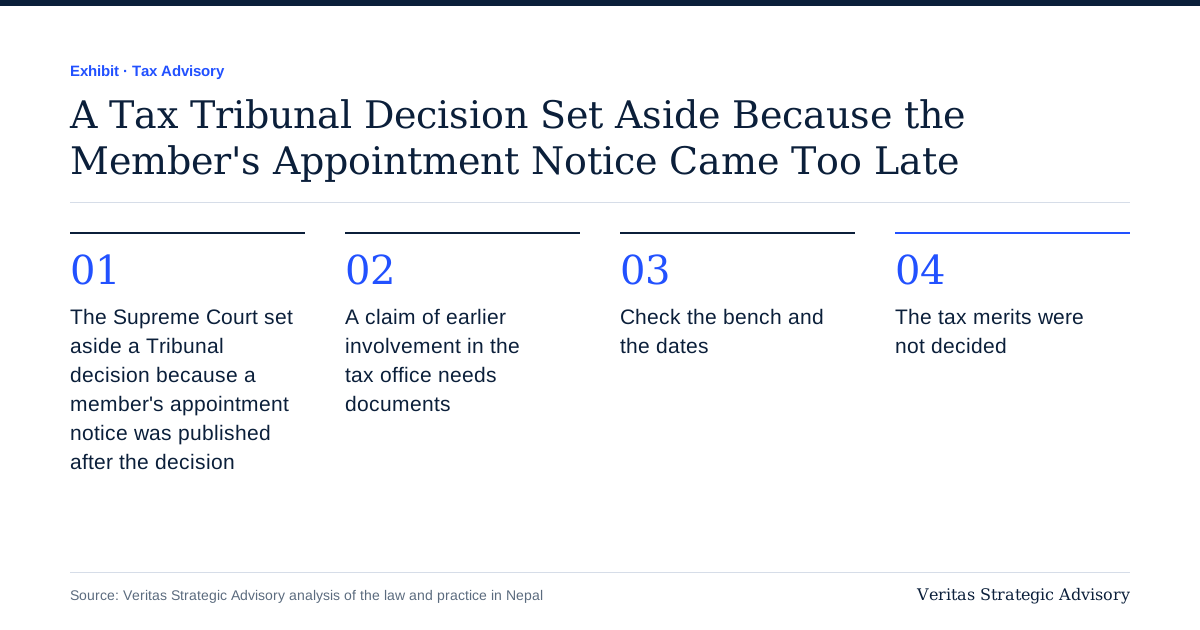
The second was about the date of appointment. The Law, Justice, Constituent Assembly and Parliamentary Affairs Ministry had published a notice in the Gazette on 2072/02/25 saying that Rameshraj Gautam had been appointed a member of the Revenue Tribunal, Biratnagar. The Tribunal's decision in the mill's case was made on 2072/01/27 with him on the bench, about a month earlier.
The mill also argued on the merits that the office had wrongly denied genuine tax-deductible expense and that the decision should be reversed.
What the Internal Revenue Office argued
The office's lawyer, Deputy Attorney General Harishankar Gyawali, said nothing showed that Rameshraj Gautam had been working at the Internal Revenue Office, Biratnagar on 2069/06/26, the date of the revised assessment. After that, he had come to the Tribunal and the Tribunal's decision had been made on the basis of the letter appointing him. The notice in the Gazette was published only later. The office asked the Court to uphold the Tribunal.
What the Court decided
The natural justice argument failed for want of proof
The Court examined the first point and did not accept it. It said the revised assessment order had not been issued by Rameshraj Gautam himself. Nothing on file, including notices and correspondence from the Internal Revenue Office in that period, carried his signature. No other document showed that he was in the office on 2069/06/26, the date of the disputed assessment.
The only thing in the file was the Gazette notice of 2072/02/25 saying that he had been serving at the Internal Revenue Office. The Court said that this alone could not show that he had been in the same office almost three years earlier, on 2069/06/26. It therefore did not agree with the mill's argument that the decision should fall for breach of natural justice on that ground.
This part of the ruling is worth remembering as much as the next. A claim that an adjudicator was involved in an earlier stage must be backed by documents that show it.
The appointment-date argument succeeded
The Court then turned to the second point, and it came out the other way.
The Tribunal's decision was made on 2072/01/27 by a bench that included Rameshraj Gautam as the revenue member. The only notice of his appointment as a member of the Revenue Tribunal, Biratnagar, was published in the Gazette on 2072/02/25. The notice did not say that it applied from any earlier date. Where a Gazette notice does not say that it takes effect from an earlier date, the Court said, it is ordinarily to be understood as taking effect from the date it is published.
Before the decision, the Court found, nothing on the file showed that he was a member of the Tribunal. The Court also noted that the notice of 2072/02/25 did not even use the words "from an earlier date". It said that, in the absence of proof that he held the office on 2072/01/27, any proceedings he took part in before the notice was published could not be given recognition.
The Court's conclusion was that the Tribunal's decision could not be recognised and was set aside. It ordered the Biratnagar Tribunal to decide the case again according to law as soon as possible.
What this decision does and does not do
It does not decide the tax. The Court gave no view on whether the mill's taxable income should be NPR 16,94,684, NPR 28,39,423 or some other figure. Nothing in the judgment should be read as a ruling for or against the mill on the merits.
It does not mean that every irregularity in a tribunal bench voids a decision. The Court looked at a specific defect: a member whose appointment notice post-dated the decision, with no proof of earlier effect.
It also does not establish that a person who worked in the tax office may never sit on the Tribunal. The Court rejected that argument on the facts because it was not proved. A future case with documents showing involvement might be decided differently, but this judgment does not say so, and this article does not predict it.
The effect for the mill is a fresh hearing by the Tribunal, years after the first, with the same tax dispute still to be decided. The cost is time, and that matters to the business. The benefit is a hearing before a properly constituted bench.
Why this matters for taxpayers
Most advisers check the limitation period, the form of the appeal and the grounds. Few ask who is on the bench and when that person was appointed. This case suggests a short, cheap check.
When a Tribunal bench is named in a hearing notice or decision, note the members and the date of the decision.
If a member's appointment is in doubt, look for the Gazette notice and compare its date with the hearing and decision dates.
If the claim is that a member was involved in the earlier stage, collect the documents: orders, signatures, notices and letters that name the person.
Raise the objection promptly, in the pleadings, so it appears in the record.
Keep the merits case in order as well. In this case, the mill won only a rehearing.
An illustrative example
This example is invented. A company receives a Tribunal decision dated 10 Baisakh. The notice appointing one of the bench's members was published in the Gazette on 25 Baisakh, with no earlier effective date. A check of the Gazette would show that on 10 Baisakh the member had no published appointment. The company could raise that as a ground, and, on the reasoning in this case, it would not need to prove anything about the member's earlier career. It would need only the dates.
Our view
There is a quiet lesson in the way the Court split the two arguments. It was strict on the first, requiring proof of an earlier connection. It was equally strict on the second, requiring proof of the legal basis for the member's authority on the day. In both, the Court looked at documents and dates.
For taxpayers, the lesson is that process points are not technicalities to be waved away. An unlawfully constituted body cannot give a decision that binds, and the cost of discovering this late is a second hearing. It is cheaper to check at the start.
For advisers, the practical step is to add a one-line bench check to the checklist for every Tribunal decision received, and to keep the Gazette references in the file.
Frequently asked
Did the Court say the mill was right about its tax?
No. The Court did not decide the tax question. It sent the case back to the Tribunal to be decided again.
Why did the conflict-of-interest argument fail?
The Court found no document showing the member had been in the tax office on the date of the disputed assessment, and the assessment order was not issued by him.
What would have made the argument succeed?
The Court said what was missing: papers showing his presence or signature in the office at the relevant time. This article does not say what outcome such papers would have produced.
Does a Gazette notice always take effect on the date of publication?
The Court's reasoning was that, where the notice does not say it applies from an earlier date, it is to be read from its date of publication. Check the wording of any notice and the law in force.
Is the decision still current?
It was decided on 2078 Saun 18 and concerns the Revenue Tribunal as then constituted. Check the current law on appointments and the Tribunal's composition before relying on it.
Sources and limits
Source: the Institute of Chartered Accountants of Nepal's collection of Supreme Court decisions on the Income Tax Act, 2058, pp.153 to 155 (Bhudev Atta Mill v. Internal Revenue Office, Biratnagar). The two taxable income figures were checked by enlarging the printed page. The Court did not decide the tax merits, and neither does this article.
General information only, not advice.