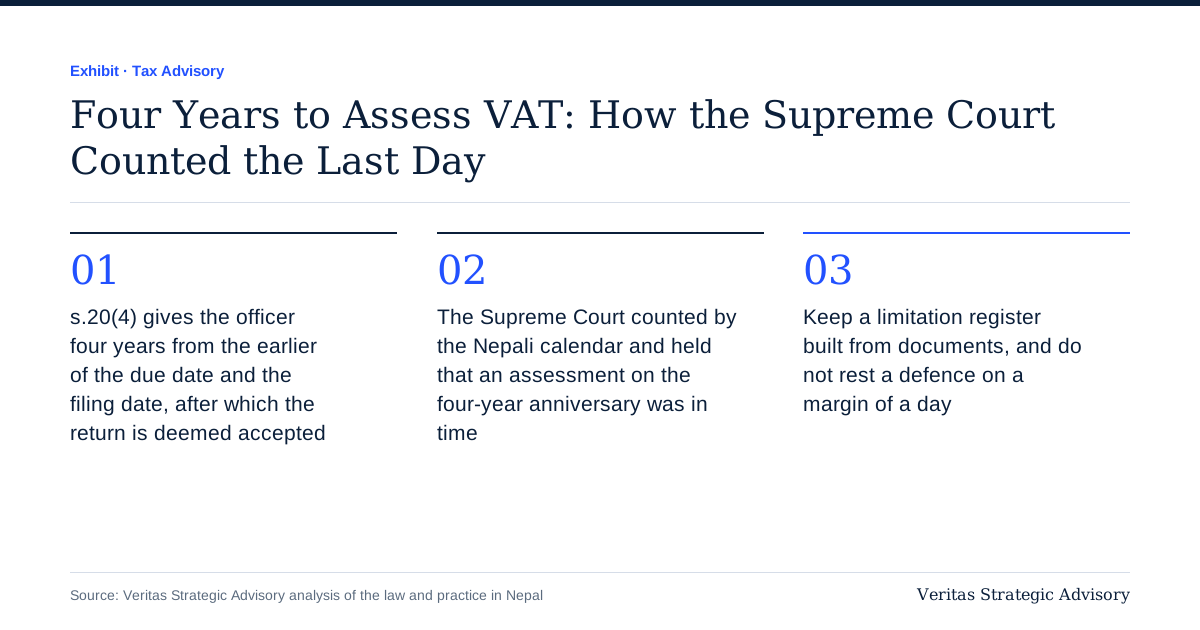
- Assessment period under s.20(4), from the earlier of due date and filing date
- 4 years
- Date the return was filed
- 2061.04.24
- Date of the final assessment order
- 2065.04.24
- VAT in the final order, in NPR
- 15,74,464
Finance teams like limitation periods. A return that has sat untouched for four years feels settled, and s.20(4) of the VAT Act appears to promise exactly that: if the officer does not assess within the period, the return is deemed accepted. For a business with a messy year in its past, that is a comforting provision.
Comfort is the wrong thing to take from it until you have done the arithmetic. This is a case about exactly that arithmetic. A company argued that an assessment was late. The Revenue Tribunal agreed with it. The Supreme Court then counted the years and found the Tribunal had it wrong.
The case in outline
The parties were the Large Taxpayers' Office at Harihar Bhawan, Lalitpur, as appellant, and Saurabh Food Products Pvt. Ltd. of Bara, as respondent. A joint bench of Justice Dr. Anandamohan Bhattarai and Justice Tejbahadur K.C. decided it in case no. 128421 on 2076 Magh 20. It is reported at pages 23 to 26 of the Institute of Chartered Accountants of Nepal's collection of Supreme Court decisions on the VAT, Income Tax, Customs and Excise Acts.
The dates drive everything, so here they are in order.
| Date | Event |
|---|---|
| 2061.04.24 | The company filed its VAT return |
| 2065.04.10 | The company received the preliminary assessment order, which asked for NPR 35,79,567 of tax for Ashadh 2061 within 15 days |
| 2065.04.24 | The Large Taxpayers' Office issued its final assessment order for NPR 15,74,464 of VAT |
| 2065.08.20 | The Inland Revenue Department upheld the assessment on administrative review |
| 2067.03.28 | The Revenue Tribunal, Kathmandu, held the assessment time-barred |
| 2076 Magh 20 | The Supreme Court reversed the Tribunal |
Two different figures appear, and they should not be confused. The preliminary order asked for NPR 35,79,567. After studying the company's written reply and documents, the Large Taxpayers' Office issued a final order for NPR 15,74,464 of VAT, payable within 15 days at a named bank, failing which penalty, additional fee and interest would follow (p.24, paras 4 and 5).
The dispute underneath
The limitation point is the subject of this article, but the Court was reviewing an assessment about something else. According to the Department's review decision, as the judgment records it, the Large Taxpayers' Office had calculated a proportionate input credit for a business making both taxable and exempt supplies. The company disagreed with that calculation and also argued that the assessment had come too late.
The Court did not decide the proportionate credit question. It sent the case back to the Tribunal to be decided on the merits. We note the underlying dispute because it is a reminder that limitation arguments often sit on top of a substantive disagreement, and winning the first does not answer the second.
What the law says
The Court read s.20 of the VAT Act, 2052 in two steps. Sub-section (1) lists the situations in which a tax officer may assess. Sub-section (4), the part that matters here, says that in assessing under sub-section (1) the officer must complete the assessment within four years from the date the return was required to be filed or was filed, whichever is earlier. If the assessment cannot be made within that period, the return that was filed is deemed to have been accepted automatically (p.25, para 9).
Three features deserve attention.
The period is four years, not four years and a day. It runs from a date, so the question is always which date.
The start date is the earlier of two dates. It is the due date or the filing date, whichever comes first. A return filed late starts the clock at the due date. A return filed early starts it at the filing date.
The consequence is automatic. A return not assessed in time is deemed accepted. That is a strong protection, which is why the taxpayer wanted to rely on it.
How the Court counted
Both sides agreed the return was filed on 2061.04.24 and the final order was dated 2065.04.24. The only question was whether that was inside the four years. The Court turned to three sources of counting rules.
First, the Nepal Law Interpretation Act, 2010, s.2(b), under which a year is counted by the Nepali calendar, a year beginning at the Baisakh sankranti.
Second, s.8 of the same Act, which provides that where the beginning and end of a period are to be fixed, the word "from" excludes the first day or part, and the word "up to" includes the last.
Third, the Muluki Ain, in its chapter on court management, No. 46, which says that where a limitation or a date is counted in days, the days are counted, and where it is fixed in months or years, it is counted by sankranti whatever the number of days in the month (pp.25 to 26, para 10).
On that law, the Court held that where the return was filed on 2061.04.24 and the final order was made on 2065.04.24, the four-year limit under s.20(4) was not seen to have lapsed. Because the assessment was within limitation, the Tribunal had to decide the substance of the dispute. Its decision of 2067.3.28, which set aside the assessment and the Department's review decision on the ground of limitation, was reversed, and the case was sent back to the Revenue Tribunal, Kathmandu, to be decided afresh on the merits (p.26, para 11).
The Court did not write out the arithmetic step by step, and it did not say in so many words that the last day is included. It applied the counting rules and found no lapse. What it did hold is that an assessment dated on the four-year anniversary of the return was in time.
Why this matters more than it first appears
A time-bar argument looks like the cleanest defence in tax. It does not depend on evidence about the business and it does not depend on a judgement about the facts. It depends on a calendar. That is exactly why it fails so painfully when the calendar is miscounted.
The Revenue Tribunal in this case accepted the argument. The company won at that level. It lost at the Supreme Court. For the period between those two decisions, the company must have believed the matter was closed.
Three lessons follow.
Count by the Nepali calendar, on the dates in the documents. Do not convert to English dates and count days. The Court counted years by the Nepali calendar and by sankranti.
Do not argue for a margin of one day. The Court treated an assessment on the anniversary date as in time.
Keep the substance alive. A time-bar that is won at one level can be lost at the next, so the merits need to be prepared in parallel.
What the decision does not decide
It does not decide the underlying dispute about proportionate input credit. That went back to the Tribunal, and we do not know how it ended.
It does not say when the company's return was due. It says the return was filed on 2061.04.24 and applies the rule of the earlier of due date and filing date to the facts it recites.
It does not discuss when the final order was served on the company. The Court treated the date of the order, 2065.04.24, as the date that mattered.
It does not say what happens on the day after the anniversary. On the plain reading of the counting rules, an assessment a day later would be outside the period, but the Court did not decide that and we do not claim it did.
It does not discuss whether any other provision of the Act changes the four-year period in particular circumstances, such as concealment. We have not reviewed the Act, and a reader should check before relying on s.20(4) in such a case.
It concerns a return filed in 2061 and an assessment in 2065. The present Act must be checked.
It is one bench, one decision.
A worked illustration
The dates below are invented. They are not a client case.
A manufacturer files a VAT return for one month on 2079.05.10. The return was due on a later date, so the filing date is the earlier of the two and the four-year clock starts on 2079.05.10. Four years on is 2083.05.10.
An assessment order dated 2083.05.09 is inside the period on any view.
An assessment order dated 2083.05.10 is the Saurabh pattern: the four-year anniversary of the filing date. On the Court's reasoning, it is in time.
An assessment order dated 2083.05.11 is a day after the anniversary. The Court did not decide such a case, but on the counting rules it applied, the period would have ended.
Now change one fact. Suppose the same manufacturer files its return late, on 2079.06.10, after the due date of 2079.05.25. The earlier of the two dates is the due date, 2079.05.25, so the four years run to 2083.05.25, not to 2083.06.10. Filing late does not buy extra time. This follows from the words of s.20(4) as the Court quoted them, "whichever is earlier", and we draw the example from the text, not from a ruling on late filing.
The lesson of both examples is the same. The date that matters is the one in the Act's formula, and an error of even a few days in choosing it decides the case.
Our view
In our view, the sensible way to treat s.20(4) is as a safe harbour you can verify, not a promise you can assume. The provision rewards the taxpayer who can show, from documents, that the officer missed the date. It punishes the taxpayer who argues from memory that "it must be more than four years".
The practical answer is usually to keep a limitation register for each VAT period, and to fill it in when the return is filed, not when a notice arrives. For each return we would record the due date, the filing date, the earlier of the two, and the four-year anniversary in the Nepali calendar. When a notice or order arrives for an old period, we would put its date against that register the same day, and also record the date of any preliminary order and the date the final order was served.
We would not advise a client to build a defence around a margin of one or two days. If the order is on or close to the anniversary, we would prepare the substantive answer with the same care as the time-bar argument, because this case shows how a limitation win at the Tribunal can be reversed.
We would also be careful about the word "deemed". The provision says the return is deemed accepted. That protects the return as filed. It does not tell you that the return was correct, and it does not stop you from wanting your records in order if the question returns in a later year on a different basis.
Practical action points
For each VAT return, record the due date, the filing date, the earlier of the two, and the four-year anniversary in the Nepali calendar.
Use the Nepali date in every working. Do not convert to English dates and count days.
When an order or notice arrives for an old period, put its date against the register on the day it arrives.
Record the date of the preliminary order and the date the final order was served, as well as the date printed on it.
Do not rely on a one-day margin. If the order falls on or near the anniversary, build the substantive answer in parallel.
Keep the full file for old periods until you are sure the period is closed. A time-bar can be reversed on appeal.
If a return was filed late, start the clock from the due date, not the filing date.
If your argument is that the return is deemed accepted, check the Act in force for any provision that changes the period in your situation.
Frequently asked
Does the four years run from the due date or the filing date?
From whichever is earlier, according to s.20(4) as the Court quoted it. For a return filed on time or early, that is the filing date. For a return filed late, it is the due date.
Can I extend the period by filing late?
On the words of the provision, no. A late return starts the clock at the due date.
Is an assessment made on the four-year anniversary in time?
In this decision, yes. The return was filed on 2061.04.24, the final order was dated 2065.04.24, and the Court found no lapse.
Does a time-bar mean the matter is finished?
Not necessarily. The Tribunal accepted the time-bar and the Supreme Court reversed it. Until the last appeal is decided, keep the merits ready.
How do I count years?
By the Nepali calendar, a year starting at the Baisakh sankranti, and not by converting to English dates or counting days. That is what the Court applied.
What happened to the underlying dispute?
The Court sent it back to the Revenue Tribunal for a fresh decision on the merits. The page does not tell us the result.
Is this still the law?
We have read the decision, which concerns a return filed in 2061. We have not reviewed the current Act, so check the provisions in force before relying on any period or counting rule.
Sources and limits
Large Taxpayers' Office, Harihar Bhawan, Lalitpur v. Saurabh Food Products Pvt. Ltd., Bara, Supreme Court of Nepal, joint bench of Justice Dr. Anandamohan Bhattarai and Justice Tejbahadur K.C., case no. 128421, decided 2076 Magh 20, reported at pp.23 to 26 of the Institute of Chartered Accountants of Nepal's collection of Supreme Court decisions on the VAT, Income Tax, Customs and Excise Acts (2079/2080). Every statement about the decision was read from the published page images, and the two rupee figures were checked against enlarged images.
We did not review the VAT Act, 2052, the Nepal Law Interpretation Act, 2010, the Muluki Ain, or the Revenue Tribunal Act, 2031 themselves. They are described as the judgment cited them.
General information only, not advice.