- Legs on a cross-border consignment: one inside Nepal, one outside
- 2
- Taxable legs on an export invoice under s.4(2)
- 0
- Rate shown on the directive's Annex form, to be confirmed for the year
- 13%
- Days after month end to self-assess if the freight business is unregistered
- 25
A forwarder in Birgunj quotes a customer one rate from a supplier's factory abroad to a Kathmandu warehouse, and another one rate from a Kathmandu factory to a buyer abroad. The accounts clerk prices both the same way, one line on the invoice, one VAT treatment. Both lines are probably wrong, and in opposite directions.
The reason is that the directive does not tax "freight". It taxes the part of the journey that sits inside Nepal's customs line, and it does so differently depending on which way the goods are moving.
What section 4(2) actually says
Section 4(1) first fixes who is bound: a freight business that is registered in VAT must issue a tax invoice under section 14 of the Act. Everything below applies to that business. A freight business that is not registered has a different obligation, covered further down.
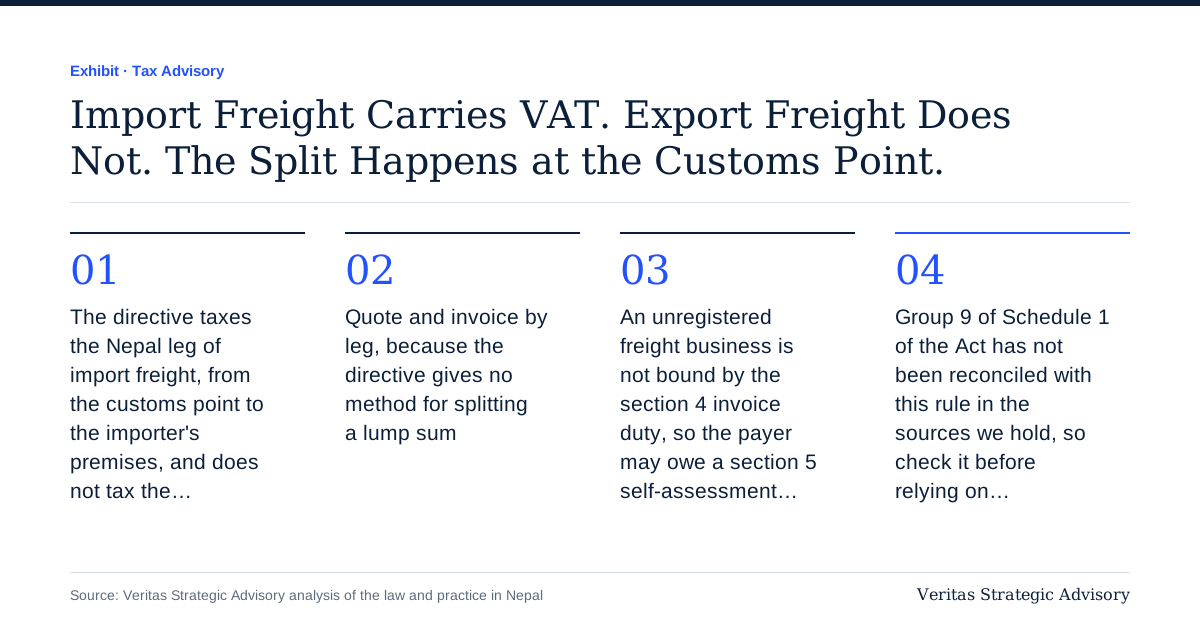
For an import, section 4(2) says that where a VAT-registered freight business does the freight work for a Nepali importer from foreign soil up to the importer's place of business, VAT must be collected on the amount for the freight service rendered from Nepal's customs point up to the importer's place of business. The directive does not bring the foreign stretch, from the supplier's side to the customs point, into the VAT base.
For an export, the same subsection (continuing on page 3) says that VAT is not to be collected on the amount for the freight service rendered from the exporter's place of business up to the customs point.
Put side by side:
Import, supplier abroad to customs point: not in the directive's VAT base.
Import, customs point to importer's premises: VAT collected.
Export, exporter's premises to customs point: VAT not collected.
Export, beyond the customs point: the directive says nothing, because that part of the journey happens outside Nepal.
The two directions are not mirror images. On an import the Nepal leg is taxed. On an export the Nepal leg is not. A single treatment for both will overtax exports or undertax imports.
How the invoice should be drawn
The directive assumes a segmented invoice. For an import, show the Nepal leg as its own charge, apply VAT to that amount, and keep the foreign leg off the VAT base. For an export, show the charge for the Nepal leg without VAT.
Section 4(3) to 4(5) add procedure. The invoice is ordinarily issued from the head office, a branch may issue it if the business has opened branches for freight work, and with the Office's approval invoices may be electronic or issued from a book kept in the vehicle, provided the vehicle number is stated and the head office keeps current records of which invoice serial numbers are in which vehicle.
A door-to-door line that does not separate the legs is where the problem starts. The directive does not prescribe how to apportion a bundled rate, so the safest practice is to quote and invoice by leg from the outset, not to apportion afterwards.
If the freight business is not registered
Section 3(3) lets a freight business with transactions under NPR 50 lakh in the past 12 months operate without VAT registration, provided it holds a PAN. Section 4's invoice duty does not bind an unregistered business, because it is addressed to a registered one.
That does not make the Nepal leg free of VAT. Under section 5(1), a person who receives freight service from someone not registered in VAT must self-assess the VAT on the Annex form at the earlier of payment or receipt of the service, and file it within 25 days of the month end. Under section 5(2), a person who gets goods carried inside Nepal by a foreign service provider must do the same. Section 5(3) lets the tax go into the purchase book as credit, or be claimed as an expense if the person deals only in exempt goods and services. We cover the reverse charge in our article on hiring trucks from unregistered transporters.
So the same consignment can produce a registered forwarder's tax invoice, an importer's self-assessment on the Annex, or both on different legs, depending on who carried which stretch.
The provision that still needs checking
Schedule 1 of the VAT Act 2052 lists what is exempt under section 5(3) of the Act. Group 9 of that Schedule, "Public Transportation and carriage service", exempts air travel, service from a machinery bridge, public transportation carrying passengers (except cable car), rent of carrier, carriage service (except carriage related to supply) and cargo service. The English text we hold is amended to the Financial Act, 2021.
The directive says VAT is collected on the Nepal leg of import freight. Group 9 exempts carriage service except carriage related to supply. Whether freight on imported goods is "carriage related to supply", and so pulled back into tax by the bracket, is the reading that would make the directive and the Act consistent. It is a reading, not something either document states. We have not found an IRD circular or a court decision on it in the sources we hold, and the directive is procedure issued under Rule 61 of the VAT Rules 2053, so it cannot widen what the Act taxes.
A separate Act-level point sits beside this. Schedule 2 of the Act (page 137) zero-rates goods proved to be exported, and Group 2(a) (page 138) zero-rates a service supplied by a person residing in Nepal to a person outside Nepal who has no business transaction, representative or agent in Nepal. A forwarder billing a foreign consignor with no Nepal presence might fall under that second test. It rests on the recipient's location, not on the customs-point split in the directive, and the two should not be run together without more work.
Illustrative example
This is a hypothetical to show how the split works, not a client position.
A registered Kathmandu forwarder brings machinery parts from a supplier in another country to an importer's warehouse in Kathmandu for a total freight charge of NPR 10,00,000. Suppose the forwarder's own costing shows NPR 6,00,000 for the stretch up to the customs point and NPR 4,00,000 from the customs point to the warehouse. On the directive's wording, VAT is collected on the NPR 4,00,000 only. At the 13 percent shown on the Annex form that is NPR 52,000, subject to confirming the rate for the year. If the forwarder had instead put VAT on the full NPR 10,00,000, the importer would have been charged VAT on a leg the directive does not tax.
On the export side, a Kathmandu manufacturer pays the same forwarder NPR 2,50,000 to carry finished goods from the factory to the customs point. The directive says no VAT is collected on that amount. If the forwarder added 13 percent, the exporter would be paying tax the directive says should not be charged.
The figures are invented for the example. The split between legs is a pricing fact that must come from the forwarder's actual quote, not from a rule of thumb.
Our view
In our view, the cleanest protection is on the commercial side: quote and invoice by leg. A forwarder who gives one door-to-door price has to invent an apportionment later, and the directive gives no method for it. The officer who sees an unsplit invoice will pick the allocation that produces the most tax.
We would also write the customs point into the contract. The directive does not define it. It could be the border crossing, an inland clearing depot or the point of customs valuation, and the answer moves the taxable amount on every import. Until the Department says which, the practical answer is usually to name the point in the agreement and invoice consistently to it.
For exporters, we would not rely on the directive alone. Ask the forwarder for an invoice that shows the Nepal leg separately and without VAT, keep the customs export documents with it, and check the forwarder is registered. If it is not, the reverse charge in section 5 may land on you as the payer.
What we would do first for an existing client: pull the last twelve months of freight invoices, mark each as import or export, and check whether any single line crosses the customs point without being split.
Before you rely on this
We could not confirm the following from the sources we hold.
How Schedule 1 Group 9 ("carriage service (except carriage related to supply) and cargo service") fits with the directive's taxation of the Nepal leg of import freight. This is material to the conclusion, and it is why this piece is held for technical review.
Whether the untaxed legs are exempt, zero-rated or simply outside the scope of a Nepal VAT supply. That decides whether a freight business can claim input credit on costs incurred for the untaxed leg. The full text of sections 5 and 7 of the VAT Act and of the Schedules is not held.
What "Nepal's customs point" means: the physical border, an inland clearing depot or the point of customs valuation. The directive does not say, and the case-law collection we hold has no decision on it.
How to apportion a lump-sum door-to-door quote between the taxable and untaxed leg. The directive assumes a segmented invoice and prescribes no method.
Whether handling, warehousing or clearing fees bundled into one invoice with carriage fall inside the split. The directive does not address it.
Finance Acts after 2081 are not held and have not been checked against the freight directive, section 7 of the Act or Schedule 2.
The VAT Directive 2069 (third amendment 2080) is on disk but its text layer is broken. It has not been rendered and read for supplementary guidance on freight invoicing.
The 13 percent rate shown on the Annex form should be confirmed against the Finance Act for the year of the advice.
No decision in the ICAN case-law collection we hold addresses splitting a freight invoice at the customs point. We record that as the state of our search, not as evidence that none exists.
Frequently asked
My forwarder charges one price from the foreign supplier to my warehouse. Is VAT due on all of it?
Not on the directive's wording. Section 4(2) collects VAT on the part from Nepal's customs point to your place of business. A single unsplit price leaves the allocation undecided, so ask for the legs to be shown separately.
Is VAT charged on freight when I export?
Section 4(2) says VAT is not to be collected on the freight charge from the exporter's place of business up to the customs point. The part beyond the customs point takes place outside Nepal, and the directive is silent on it.
Does this apply if my transporter is not VAT-registered?
Section 4 binds a registered freight business. If the transporter is unregistered, section 5(1) puts a self-assessment duty on you as the recipient, filed within 25 days of the month end on the Annex form.
Where exactly is the customs point?
The directive does not define it. We would name it in the contract and apply it consistently, and ask the Inland Revenue Office if the amount at stake is large.
Can the forwarder claim input VAT on costs for the untaxed leg?
We cannot say from the sources we hold. It depends on whether that leg is exempt, zero-rated or outside the scope of VAT, and the Act's full text is needed to answer it.
Is there a court decision on this?
We searched the ICAN case-law collection we hold for freight, customs, import and export terms and found none on splitting a freight invoice at the customs point.