- Group of Schedule 1 that exempts building and land rent
- 12
- Companion appeals decided the same day, by the same bench
- 3
- Year "apartment" entered the Group 12 exception
- 2071
- Line of authority, not three independent ones
- 1
An owner in Kathmandu lets the ground floor and the upper floors of his building. The upper floors go to foreign nationals working in diplomatic missions, on terms running from one month to one or two years. He deducts tax at source on the rent, deposits it, and files nothing for VAT, because rent of a building is exempt.
Then an officer decides the building is effectively run as a guest house, and assesses VAT on the whole rent for several years. The owner's real problem at that point is not the rate. It is the question of who has to show what.
That is close to what happened in Sonam Rapten Tuladhar v. Inland Revenue Department and Inland Revenue Office Kathmandu No. 3.
What Group 12 actually says
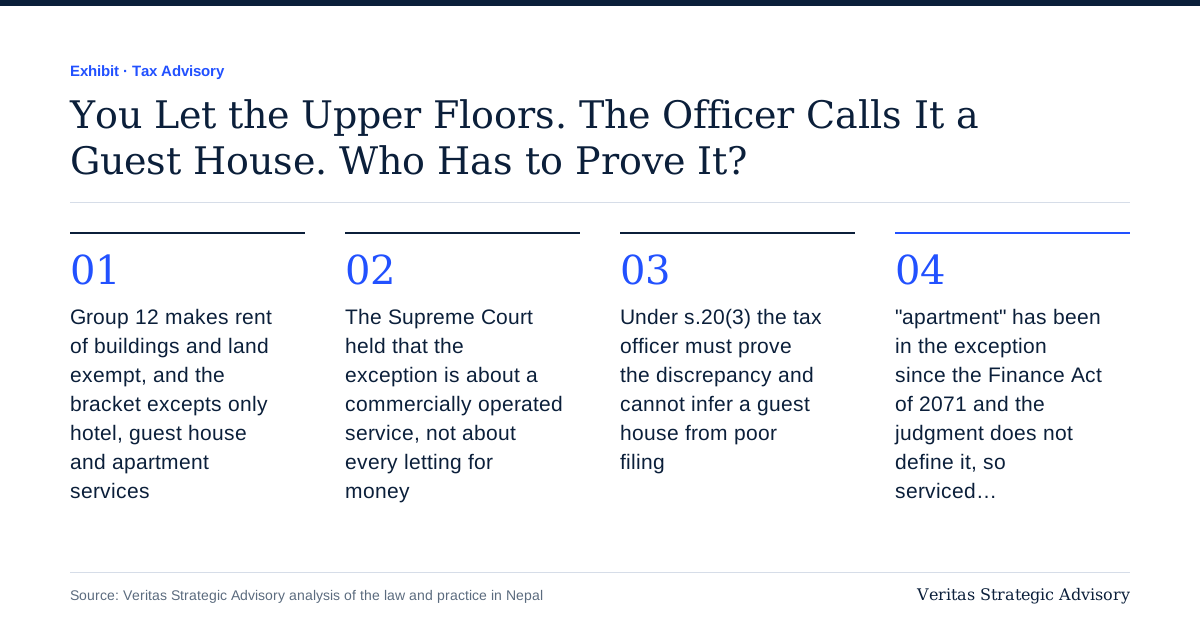
Schedule 1 to the VAT Act 2052 lists the goods and services on which tax is not levied under s.5(3). Group 12 of that Schedule covers "Purchase, sale and rental of buildings and lands", with a bracket excepting "the services provided by hotel, guest house and apartment and entity carrying on business such as hotels guest houses" (VAT Act 2052, Schedule 1, Group 12, p.136, in the English text we hold).
Read it in the order it is written. The rule is exemption. The bracket is the exception. Most of the confusion starts when people read the bracket first and treat any building let for money as probably caught.
The bracket is drawn by reference to the service supplied, not the size of the rent and not the length of the tenancy. Letting space is one thing. Running a hotel, guest house or apartment service in that space is another.
What the Supreme Court decided
The facts above are the facts of the case. The landlord let the ground floor and the third, fourth and fifth floors; the first floor was owner-occupied and the second floor was used by a sister. He had deducted and deposited tax on the rent. The Inland Revenue Office treated the building as being run as a guest house and assessed VAT; the Inland Revenue Department and the Revenue Tribunal upheld that.
A Joint Bench of the Supreme Court (Hon. Sapana Pradhan Malla and Hon. Dr. Manoj Kumar Sharma) reversed all three. The lead decision is case no. 165697, decided 2076 Magh 20, with companion appeals 165685 and 165687 on the same facts and the same date (ICAN judicial case law collection, pp.108-112, 121-125 and 130-134; the VAT reasoning is at pp.110-111 and repeats at p.133).
Three points matter in practice.
The exception is about a commercial service. The Court held that the provision does not make VAT arise on every house-rent transaction. For VAT purposes it is limited to services provided by a commercially operated entity. Unless there are grounds showing that the letting was a commercial entity's service trade, no VAT liability arises on the rent (p.110).
The officer carries the burden. The Court applied s.20(3) of the VAT Act 2052: the duty to substantiate a discrepancy found on tax examination rests on the tax officer. It held that an officer cannot infer a guest house from the landlord having filed details poorly. He must objectively rebut the landlord's case and produce the evidence himself (p.110).
The facts did the work. No business registered with any competent authority was operating in the premises, and the landlord had only the minimum facilities a tenant needs. The Court looked at the Hotel, Lodge, Restaurant, Bar and Trekking Guide Rules 2038, r.3 (registration to operate a tourist-standard lodge or guest house) and r.6 (the infrastructure required), and found none of it present. Those rules were treated as indicators of what a guest house is (pp.109-110).
The Court also noted that the landlord had taken a PAN on 2058.06.22 stating an intention to build and operate an apartment commercial complex, and said that if VAT applied to such a business, the tax office had a duty to tell him at registration or afterwards (pp.110-111).
"Apartment" arrived later, and it is not defined
The Court held that the word "apartment" entered the Group 12 exception only through the Finance Act of 2071. Before that, the exception read "purchase, sale and rental of house and land (except services provided by a commercially operated entity such as a hotel or guest house)". After it, apartment-provided services were added. The requirement to register in VAT for apartment services began from FY 2071/072, and the Court would not apply the amendment to earlier years (pp.110-111, repeated at p.133).
Read that carefully, because it cuts both ways. For the years in dispute, the officer could not use the apartment wording. For any letting today, the apartment wording is in the exception, and the judgment does not tell you what makes a letting an "apartment service" rather than an ordinary lease of flats.
What the decisions do not decide
They concern years before FY 2071/072. The retrospectivity holding is historical.
They do not define "apartment service".
They do not deal with the VAT registration threshold for a person who does fall inside the exception.
They do not say whether the burden holding applies where the landlord has filed nothing at all.
They do not say whether, for a letting caught by the exception, VAT applies to the whole rent or only to a service element.
The three appeals are one taxpayer on one set of facts. That is one line of authority, not three.
The collection prints the decisions under the Income Tax Act 2058 heading; the VAT point was decided inside them.
Illustrative example
This is a hypothetical, not a client matter. Mr. A owns a five-storey building. Floors one to three are let to a company on a signed three-year lease at a fixed monthly rent, with the tenant arranging its own staff and furniture. Floor four is let by the room, with daily housekeeping, linen and a front desk operated by the owner's staff, and guests booked through an agent.
Floors one to three look like ordinary letting. Floor four looks like a service business. On the Court's reasoning the character of the service decides it, so the two should not be treated alike merely because they sit in one building. Whether floor four is inside the exception, and how its taxable value would be worked out, depends on points this judgment does not answer. That is a question for a review of the documents, not a rule of thumb.
Our view
In our view the Court's reasoning is sound and should be the starting point for any landlord facing this assessment. The exception is textually narrow, and an officer asserting it is asserting a fact about how the premises are used. It is fair that the officer must prove that fact.
But we would not advise any landlord to rely on the burden of proof alone. The practical answer is usually to make the evidence yours before anyone asks for it. Keep the tenancy agreements, which show term, rent and who is responsible for what. Keep records showing there is no housekeeping, no front desk, no per-night billing and no marketing as accommodation. Keep proof that no hotel, lodge or guest house registration exists for the premises. The Court weighed exactly these things.
We would be most cautious with a landlord who adds services over time, such as cleaning, laundry, meals or a managed front desk, while still calling the arrangement a lease. That is the direction in which a letting starts to look like an apartment service. Since "apartment" is now in the exception and undefined, we would treat any serviced arrangement as a question to settle with advice before the first invoice, not after the first assessment.
The first thing we would do for an owner who has been assessed is read the assessment for what the officer actually relies on. If it relies on the quality of the owner's filing rather than on evidence of how the premises were used, the judgment is directly in point.
Before you rely on this
We could not confirm the following from the sources we hold:
We hold Schedule 1 in English, and have read s.5(3) and s.20(3) as quoted in the judgment, not from the Act itself.
We have not checked whether a Finance Act after the version we hold has amended Group 12 again. The wording in force for the year in question must be checked.
We state no VAT registration threshold for a person inside the exception, because we have not confirmed one.
The operative text of the Schedule is the Nepali one, and we hold the English.
We have not confirmed whether the Inland Revenue Department has issued a directive or circular on when a letting is an apartment or guest-house service.
Income tax on rent, including withholding and the character of the income, is a separate question and is not covered here.
Frequently asked
Is rent from a building subject to VAT in Nepal?
The default under Group 12 of Schedule 1 to the VAT Act 2052 is that it is exempt. The exception is for services provided by a hotel, guest house or apartment, or an entity carrying on business like one.
Does a short tenancy turn a letting into a guest house?
The Court did not treat it that way. In the case the upper floors were let for one month to one or two years, and the Court still found a letting. It looked at registration, facilities and the absence of any business operating in the premises. It did not decide what happens beyond those facts.
Who has to prove it is a guest house?
The Court held, applying s.20(3) of the VAT Act 2052, that the tax officer must substantiate the discrepancy and produce the evidence. It said an officer cannot rely on poor filing by the landlord.
Does this help me if I let furnished flats with cleaning included?
It may not. "Apartment" has been in the exception since the Finance Act of 2071, and the judgment does not define an apartment service. This is the open question, and it needs advice on the actual arrangement.
Does the judgment fix the registration threshold?
No. It says nothing on the threshold for a person within the exception.
Is this one case or three?
Three appeals, one landlord, the same facts and the same date. We treat it as a single line of authority.
Does it cover income tax on the rent?
No. Tax at source on rent and the character of rental income are separate questions under the Income Tax Act 2058 and are not addressed here.