- Rent in 12 months that triggers registration under s.3(4)
- 50 lakh
- Parties the directive can require to register on one lease
- 2
- Days to file the reverse-charge Annex if the lessor stays unregistered
- 25
- Schedule 1 group whose "rent of carrier" exemption is not yet resolved against this rule
- 9
A transport owner in the Tarai used to run his own two trucks on freight routes. Trade slowed, so he struck a deal with a larger cargo company: they take both trucks on a fixed monthly rent, and his own freight business stops. He reasons that since he is no longer in the freight business, VAT registration is now someone else's problem.
That reasoning assumes VAT registration follows the freight business. The VAT on Freight Services Directive, 2080 does not test it that way once the arrangement becomes a rental.
The directive's basic test, for an owner who still drives
Sections 3(1) to 3(3) of the directive set the ordinary rule for a person directly engaged in moving goods by a means of transport: register once annual turnover is estimated to exceed NPR 50 lakh, apply within 30 days if actual transactions cross that figure unexpectedly, and a business that stays under NPR 50 lakh over the past 12 months may operate without VAT registration, provided it holds a PAN. This is the baseline most people have in mind when they think about "the freight VAT rule."
Leasing it out does not step outside that net
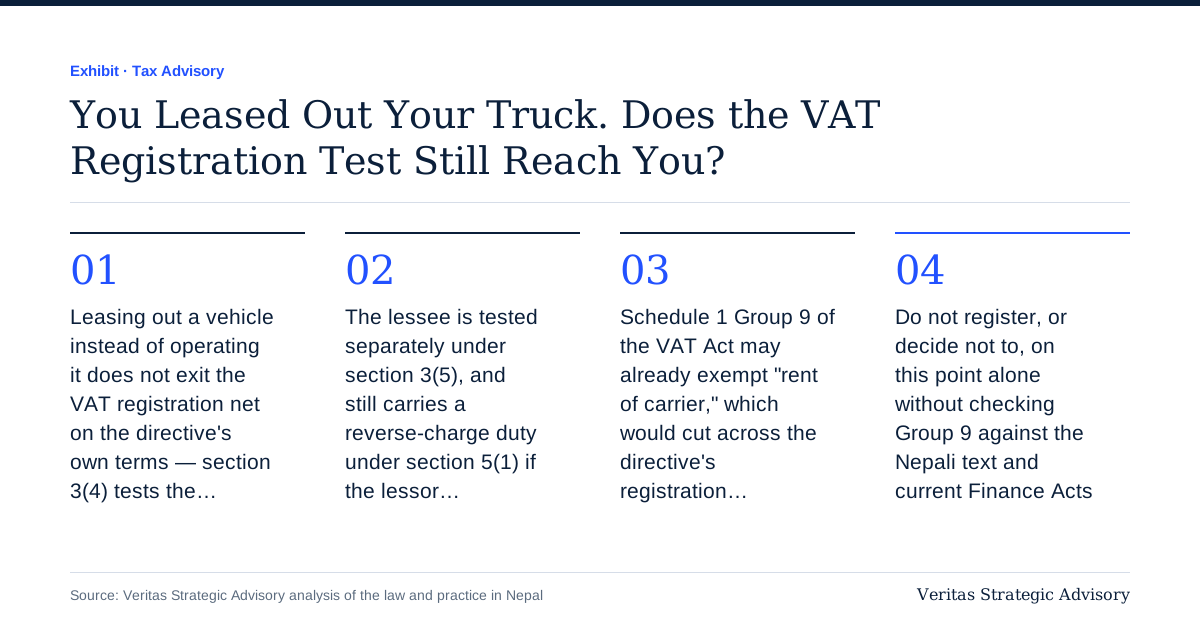
Section 3(4) addresses the owner who stops operating the service and instead gives the means of transport on rent to another person or institution, with or without a written agreement. If the rent received in the past 12 months exceeds NPR 50 lakh, that owner must register in VAT. The test has moved from freight turnover to rental income, but the NPR 50 lakh threshold and the registration duty have not gone away.
Section 3(5) then asks a separate question about the other side of the same lease: the person who takes the vehicle on rent must also register, but only if that person's own transactions are above the threshold that requires registration. A small operator who rents in one truck and stays under the threshold on its own business is not pulled into registration by section 3(5) alone.
Sections 3(6) and 3(7) matter for an owner who already runs a proprietorship under one PAN and leases out more than one vehicle: that owner may apply, attaching the vehicle registration certificate, to have a vehicle's turnover added to the PAN's own turnover, with income and expenses booked under that same PAN. In practice this is the mechanism for aggregating several leased vehicles toward the NPR 50 lakh figure, rather than treating each one as a separate, smaller stream of rent that never crosses the line on its own.
The reverse charge does not disappear either
Even where the lessor is not required to register, or has not registered, the recipient does not get a free pass. Section 5(1) of the directive requires a person who takes a means of transport on rent from someone not registered in VAT to self-assess the VAT on the Annex form, at the earlier of payment or receipt of the service, and file it with the relevant office within 25 days of month end. Section 5(3) lets a normally taxable business enter that amount in its purchase book and claim it as credit; a business dealing only in exempt supplies claims it as an expense instead.
So on the face of the directive, a leased-out truck does not leave VAT behind in either direction. The owner is tested on the rent under section 3(4). The person renting it in is tested on its own turnover under section 3(5), and separately carries a reverse-charge duty under section 5(1) if the owner stays unregistered.
The provision that complicates this answer
Schedule 1 to the VAT Act 2052 lists what is exempt from VAT under section 5(3) of the Act. Group 9 of that Schedule, headed "Public Transportation and carriage service," exempts: air travel, service from a machinery bridge, public transportation carrying passengers (except cable car), rent of carrier, carriage service (except carriage related to supply), and cargo service. The words "rent of carrier" were themselves inserted by the Financial Act, 2021, according to the footnote in the Schedule we hold.
If "rent of carrier" in Group 9 reaches the rent an owner receives for leasing out a goods vehicle, that rent may be exempt from VAT under the Act itself — which would mean section 3(4) of the directive is testing a registration threshold for an activity that the Act does not tax at all, or taxes only in part. The directive is procedure issued under Rule 61 of the VAT Rules, 2053; it cannot widen what the Act taxes.
We cannot resolve this from what we hold. Two readings are both plausible from the English text alone:
A narrow reading: Group 9 sits under a heading about public transportation, and most of the other items in the same list (air travel, passenger transport, a machinery bridge) describe moving people, not goods. On this reading, "rent of carrier" may describe hiring out a passenger-carrying vehicle, not a goods truck, and a goods-vehicle lease would fall outside the exemption and inside section 3(4) as the directive assumes.
A wide reading: the same Group 9 entry also exempts "cargo service" in the same breath, so the group plainly covers goods movement as well as passengers, and "carrier" in "rent of carrier" could mean any means of transport, goods vehicles included — in which case the rent in our scenario may be exempt, and section 3(4) would have nothing to register.
Resolving this needs the Nepali text of Schedule 1 (the operative text; we hold only the English), any Finance Act since 2021 that has touched Group 9, and ideally an IRD circular on the point. None of those is in the corpus we searched. We are not going to guess at an answer that carries a registration consequence either way.
Illustrative example
This is a hypothetical to show how the test would be worked, not a client position on the open question above.
A transport owner leases two trucks to a cargo company at a combined NPR 60,000 a month, with no separate freight business of his own. Over 12 months that is NPR 7,20,000 — well under the NPR 50 lakh figure in section 3(4), so on the directive's own terms this owner is not required to register on this lease alone, regardless of how the Group 9 question is eventually resolved. A larger fleet owner leasing out six trucks at a combined NPR 5,00,000 a month would cross NPR 50 lakh within the year and would need to work through both the section 3(4) test and the Group 9 question before deciding whether registration is actually required or whether the rent is exempt.
Our view
In our view, the sensible position for a transport owner today is to track the NPR 50 lakh rent figure under section 3(4) as if it applies, while separately asking a direct question — not a general one — about whether Group 9 reaches goods-vehicle rental, before registering or before relying on exemption to avoid registering. Guessing in either direction carries a real cost: register when you did not need to, and you take on return filing and disclosure for no reason; stay unregistered when the Act in fact taxes the rent, and you face an assessment with interest once an officer takes the position that section 3(4) governs.
We would not advise a lessee to rely on the lessor's informal assurance that "trucks are exempt." Section 3(5) and the section 5(1) reverse charge test the lessee's own position independently of what the lessor believes about Group 9. If the lessor is not VAT-registered, the safer default for the lessee is to treat section 5(1) as live and self-assess, because the cost of an unnecessary self-assessment that turns out to be creditable is far lower than the cost of a missed reverse charge.
Where we would start for any client already leasing out vehicles at scale: pull the rent received over the last 12 months per lessee, check it against NPR 50 lakh, and get the Group 9 question answered in writing before deciding whether to register. This is not a case where "we have always done it this way" is a safe answer, because the directive is from 2080 and the aggregation mechanism in sections 3(6) and 3(7) suggests the authorities are actively watching multi-vehicle owners who might otherwise split income across family PANs to stay under the threshold.
Before you rely on this
We could not confirm the following from the sources we hold, and none of them should be treated as settled:
Whether "rent of carrier" in Schedule 1 Group 9 of the VAT Act 2052 exempts the rent of a goods vehicle. This is the material open question above, and it decides whether section 3(4) has anything to bite on for a given lease.
The VAT Act 2052 and VAT Rules 2053 full texts are not held locally; we rely on the English text of Schedule 1 only, and the operative text is Nepali.
Whether any Finance Act after the Financial Act, 2021 has amended Group 9 again. Not checked.
Whether the NPR 50 lakh threshold in the directive is measured per vehicle, per lessor across all vehicles leased out, or per lessee relationship. The directive says "that rent amount" over 12 months without being explicit, and section 3(6)-(7) aggregation is framed as something the owner applies for, not an automatic rule.
Whether section 3(5) is tested against the lessee's whole business or against its freight transactions specifically. The directive's wording is not qualified.
The current VAT rate (13 percent, per the Annex form) should be confirmed against the Finance Act for the relevant year before it is quoted as current.
Penalty, interest and late-filing consequences for a missed section 3(4) registration or a missed section 5(1) reverse charge sit in the VAT Act, 2052 and the VAT Rules, 2053, not in this directive. We state no figure.
The VAT Directive 2069 (3rd amendment 2080) is on disk but has a broken text layer and has not yet been rendered and read. It may bear on this question and should be checked before this is finalised.
No case law on "rent of carrier" or vehicle rental VAT was found in the ICAN judicial case law collection we hold; the absence of a case is recorded as a fact, not as evidence either way.
Frequently asked
I own one truck and lease it out instead of driving it. Do I need to register for VAT?
On the face of section 3(4) of the VAT on Freight Services Directive, 2080, you register only once the rent you receive in the past 12 months exceeds NPR 50 lakh. For a single vehicle leased at ordinary market rent, many owners will stay under that figure. A separate question, not yet resolved in what we hold, is whether Schedule 1 Group 9 of the VAT Act exempts this rent from VAT altogether.
I am the one renting the truck in. Does the owner's registration status matter to me?
Yes, in two ways. Section 3(5) asks whether your own business is above the threshold requiring registration. Separately, if the owner is not VAT-registered, section 5(1) requires you to self-assess the VAT yourself and file within 25 days of month end.
If I lease out several trucks under different family members' PANs, does that keep each one under the NPR 50 lakh line?
The directive does not say so. Sections 3(6) and 3(7) let one PAN proprietorship apply to add a vehicle's turnover to its own, which points the other way — toward aggregation, not separation, for an owner who is in substance one business.
Does "rent of carrier" in the VAT Act mean my truck rental is exempt?
We cannot confirm that from the English text of Schedule 1 Group 9 that we hold. The group heading is about public transportation, but the same entry also names cargo service, so the scope is genuinely unclear without the Nepali text and the Finance Acts since 2021. Do not assume either answer.
What rate applies if VAT is due?
The directive's Annex form states 13 percent. Confirm this against the Finance Act for the year in question before relying on it.
Is there a court decision on this?
We searched the ICAN judicial case law collection we hold for "rent of carrier," "carriage" and related terms and found none directly on point. We record that as the state of the search, not as confirmation that no such decision exists anywhere.