- Rate stated on the directive's own Annex form
- 13%
- Days after month end to file the self-assessment
- 25
- Turnover below which a transporter may stay unregistered
- 50 lakh
- The directive that replaced the 2076 one
- 2080
A distributor in Balaju moves goods to twelve districts. It does not own trucks. It calls the same handful of vehicle owners it has used for years, agrees a rate per trip, and pays against a simple bill. Those owners have a PAN. None of them is registered in VAT, because none of them is anywhere near fifty lakh rupees of annual freight work.
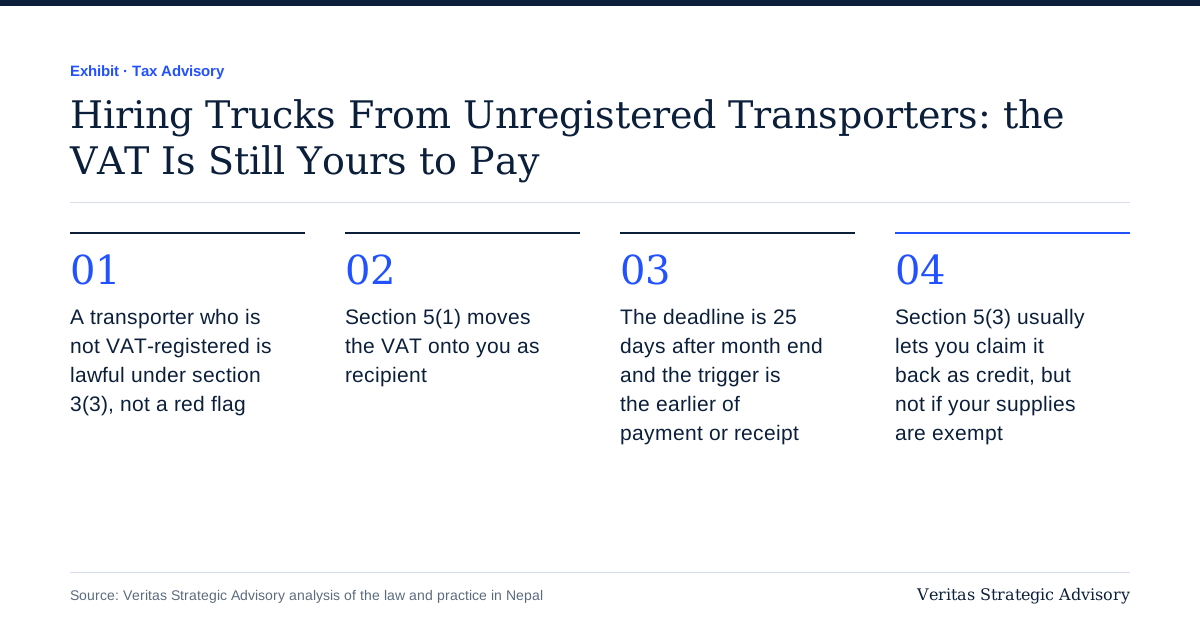
Nothing about that arrangement is irregular. Section 3(3) of the VAT on Freight Services Directive, 2080 expressly allows a freight business whose transactions in the past twelve months are under fifty lakh rupees to operate without VAT registration, so long as it holds a PAN. The transporters are doing what the directive permits.
The finance team books the freight gross, claims no input tax, and moves on. That is where the problem starts, and it usually surfaces a year or two later when an officer asks a short question: where are your reverse VAT filings for freight?
Why the usual assumption fails
Most people carry a reasonable mental rule: if the supplier is not registered in VAT, there is no VAT on the purchase. For ordinary goods that rule mostly holds.
Freight is treated differently. The directive does not ask whether the service provider charged VAT. It asks who received the service. Section 5(1) puts the obligation on the person who takes a means of transport on rent from, or receives freight service from, a person not registered in VAT. That person must self-assess the tax on the value on which tax applies.
So the absence of VAT on the transporter's bill is not evidence that no VAT arises. It is the precise condition that triggers the recipient's own obligation.
A second assumption fails alongside it. Businesses often think of this as a trucking issue, so a company that uses a cargo firm or a freight forwarder rather than individual truck owners assumes it is outside the rule. Section 2(ng) defines a freight business to include a freight forwarder and a cargo business. The test is the registration status of the person you are paying, not the label on their signboard.
What the directive actually requires
Three things, and the order matters.
First, the timing. Section 5(1) fixes the trigger at the time of payment or the time of receiving the service, whichever is earlier. A business that waits for the bill, or for the month in which it finally pays, can already be late. If the trucks ran in Ashwin and payment follows in Kartik, the Ashwin receipt of service is what starts the clock.
Second, the form. The self-assessment is not a free-form note in the VAT return. The directive prescribes a form in its Annex. It asks for the recipient's name, address and PAN, a reverse VAT form number, the name and PAN of the person who provided the service, the number of the means of transport, the value of the service, and the VAT at 13 percent, signed by both the provider and the recipient.
That vehicle number field is worth pausing on. It means the directive expects freight to be documented trip by trip, with the vehicle identified. A finance team that has only a monthly lump-sum bill from a broker will struggle to complete the form honestly, which is itself a sign that the underlying documentation needs fixing.
Third, the deadline. The assessment must be filed with the relevant office within 25 days of the end of the month. This sits alongside, and is not replaced by, the ordinary return cycle.
The part that makes it recoverable
For a normally taxable business, this is a cash-flow and documentation exercise rather than a permanent cost. Section 5(3) allows the tax assessed under section 5(1) and 5(2) to be entered in the purchase book and claimed as tax credit.
The same subsection carves out a different outcome for one group. A person transacting only in goods and services on which VAT does not apply cannot use a credit, so the directive allows that person to claim the amount as an expense deduction instead.
That distinction decides whether this is a timing matter or a real cost. A VAT-registered trading company recovers it. A business whose supplies are entirely exempt does not recover it; it deducts it. A business with a mix of exempt and taxable supplies should work out its position carefully, because the directive addresses the two clean cases and not the blend.
The foreign carrier case
Section 5(2) extends the same obligation to a different situation: a person who gets goods carried inside Nepal by a foreign service provider must assess the tax on the taxable value at the earlier of payment or receipt of service, and file within the same 25 days.
This is the provision most likely to be missed, because the payment often looks like an international transaction handled by someone else in the group, and because no Nepali tax document is generated anywhere in the chain.
A worked example
The figures below are illustrative, not a client case.
A VAT-registered distributor hires trucks from unregistered owners during Kartik. Freight charges for the month total NPR 8,00,000. Goods are delivered in Kartik; payment is made in Mangsir.
The trigger is the earlier of payment or receipt of service, so the obligation falls in Kartik, not Mangsir.
The VAT to be self-assessed at 13 percent is NPR 1,04,000.
The Annex form is completed for the month's freight, filed with the relevant office within 25 days of the end of Kartik.
Because the distributor's own sales are taxable, that NPR 1,04,000 is entered in the purchase book and claimed as credit under section 5(3).
Net cost to the distributor, assuming the credit is properly claimed and supported: nil. Cost of not doing it at all: an undocumented exposure that grows every month, plus whatever the VAT Act provides for a failure of this kind, which this directive does not itself set out.
What this directive does not tell you
The directive is a procedure. It is not the whole law.
It does not state the penalty, interest or fee for a late or missed reverse-charge filing. Those consequences sit in the VAT Act, 2052 and the VAT Rules, 2053, and anyone quoting a figure should quote it from there, for the year in question, rather than from this directive.
It also does not resolve every mixed contract. A pure trip-rate haulage arrangement is plainly freight service. A contract that bundles vehicles, labour and handling inside a client's own premises may not be, and the answer turns on the facts rather than on the invoice heading.
Nor does it deal with income tax withholding on freight payments, which runs on a separate track under the Income Tax Act and should be checked separately.
Practical action points
List every freight supplier you paid in the last twelve months and record, for each, whether they are registered in VAT. The answer decides whether section 5(1) applies to that supplier.
For each unregistered one, identify the month in which the service was received, not the month you paid.
Ask brokers and cargo firms for trip-level documentation that includes the vehicle number, because the Annex form requires it.
Put a recurring task in the compliance calendar at day 20 of each month, so the 25-day deadline is met rather than discovered.
Check that the amounts assessed are actually entering the purchase book, since an assessment that is never claimed converts a timing item into a permanent cost.
If your supplies are wholly or partly exempt, settle your treatment under section 5(3) before the first filing rather than after.
Where a foreign carrier moves goods inside Nepal for you, treat that payment as falling within section 5(2) until you have advice to the contrary.
Frequently asked
Our transporter is not registered in VAT. Is that a problem we should fix?
Not in itself. Section 3(3) of the directive permits a freight business with under fifty lakh rupees of transactions in the past twelve months to operate without VAT registration, provided it holds a PAN. The compliance step that follows is yours, not theirs.
The bill shows no VAT. What value do we assess the tax on?
The directive refers to the value on which tax applies, and the Annex form asks for the value of the service and the VAT at 13 percent on it. In the ordinary case that is the freight charge agreed and payable.
When exactly does the obligation arise?
At the time of payment or the time of receiving the service, whichever is earlier, under section 5(1). For most trading businesses the service is received first.
Can we recover it?
Section 5(3) allows the tax to be entered in the purchase book and claimed as tax credit. A person dealing only in goods and services on which VAT does not apply claims it as an expense deduction instead.
Does this apply to a cargo company or a freight forwarder?
The question is whether the person you are paying is registered in VAT. Section 2(ng) brings freight forwarders and cargo businesses within the definition of a freight business, so the label does not take the arrangement outside the rule.
What if a foreign company moves our goods inside Nepal?
Section 5(2) imposes the same self-assessment and the same 25-day filing on the person who gets the goods carried.
What happens if we have never filed these?
The directive does not set out the consequence; that comes from the VAT Act, 2052 and its Rules. The practical step is to quantify the exposure by month, establish whether credit would have been available, and take advice on disclosure before an assessment raises it for you.
Is this a new rule?
The current instrument is the VAT on Freight Services Directive, 2080, which by section 8 repeals the 2076 directive while saving acts done under it.