- instalment deadlines
- 3
- cumulative schedule
- 40/70/100%
- instalment amount below which payment is not required
- Rs 7,500
- governing section
- Sec 94
Most businesses in Nepal already know advance tax exists. Far fewer treat the estimate behind it as something that needs revisiting through the year, which is exactly where the two most common and most expensive mistakes happen: paying instalments based on a stale estimate made in Shrawan and never revised, or treating each instalment date as a fresh 40% rather than a cumulative target.
What Section 94 actually requires
Under Section 94 of the Income Tax Act, 2058, any person who has or will have assessable income in an income year from a business or an investment must pay estimated tax in three instalments:
| Deadline | Cumulative amount of estimated tax due |
|---|---|
| End of Poush (mid-January) | 40% |
| End of Chaitra (mid-April) | 70% |
| End of Ashad (mid-July) | 100% |
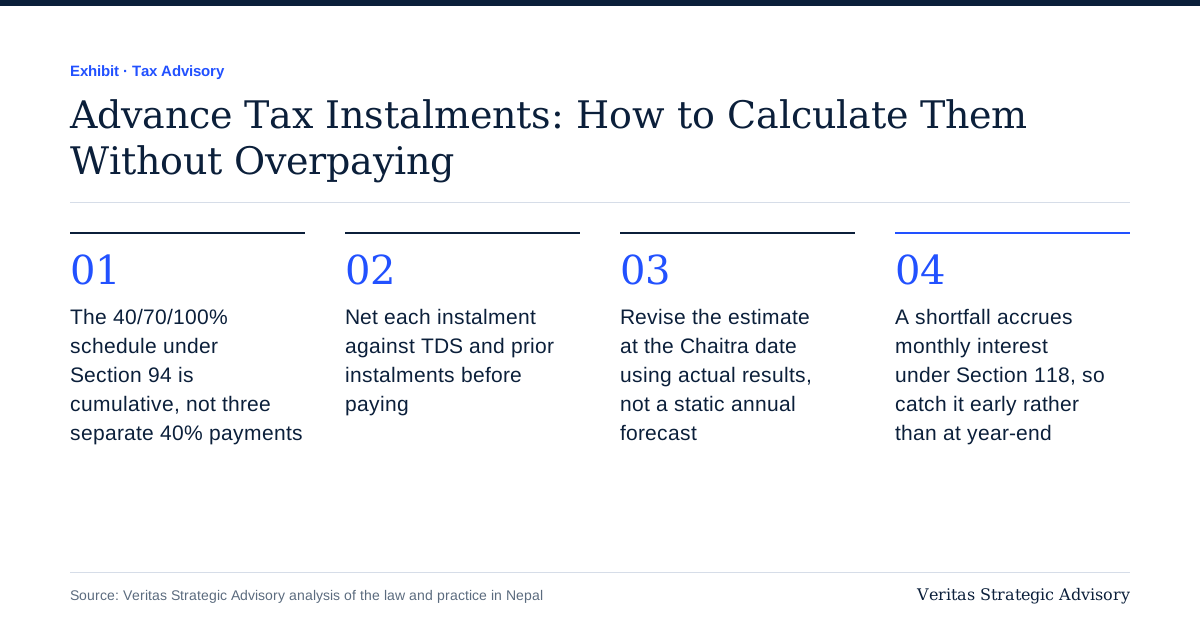
Each figure is cumulative for the year, not an additional 40%, 70% and 100% stacked on top of each other. The amount actually payable at each date is the shortfall after netting off what has already been accounted for: instalments already paid, tax withheld at source under Chapter 17 on income already earned, amounts a withholding agent has deposited on your behalf, and any medical-expense tax credit adjustment under Section 51.
A built-in exemption. Where the computed instalment works out under Rs 7,500, the Act does not require it to be paid. This is relevant mainly for small businesses or a slow first year, where the estimate genuinely produces a negligible figure.
A separate schedule for transaction-based tax. Businesses taxed on a transaction basis rather than net income follow a different, two-date schedule (mid-January and mid-July) under a separate sub-section, not the three-date schedule above.
Where the estimate actually comes from
The instalment obligation runs off an *estimate* of the year's tax, filed under Section 95, not off the prior year's final return automatically rolled forward. In practice, three approaches are used, in order of reliability:
A current-year forecast, built from actual results so far plus a realistic projection for the rest of the year. This is the most accurate and the most defensible if the IRD later asks how the estimate was derived.
Last year's final tax, adjusted for known changes: a new contract, a lost client, a rate change, a one-off gain or loss. This works reasonably well for a stable business but understates or overstates tax in a year with real swings.
Last year's final tax, unadjusted. The weakest approach, and the one that most often produces either a large shortfall (growth year) or an overpayment that ties up working capital for months (slower year).
If the Department itself issues a notice estimating the tax for a person required to pay instalments, that departmental estimate becomes the amount payable for the year, overriding the taxpayer's own figure.
Why overpaying is also a real cost
Advance tax is frequently treated as a compliance-only decision, when it is also a cash flow decision. A business that estimates on the high side, often out of caution, is pre-paying tax on income it has not yet earned, sometimes by several months. For a business already managing tight working capital around receivables and inventory, that prepayment is real cash sitting with the tax office rather than funding operations. The fix is the same for both directions of error: revise the estimate before the Chaitra instalment, using actual results for the first two-thirds of the year, rather than carrying the Poush estimate through to Ashad unchanged.
What underpaying actually costs
Falling short of the required cumulative instalment at any of the three dates exposes the shortfall to interest under Section 118, charged for each month or part of a month from the instalment due date until the return is filed or a revised assessment is issued. The exact general interest rate applied changes from time to time under the Act and Rules, so confirm the current figure before estimating the cost of a shortfall rather than relying on a number carried over from a previous year. The practical point is the same regardless of the exact rate: an underpaid instalment is not a one-time penalty, it accrues monthly, which makes a shortfall identified and corrected in month one far cheaper than one left unaddressed until the annual return.
A practical mid-year checklist
Re-forecast at the two-thirds mark of the year, not just at year-end, using actual revenue and cost data through to that point.
Net off TDS already deducted on your income before calculating what remains payable, not just TDS you have deducted from others.
Flag any one-off item — an asset sale, a bad debt write-off, a one-time grant — that would distort a simple "last year plus growth" estimate.
Confirm which schedule applies: the three-date net-income schedule, or the two-date transaction-based schedule, since using the wrong one misses deadlines entirely.
Keep the workings, not just the paid amount. If the IRD later asks how an instalment was estimated, having the calculation on file is the difference between a quick answer and a drawn-out query. See our piece on how the IRD selects companies for tax audit for how unexplained swings get flagged in the first place.
How Veritas supports this
We build the mid-year re-forecast most businesses skip, reconcile it against TDS already withheld, and set the instalment amount so it reflects where the year is actually heading rather than where last year ended. See our tax consultant services for how this fits into ongoing tax support through the year.
Frequently asked
Do I have to pay an instalment if the amount works out very small?
No. Section 94 does not require payment of an instalment below Rs 7,500.
Can I use last year's tax figure as this year's estimate?
You can, but it is the least reliable method if the business has grown, shrunk, or had a one-off item during the year, since it produces either an overpayment or a shortfall rather than tracking the year actually in progress.
What happens if the IRD disagrees with my estimate?
If the Department issues its own estimate by notice to a person liable for instalments, that departmental figure becomes the amount payable for the year in place of the taxpayer's own estimate.