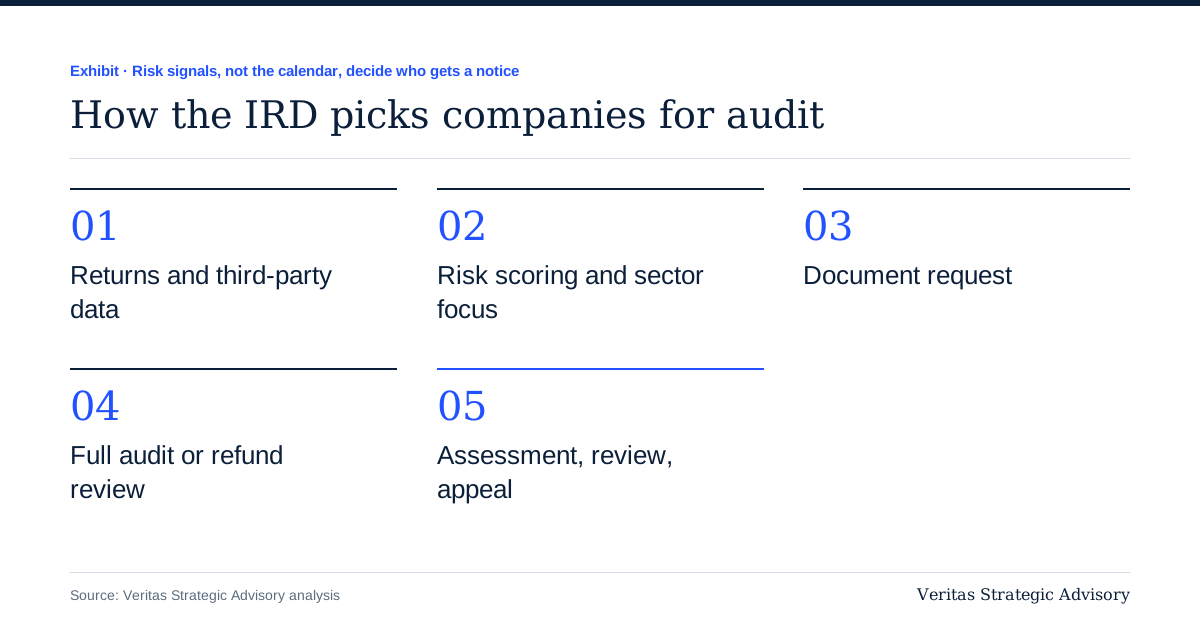
Notices go out in Shrawan, in Kartik, in Magh, in Chaitra and in the last week of Ashad. A file that has been quiet for two years can be reopened in any month, and a request to "come to the office" can arrive on any working day.
What changes through the year is not whether notices are issued, but how cases are handled once they are open. So a company cannot prepare for an audit season. It has to be ready all year, because the notice can arrive at any time.
This article explains how companies get selected, what the different notices mean, which patterns draw attention, and what a company can do about it. It is general information based on the Income Tax Act, 2058 and public sources, and it is not advice on a specific case.
Two forces behind a selection
Most writing on audit selection covers only the first force. Both are real.
1. Taxpayer risk. The company's returns, ratios, transactions or compliance history suggest a higher chance of under-reporting. This runs all year: risk scoring, cross-matching of returns, sector reviews and third-party information.
2. How the tax office is measured. Tax offices work against performance indicators such as revenue collected, audits completed and arrears recovered. Revenue administrations commonly track indicators like these. How targets are set for individual Nepali offices is not published in detail, so this article does not claim to know it.
What it is reasonable to say is limited. Targets can affect how quickly cases move and which files get picked up first. They cannot change the law. Income that is not taxable stays not taxable, and a valid expense stays deductible. Our advice is the same either way: keep records that explain your numbers.
What the law provides
Under the Income Tax Act, 2058, a return is treated as a self-assessment (Section 99). The tax office can amend that assessment on reasonable grounds, generally within four months of the return due date (or of its own notice under Section 100(2)), by an order under Section 101 and a notice under Section 102. A jeopardy assessment is a separate, narrower power for cases such as a taxpayer about to leave Nepal or wind up. Our guide on what to do when a tax notice arrives covers these in more detail.
If you disagree with a decision, Section 115 allows an application for administrative review to the Department within 30 days of receiving notice of the decision, and Section 116 provides for appeal to the Revenue Tribunal. Check the exact time limits for your own situation, because missing one can close off your options.
Types of notice, and what they actually mean
Companies often treat all tax office letters the same way. They should not.
| Notice | What it is | How to treat it |
|---|---|---|
| Request for documents or information | Preliminary step; may be routine or triggered by a specific data point | Respond completely and on time. What you submit can decide whether it escalates. |
| Full audit notice | Formal start of an audit for stated periods and tax types | A substantial exercise. Plan resources and appoint one coordinator. |
| VAT refund review | Triggered by a refund claim; examines whether the refund is due | Quick if the file is complete. Can widen into a full audit if it is not. |
| Sector or thematic review | Notices to a group of taxpayers on one issue | May look like routine requests. Check whether your sector is under review. |
| Investigation | Concerns about concealment, false invoices or fictitious suppliers | Serious. Get professional representation immediately. |
| Arrears notice | Follows up an assessed amount not yet paid | Not a new audit. Old disputes can resurface. |
Knowing which one you have is the first step. A document request and a full audit notice need very different responses, and treating one as the other wastes time or creates false alarm.
What typically triggers selection
The IRD does not publish its full selection criteria. That is normal for tax administrations, because full disclosure would help people avoid detection rather than comply. The broad picture is well understood:
Risk scoring and data cross-matching. Returns are compared with VAT, withholding, customs and bank information. Mismatches go on a list.
Sector and size focus. Nepal has moved towards a risk-based approach to full audits. Reports say low-risk large taxpayers are no longer subject to mandatory full audits, while attention concentrates on higher-risk ones (eStartup Nepal). The IRD has also reportedly started full audits of 105 large taxpayers on suspicion of misreporting turnover (myRepublica).
Cross-border and related-party dealings. Consistent losses, low margins and high management fees often trigger reviews (Prime Law Associates).
Referrals and third-party information. Suppliers, customers, other agencies or former employees can all be sources.
Prior audit history. An earlier adjustment in an area makes a repeat review of it more likely.
A company can therefore attract attention for reasons outside its own conduct, such as the sector it works in or a counterparty that has been flagged.
The patterns that draw attention
Most audits start with a combination of ordinary things that do not add up commercially. Each has an innocent explanation. The problem is when the company cannot produce it, in writing, when asked.
| Pattern | What the tax office asks | What you need on file |
|---|---|---|
| Revenue moves with no explanation | Is sales being under-invoiced, shifted or inflated? | Contracts, delivery notes, bank receipts, customer correspondence, board minutes |
| Losses continue while the business expands | Are the losses real? | Business plan, budget against actual, market evidence, cash flow forecast |
| Margins far from the sector | Is income missing? | Product mix, pricing and discount policy, customer concentration |
| Large or growing VAT credits and refunds | Did the purchases happen, and are the suppliers real? | Purchase order, goods received note, invoice, payment proof, customs papers where relevant |
| Returns that do not tie | Do VAT, income tax, withholding and bank data agree? | Regular reconciliations, with every material difference explained |
| Related-party charges | Is the pricing at market terms? | Written agreement, board approval, proof of service, pricing support |
| Cross-border payments | Why did the money leave Nepal? | Contract, proof of work, withholding tax analysis, foreign exchange records |
| Year-end transactions | Do they belong to this period and make commercial sense? | Cut-off testing, delivery evidence, reason for any unusual entry |
| Large advances to promoters or directors | Is this a disguised distribution or personal spending? | Loan agreement, board approval, repayment record |
| Cash-heavy business | Are sales fully recorded? | Sequential invoices, daily cash counts, deposit policy |
Two points deserve more space.
Reconciliation is the biggest single protection. If your VAT return shows NPR 80 million of sales, your income tax return shows NPR 100 million and your customers' withholding certificates add up to NPR 110 million, expect questions. Reconcile the ledger to the VAT return, the income tax computation and the withholding records every month or quarter, and write down the reason for each material difference. If you cannot reconcile your own numbers, you cannot expect the IRD to accept your explanation.
Related parties are legitimate and common, and still the area where adjustments most often arise. Management fees, shareholder interest, rent to a promoter's property and purchases from group companies are fine if they are documented. "The promoter charged it" is not documentation. See our tax health check for the full list of items we review.
How the pattern shows up in practice
Imagine a distributor whose sales fall by about a third in a year while its VAT input credits and receivables both rise. Any risk model would flag it. There may be an honest reason, for example a key customer paying late and stock bought early ahead of a price rise. But if the company has no customer confirmations, no purchase-order trail and no board minute for the stock decision, the finance team knows the story while the records do not tell it. The company then faces a long audit it could have shortened with a few documents. *This is an illustration, not a description of a specific client.*
The reverse also holds. A company with an aggressive but lawful position can get through an audit cleanly if every transaction has a file: contract, invoice, proof of service, pricing memo, board approval and bank record. Documentation does not guarantee an outcome. It is the thing a company can control most.
Year-round readiness
Preparing after a notice arrives is the wrong starting point. By then you are chasing former staff and rebuilding explanations from memory. The work that matters is continuous:
Reconcile before you file. Ledger to VAT, VAT purchases to expenses and stock, withholding certificates to revenue, payroll to salary expense, customs records to cost of sales. Where a withholding rate itself is in doubt, check it against the TDS rate table for FY 2083/84 before the payment, not after the notice.
Write a short note when something unusual happens. Ten minutes at the time is worth more than a detailed reconstruction three years later.
Know your related parties. Every transaction with a promoter or group company needs an agreement, an invoice, proof of delivery, a defensible price and approval.
Close prior findings. A repeat adjustment in the same area suggests management is not fixing root causes.
Keep a dispute schedule. For each open matter: tax year, tax type, amount, status, appeal deadline, next action and owner.
Keep institutional memory. If only one person understands a transaction and they leave, the explanation goes with them. For the broader routine, see how businesses can lawfully improve their tax position.
If a notice arrives
Verify it. Check the taxpayer name, PAN, period, tax type, issuing office, documents requested and deadline. Notices are sometimes sent for the wrong entity or period.
Name one internal coordinator who owns the response. If two people coordinate, nothing is coordinated.
Track every request and submission in a log: what was asked, what was sent, when, and by whom.
Index what you submit and explain the structure in a cover letter. A tidy submission signals a competent finance function.
Do not guess, and never alter or backdate documents. If something is missing, say so, explain why and offer other evidence. A falsified document is more serious than almost any tax issue underneath it.
Keep fact and interpretation apart. What happened and why you treated it that way are different questions.
Ask for the legal basis in writing if a position looks unsupported, together with the computation.
Protect your deadlines. Administrative review is 30 days under Section 115. If you are unsure whether to dispute, file rather than let the date pass.
Audit and investigation are not the same
An audit asks whether declared positions are correct and supported. An investigation involves suspected concealment or fraud, has broader powers and more serious consequences. A review can move that way if it finds missing records, contradictory explanations, altered documents or fictitious suppliers. If an audit starts to feel like an investigation, with questions about personal records or interviews with staff, get professional representation straight away.
After the audit
Assessment is not collection. The assessed amount is what the IRD says you owe. Many assessments are reduced or withdrawn on review or appeal.
Pay what is genuinely undisputed. It limits interest on that part and separates settled issues from contested ones. Payment is not agreement.
Decide on numbers, not pride. Disputes cost time, management attention and money. Sometimes settling is the pragmatic choice, but record the basis and do not admit facts that are untrue.
Learn from the result. What triggered the review, which records were missing, and which process should change before the next period is examined.
The deeper point
Tax risk is rarely about one wrong number. It is about a pattern that does not make commercial sense, and the company carries the burden of explaining it. The companies that handle audits well are not the ones with the cleverest positions. Our guide to tax evasion vs tax avoidance vs tax planning sets out the four questions that separate a defensible position from one an assessor will challenge. They are the ones whose records tell one coherent story: commercial activity, accounting entries, returns and payments all line up, and the finance team can explain any part on request.
That is what audit readiness means. It is not a file assembled in a panic. It is a discipline built into how the business runs.
How Veritas helps
We help companies keep their records ready for review, and support them through responses, objections and appeals when a notice arrives. This includes reconciliation routines, related-party documentation, refund-file preparation and procedural support. We assist with tax audits; we do not carry out or sign statutory audits. See our IRD assessment defence service, or talk to us for a confidential review at any point in the year.
Frequently asked questions
When does the IRD issue notices?
Throughout the year. There is no audit season. Priority, pace and tone may vary with the calendar, but a company should be ready at all times.
How does the IRD select companies?
Through risk scoring, cross-matching of returns, sector focus, referrals and audit history. The full criteria are not published.
Does a clean audit protect me next time?
No. It closes a specific period. A later review may test whether you kept positions consistent.
How long can the IRD go back?
For an amended assessment, generally four months from the return due date (or from the date of a Section 100(2) notice) under Section 101 of the Income Tax Act, 2058. A fraud-related amendment has its own, separate rule. Other tax types have their own rules, so check the one that applies to you.
Can I dispute an assessment?
Yes. Section 115 provides for administrative review within 30 days of receiving the decision, and Section 116 for appeal to the Revenue Tribunal. Quality of documentation usually matters more than the strength of the argument.
What should I do first when a notice arrives?
Verify it, name one coordinator, log every request, gather and index records, respond within the deadline and never alter documents.
Is it better to settle or dispute?
Neither is automatically right. Decide on the legal merits, documentation, the amount at stake, the cost of dispute and the cash-flow effect.
What is the one thing that reduces risk most?
Records that tell a coherent story, backed by regular reconciliation between your accounts, returns and payments.
Sources
Income Tax Act, 2058
Section 115, administrative review
eStartup Nepal: no mandatory full audit for low-risk large companies
myRepublica: IRD starts full audit of 105 large taxpayers
Prime Law Associates: tax audit process in Nepal
*This article is general information, not professional advice. Every company's circumstances differ, so speak to us before acting on anything here.*
Related: Is interest on a loan used to buy shares deductible? A Supreme Court case on Section 14(1).
Related: Construction contractors: contract accounting, retention money and TDS How withheld tax becomes a credit a contractor has to reconcile, not just a deduction.