

This guide explains which visa fits which investor, how the recommendation works, the documents each office asks for, and the points where applications usually stall.
Why the visa follows the investment
Nepal ties the investor's right to stay to the investment itself. The Immigration Rules make the business visa available to a foreigner who holds a licence to invest in a trade or industrial enterprise in Nepal, or to that investor's authorised representative. A person who is only considering an investment is not in that position yet, which is why the first visa a prospective investor holds is usually a different one.
The Foreign Investment and Technology Transfer Rules, 2077 (2021) extend visa facilities to the foreign investor or the authorised representative and their families. In a summary of Section 30(2) of the Foreign Investment and Technology Transfer Act, one law firm describes "family member" as a spouse, parents and minor children. The same summary says representative and family recommendations need the foreign investment approval letter, a passport copy, evidence of the representative's appointment, and proof of relationship. Treat that definition as a guide and confirm the current wording with DOI.
Visa options for foreign investors
| Visa | Who it is for | Condition | Validity |
|---|---|---|---|
| Non-tourist visa (feasibility) | Foreign nationals researching or surveying a prospective investment | No minimum investment. DOI recommends it for a feasibility study | DOI's page lists up to six months |
| Business visa | The investor or one authorised representative, plus family | Large-investor route: a committed investment of NPR 100 million, with at least 25% brought in, under the 2021 rules. Confirm the current amounts with the Department of Industry | For as long as the minimum investment is kept in Nepal; DOI recommends it for up to five years at a time |
| Residential visa | Investor or representative, plus family | Pradhan & Associates reports over USD 1 million in a single transaction, valid while 50% of the investment is maintained in Nepal. DOI's own page, last updated in 2021, describes a lower threshold and one-year terms, so confirm which applies | Depends on which rule DOI applies; confirm at application |
| Non-tourist visa (specialists) | Foreign employees of the invested company | Subject to labour approval and DOI recommendation | DOI's page lists one year at a time, linked to the work permit |
Two points in the table deserve attention. First, the business visa has more than one entry level. The same rules that set the NPR 100 million route also refer to a business visa for as long as the minimum investment stays in the country, and the minimum investment under those rules is reported at NPR 50 million in some secondary sources, which does not match the general NPR 20 million FDI minimum quoted elsewhere on this site. The two may be different thresholds for different purposes, or one source may be outdated. Smaller investments should therefore not assume they are excluded. Ask DOI directly which category your approved investment falls into, and at what amount. Second, the residential visa figures differ between sources. Do not rely on any single number from an article, including this one, without checking the current DOI position in writing.
How the business visa is granted
DOI recommends the business visa, valid for up to five years at a time, and the Department of Immigration issues it. DOI weighs the level of investment, the company's financial performance, the employment it generates, the income tax it has paid and the area of investment. A company that files returns and pays tax on time is in a stronger position at renewal than one with open tax issues.
Visa fees are set in US dollars and, according to DOI's page and a law-firm guide, they fall as the size of the investment rises, and one guide reports no charge above NPR 100 million. The two sources do not give identical amounts, so ask DOI or the Department of Immigration for the current schedule rather than budgeting from an article.
Steps to apply
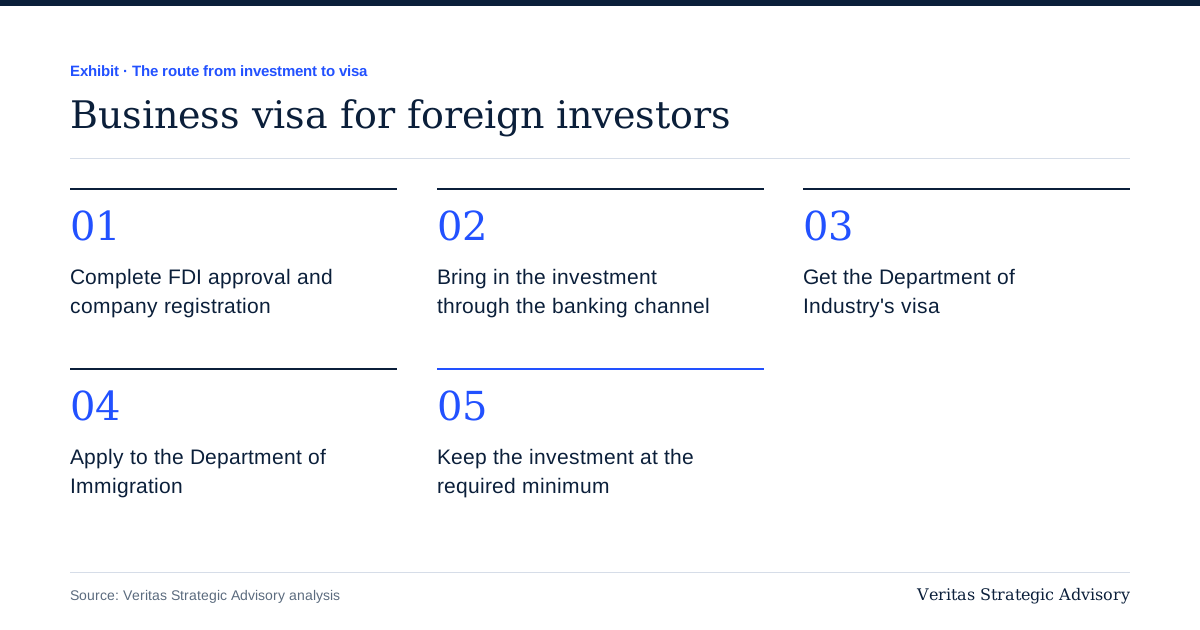
Complete the foreign investment approval and company registration.
Bring in the investment through the approved banking channel and keep the evidence.
Apply to DOI for a business visa recommendation.
Once DOI issues the recommendation, apply to the Department of Immigration.
Keep the investment at or above the required minimum and the company compliant for renewals.
A law-firm guide estimates the whole process at about three to four weeks. Treat that as indicative only, because it depends on how complete the file is and on the offices' workload.
Documents DOI asks for
For the recommendation, DOI's visa page lists:
Passport copy with the last visa
Proof of investment in the company
Industry registration certificate
A progress report showing the current status of the business
A certificate of relationship for dependents
Where a representative applies, an authorisation letter and the representative's passport copy
The investor's contact address and phone number
Documents the Department of Immigration asks for
After DOI issues its letter, the Department of Immigration's list on the same page includes:
DOI recommendation letter
Company incorporation certificate
PAN certificate
Share certificate showing the investor's holding
Industry registration certificate
Passport and passport history
Passport photographs and the holder's bio-data
For an extension, the DOI page lists the DOI recommendation letter, a tax clearance certificate, the passport copy with the last visa, photographs and bio-data. A tax clearance certificate is the item most often missing, so request it early.
Where investors get stuck
Most delays come from the steps before the visa:
Incomplete approval. The foreign investment approval or company registration is not finished, so DOI has nothing to recommend against.
Investment not remitted properly. The capital has not come in through the banking channel, or the evidence of the inward remittance is missing. See our FDI approval guide for how the remittance record is built.
Tax filings behind. A company that has fallen behind cannot produce a clean tax clearance certificate for an extension.
Mismatch between records. The share certificate, the registered holding and the passport details do not agree, which prompts questions at the Department of Immigration.
Confusing the visa categories. An investor applies for a non-tourist visa when the investment already supports a business visa, or the reverse.
Fixing these first makes the visa itself routine. For a company that is registered in Nepal, a simple way to stay ready is to keep one folder with the approval letter, remittance evidence, incorporation and PAN certificates, share certificate and the latest tax clearance.
What to do next
If you are still deciding on a structure, our guide to registering a branch or liaison office covers the route for foreign companies that are not incorporating a company. If you are ready to proceed, our FDI services in Nepal page explains approval, registration and ongoing compliance. Once the visa is issued, keep the investment, tax filings and company records in order, because each renewal looks at them again.

If you would like help with the approval, the remittance record or the visa file, our team of chartered accountants can walk through your case with you.
*Prepared from published sources, October 2026. This is general guidance, not advice on your case. Confirm figures and requirements against the current text and with the Department of Industry and the Department of Immigration.*