- Minimum equity per foreign investor
- NPR 20m
- Steps from approval to NRB notice
- 8
- Typical approval time
- 2-4 weeks
- Remit capital or approval can lapse
- 2 years
Investors researching Nepal usually arrive with the same short list of questions: who approves the investment, how much has to come in and by when, what can go wrong after approval, and how the money eventually comes back out. This guide works through all of it in the order a real transaction actually happens — not just the approval letter, but the ninety-day compliance clock that starts the moment the company is incorporated, and the repatriation mechanics investors tend to research only once they are already trying to exit.
Which laws govern foreign investment in Nepal?
Nepal's foreign investment regime sits on one primary statute and a supporting set of sector laws:
Foreign Investment and Technology Transfer Act, 2075 (2019) — the core FDI law: approval authority, permitted and restricted sectors, capital thresholds, and repatriation rights.
Industrial Enterprises Act, 2076 (2020) and its regulations — industry classification and registration.
Companies Act, 2063 (2006) — incorporation, governance, and the compliance calendar every company (foreign-invested or not) must follow.
Special Economic Zone Act, 2073 — where the investment sits inside an SEZ.
Public Private Partnership and Investment Act, 2019 — large infrastructure and PPP projects.
Bank and Financial Institution Act, 2073 and Environment Protection Act, 2076 — sector-specific overlays that apply alongside FITTA where relevant.
Who approves foreign investment in Nepal?
| Authority | Role |
|---|---|
| Department of Industry (DOI) | Approves foreign investment below the large-project threshold — the route for the large majority of applications |
| Investment Board Nepal (IBN) | Approves investment above roughly NPR 6 billion and designated large infrastructure projects |
| Office of the Company Registrar (OCR) | Incorporates the Nepali company and maintains its share registry |
| Nepal Rastra Bank (NRB) | Records foreign capital inflow, clears foreign-exchange transactions, approves repatriation |
| Tax offices, local ward office, Department of Immigration | PAN/VAT registration, local business registration, and investor visas respectively |
Sectors Foreign Capital Is Actively Welcomed Into
FITTA keeps most of the economy open by default rather than listing what is allowed, but certain sectors are where Nepal is actively courting foreign capital: hydropower and other energy generation, tourism and hospitality, IT and IT-enabled services (with real tax incentives attached), manufacturing and export-oriented production including SEZ-based units, commercial agriculture and agro-processing, infrastructure and PPP projects, financial and professional services, mineral extraction and processing, and aviation/logistics.
The Negative List
A defined set of sectors is closed or restricted, largely to protect small domestic operators and sensitive industries:
Large-scale primary agriculture, livestock, poultry, and fisheries operations that export at least 75% of output (agricultural technology and mechanization businesses are exempt from this restriction)
Cottage and small-scale industries
Personal services — hairdressing, tailoring, driving, and similar
Arms, ammunition, explosives, and nuclear/biological/chemical weapons production
Real estate (construction industries excepted), retail trade, domestic courier, local catering, money-changing, and remittance services
Tourism-adjacent services specifically — travel agencies, tour and trekking guiding, homestays, rural tourism
Mass media in the national language, and film production in Nepali
Management, accounting, engineering, and legal consultancy, plus language, music, and computer training
Consultancy services generally, above 51% foreign ownership
Ride-sharing, above 70% foreign ownership
Air transport: 80% cap on international air services, 49% on domestic air services, 95% on training and maintenance institutions
This list is revised periodically — always verify current status against the specific business activity before structuring a deal, not against what a similar-sounding business elsewhere is doing.
What is the minimum investment and when must the money come in?
The minimum equity investment is NPR 20 million per foreign investor, with an exception for certain IT and digital activities, which are exempt from the minimum under a Government of Nepal notification. Check the current notification for the activities it covers.
Approval does not require the full amount on day one. FITTA sets a tranche schedule for bringing the committed capital in:
Within one year of approval — 25% of a minimum-threshold investment (NPR 20 million); 15% where the investment is between NPR 20 million and 250 million; 10% where it is between NPR 250 million and 1 billion.
Before commercial operation — up to 70% of the total committed investment, in line with the FITTA rules' schedule. Larger investments (above NPR 1 billion) have their own, smaller first tranche.
Within two years of commencing production — the remaining balance.
Investors sometimes assume the entire amount must land before operations start; it does not, but the schedule is a legal obligation, not a suggestion, and missing it puts the approval itself at risk.
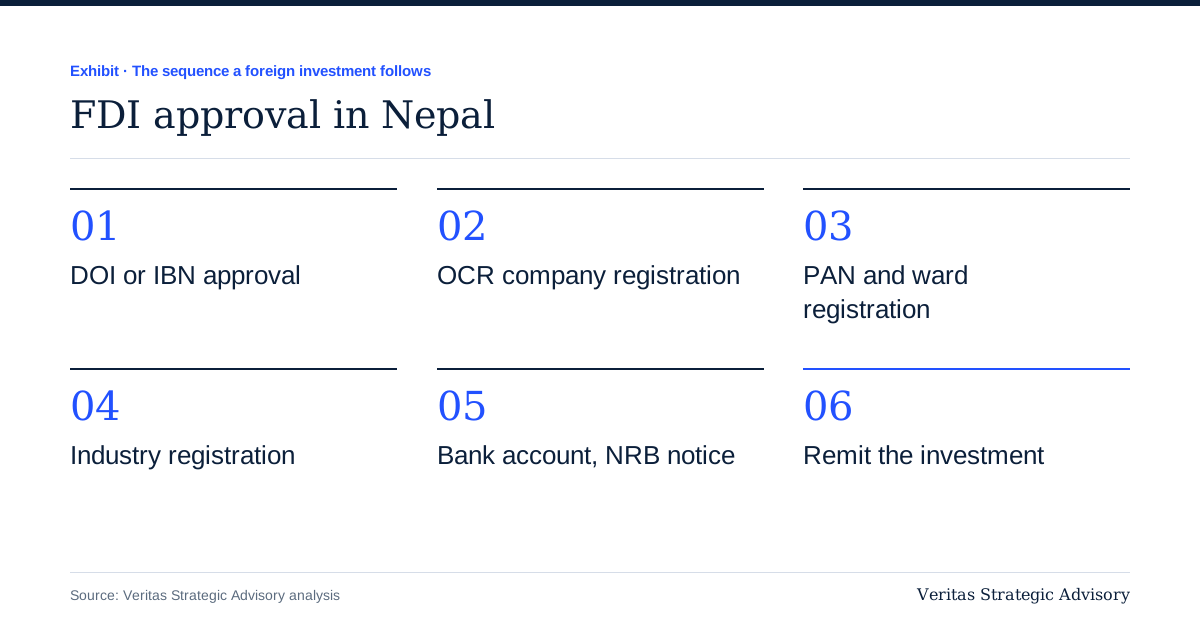
What are the steps to get FDI approval in Nepal?
Foreign investment approval from DOI (or IBN above the large-project threshold).
Company registration at the Office of the Company Registrar.
Tax registration (PAN) at the Inland Revenue Office.
Local business registration at the ward office.
Industry registration with the Department of Industry.
Non-blacklisted certificate from the Credit Information Bureau.
Bank account opening with a local commercial bank.
Statutory notice to NRB, filed before the investment amount is actually remitted.
Each stage depends on the one before it — OCR will not incorporate without the DOI letter, the bank will not open an account without incorporation and PAN, and NRB will not accept the inflow without the account and prior notice in place.
Document Checklists
Where the investor is a company:
Notarized certificate of incorporation, memorandum and articles of association
Notarized passports of the investing company's directors and shareholders
Signed company profile
Notarized passport or citizenship document of the authorized representative
Proposed Nepali company name, registered address, and investment amount
Project report for the local subsidiary
Financial Credibility Certificate from the investor's home-country bank
Notarized latest audited financial statements
Board resolution approving the investment
Power of attorney for the representative handling the approval and registration
Notarized joint venture agreement, where more than one investor is involved
Ultimate beneficial owner documentation, where the investor is itself owned by another company
Where the investor is an individual:
Notarized passport copy
CV / biodata
Proposed company name, address, and investment amount
Project report
Financial Credibility Certificate
Power of attorney for the representative
Joint venture agreement, if applicable
How long does FDI approval take and what does it cost?
Applications that qualify for the automatic-approval route clear as soon as they are submitted through DOI's online system. Everything else typically runs two to four weeks, longer where the sector needs clarification or the structure involves multiple investors.
Fees are modest relative to the investment itself: a NPR 20,000 guarantee deposit at DOI, an OCR company registration fee scaled to authorized capital, NPR 5,000–15,000 annually at the ward office (varies by local government), and a 10% house rent tax on the monthly rent of business premises.
Investor Visas
| Visa | Who Qualifies | Condition | Validity |
|---|---|---|---|
| Non-tourist visa | Foreign nationals researching or surveying a prospective investment | No minimum investment | Up to 6 months |
| Business visa | Investor or one authorized representative, plus family | Minimum investment as set by the FITTA regulations. Confirm the current amount | As long as the minimum is maintained |
| Business visa (large investors) | Up to two investors/representatives, plus families | NPR 100 million or more committed, at least 25% already invested | As long as maintained |
| Residential visa | Investor or representative, plus family | Over USD 1 million in a single transaction, at least 50% retained in Nepal | While conditions continue to be met |
| Non-tourist visa (specialists) | Foreign employees of the invested company | Subject to labor/work approval | Per the work permit |
DOI recommends the business visa, valid up to five years at a time, weighing investment level, financial performance, employment generated, and tax paid. The route runs application to DOI first, then — once DOI issues its recommendation — application to the Department of Immigration with the incorporation certificate, PAN, share certificate, and passport history.
Post-Registration Compliance: The Clock Investors Miss
Approval and incorporation are the beginning of a compliance calendar, not the end of the process:
Within three months of incorporation — register the office address with the ward office and formally constitute the Board of Directors per the Articles of Association (§86).
Ongoing — appoint an auditor (§110/§111), notify OCR of the appointment within 15 days.
Within one year — hold the first Annual General Meeting, filing AGM minutes and audited financials with OCR; annually thereafter, with the annual report due within six months of fiscal year-end.
Within one year of industry registration — commence operations, having injected at least 70% of authorized capital first; notify the Department of Industry within 30 days of issuing the first invoice. Missing this without an approved extension risks fines.
Investment injection mechanics — funds must move by SWIFT transfer from the investor's own account abroad into the company's local account; no other transfer method is recognized as a valid FDI inflow. The receiving bank then issues an investment inflow certificate.
Share registry — once the inflow certificate is in hand, apply to OCR for the share registry, supported by board minutes and the bank's investment documentation.
NRB recording, within six months of the remittance — the investment must be formally recorded with Nepal Rastra Bank using the inflow certificate and approved share registry. This is the single step most likely to be forgotten, and its absence is what complicates repatriation years later, not the original investment approval.
How does an investor take money out of Nepal?
A foreign investor may repatriate capital by selling shares in whole or part, and may take out: proceeds from a share sale, dividends or profit, the residual amount after liquidation, technology-transfer royalties, lease rent, litigation or arbitration settlements received in Nepal, and profit from specialized investment funds as NRB determines — all after settling Nepali tax on the amount.
The repatriation sequence:
Application — submitted to an authorized commercial bank with the documents required under Schedule 9 of the NRB Regulation, 2078.
Bank review — the bank checks completeness and correctness of the submission.
Approval check — where prior IBN/DOI approval exists, the bank processes the repatriation directly under NRB rules; where it does not, the bank forwards the application to NRB itself.
Decision — the bank must respond within 15 working days of receiving a complete application.
Transfer — the approved amount is credited to the investor's account in the original investment country; repatriating to a different country requires separate prior NRB approval.
Documents required: the prescribed application form, industry registration certificate, foreign investment approval certificate, board resolution, AGM decision on dividend payment (where dividends are being repatriated), current audit report and tax clearance certificate, a notarized letter confirming the company is not blacklisted, the NRB investment-recording letter, any approved share purchase/subscription agreement, evidence of proceeds where shares were sold, principal/interest payment records where relevant, a chartered accountant's royalty calculation where royalty is being repatriated, and an OCR-verified list of promoters and shareholders.
Expect one to two months for funds to actually leave Nepal once the application is filed, assuming the documentation is complete on the first submission.
When FDI Approval Lapses
Approval is treated as automatically inactive if the approved investment is not remitted to Nepal within two years without reasonable cause, if share transfers after approval result in 100% of the business passing to Nepali ownership, or if the underlying industry registration or the company itself is cancelled for any reason. None of these require a separate revocation notice — the approval simply ceases to have effect.
Frequently asked
Can a foreign individual invest directly, without a corporate vehicle?
Yes — an individual foreign investor can hold shares directly; the documentation shifts from corporate incorporation papers to personal identification, CV, and proof of funds.
Does the NPR 20 million minimum apply per shareholder or to the company overall?
It is assessed per foreign investor named in the approval — each foreign investor bringing capital into the company needs to individually meet or contribute toward the threshold being approved.
What happens if the injection schedule is missed?
The approval can lapse, and remains at risk of automatic inactivation if the committed capital is not remitted within two years without reasonable justification.
Is legal or advisory support necessary, or can an investor file directly?
Filing directly is possible for straightforward, single-investor cases in an unambiguous sector. Professional support earns its cost where the structure involves joint ventures, a restricted or borderline sector, multiple regulatory approvals interacting with each other, or repatriation planning that needs to be built into the structure from day one rather than solved at exit.
How Veritas Can Help
If the investment is a purchase of an existing Nepali company rather than a new one, read mergers and acquisitions in Nepal and FDI in Nepal: a practical guide for investors first. For visa questions see business visa for foreign investors.
Our foreign investment practice takes clients through the full sequence above — DOI or IBN approval, OCR incorporation, tax and industry registration, NRB recording, and the compliance calendar that follows — coordinating the parallel-track steps rather than working them one at a time. We also build repatriation planning into the investment structure at the outset, which is the point where it is cheapest to get right. Talk to our foreign investment team or see our FDI approval service for what a full engagement covers.
The NPR 20 million minimum does not apply to every sector. Software development, data processing, BPO and KPO, data centres and cloud computing are reported to be exempt, which changes the arithmetic entirely for a technology investor. See IT and BPO company registration in Nepal through FDI.