
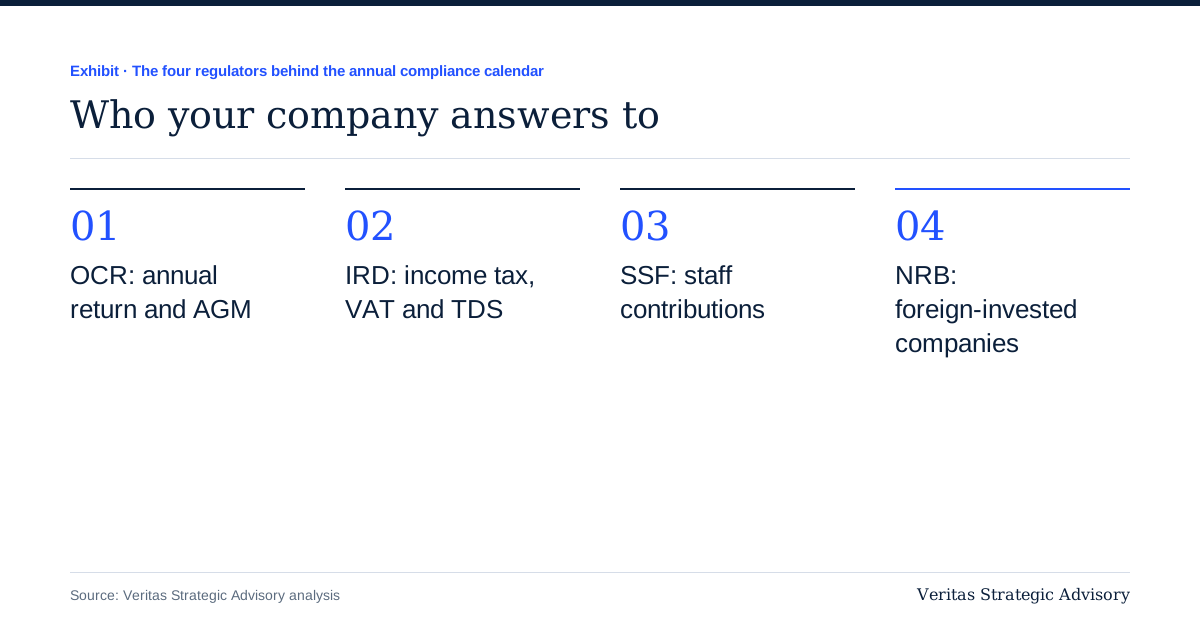
This checklist covers the core annual obligations applicable to most private and public limited companies. Where a figure or time limit could be confirmed from the text of the law or a published source, it is given. Where it could not, the rule is described in general terms and you are pointed to the authority to confirm.
Office of the Company Registrar
Holding the AGM. Under Section 76 of the Companies Act, 2063, a public company holds its first annual general meeting within one year of being permitted to start business, and then every year within six months after its financial year ends. If a public company has not called the meeting within three months after that deadline, the Registrar's office may direct it to do so, and if the meeting is still not held within three months of the direction, any shareholder may petition the court. The Section applies to private companies as provided in the rules for holding an AGM.
Annual General Meeting return. Under Section 80, a company that holds its AGM sends the Registrar the attendance details, the annual financial statement, the reports of the board and the auditor, and the decisions taken, within thirty days of the meeting. Submission is by upload to the Registrar's online system.
Private company statements. Unless the Act provides otherwise, a private company sends the Registrar a copy of its annual financial statement certified by the auditor within six months of the end of its financial year. Check which of the two provisions applies to your company.
Late filing fines. Section 81 sets fines that rise with the delay and with the company's paid-up capital. As published on nepallaws.com, a return up to three months late attracts Rs 1,000 for paid-up capital up to Rs 2.5 million, Rs 2,000 up to Rs 10 million, and Rs 5,000 above that. The amounts are higher for the next three months and the six months after that, and if the return is still missing after that, an annual fine applies (Rs 5,000, Rs 10,000 or Rs 20,000 for the same bands). Other late statements and notices carry Rs 200 for each month of delay, starting one month after the deadline. Check the current schedule for your paid-up capital, because the Act has been amended over time.
Changes in directors, shareholders or registered office. Notify the Registrar within the period the Act and the Registrar's rules provide, and confirm the current period before relying on a calendar date.
Inland Revenue Department
Income Tax Return. Due within three months of the end of the income year. For a company with an Ashadh year-end, that is the end of Ashwin. The IRD can extend the date by up to three months on a written request approved before the deadline.
VAT returns. Monthly filing, due by the 25th of the following month.
TDS returns. (Use the TDS rate calculator to check what to deduct.) The tax deducted in a Nepali month is deposited, with the return, within 25 days of the end of that month. One published guide notes that interest and late-filing fees can follow if tax is not deducted or deposited on time, and that the payer can be held liable for tax that was not deducted. Confirm the current rates with the IRD.
Transfer pricing documentation. Groups with related-party dealings abroad should follow the IRD's Transfer Pricing Directives, 2081, which set when documentation and certification are expected. See our transfer pricing guide.
Tax clearance. A tax clearance certificate is asked for in several other processes, including dividend repatriation, so unresolved filings with the IRD hold up work elsewhere.
Nepal Rastra Bank and the Department of Industry
Foreign-invested companies have a second layer of obligations on top of the domestic ones.
Reporting on foreign investment. Foreign-invested companies have periodic reporting duties to the Department of Industry and, for loans and remittances, to Nepal Rastra Bank. We could not confirm a single set of annual forms and dates from published sources, so confirm them with the bank handling your account.
Foreign loans. Foreign loans need approval and records at the time they are taken. Whether a periodic renewal or report applies depends on the loan terms and the bank's requirements, so ask your bank for the current position.
Profit and dividend repatriation. A published law-firm guide describes two approvals: first from the Investment Board of Nepal or the Department of Industry, then from Nepal Rastra Bank. The documents listed include the current audit report, a tax clearance certificate, the board and general meeting decisions, and evidence that the foreign investment is recorded with the bank. The same guide notes that tax on the dividend, reported there as 5% withholding tax, is paid before the money leaves, and that the whole process takes roughly one to two months. Plan dividends with that lead time in mind.
Social Security Fund
Monthly contributions. Employers deposit contributions within 25 days after the end of the month in which the wages are due. A 2082 amendment to the Social Security Act is reported to have extended the earlier 15-day period, and late contributions are reported to be recovered with 10 per cent interest. The older 15-day figure is still widely repeated, so confirm the current rule on the Social Security Fund's official notices.
Annual position. Check with the Fund whether any year-end reconciliation or return is expected for your company and what it must contain. We did not find a published rule to quote.
Practical tips
Create a compliance calendar at the start of each fiscal year and mark each regulator's filings with a date.
Appoint a dedicated compliance officer or engage an external firm.
Maintain a running register of all regulatory filings and confirmations, including the acknowledgement for each upload or payment.
Build a 30-day buffer before each deadline to allow for review.
Hold the AGM early enough that the thirty-day return and the audited statements fit comfortably inside their time limits.
Keep board and shareholder minutes ready, because several filings and repatriation applications ask for them.
A simple annual rhythm
Most companies find that obligations cluster around three points in the year. The first is month-end, when VAT, TDS and social security contributions fall due within a few weeks of each other. The second is the income-year close, when the accounts are finalised and the income tax return is due within three months. The third is the AGM, which triggers the thirty-day return to the Registrar. Mapping your own dates against these three points shows where a delay in one task will push into the next.

If you would like a hand building the calendar or preparing the filings, our team of chartered accountants can help you set it up.
*Prepared from published sources, October 2026. This is general guidance, not advice on your company. Confirm deadlines, fines and rates against the current text of the law and with the relevant authority.*