- to disclose interests after becoming a director
- 15 days
- for the company to file that disclosure with the Office
- 7 days
- shareholding that counts as direct involvement
- 10%
- things a new director must disclose
- 4
Most directors of Nepali private companies were not chosen for their governance skills. They were chosen because they are a spouse, a sibling, a trusted friend or a senior manager, and they signed the papers they were asked to sign. That works until a lender, a co-shareholder, a regulator or a tax officer asks a direct question: who approved this payment, and what did you know?
This guide sets out what the Companies Act, 2063 actually requires of a director, where the exposure sits, and the habits we would put in place. It is written for owner-directors, family directors and non-executive directors. It reads the statute as published on nepallaws.com; for any live dispute, check the current consolidated text and take legal advice, because amendments may apply.
What does the Companies Act require every director to do?
Three sections do most of the work for a working director: Section 92 on disclosure, Section 99 on responsibilities and duties, and, for related party dealings, the approval and lending rules in Sections 93 and 101.
| Duty | Where it sits | What it means in practice |
|---|---|---|
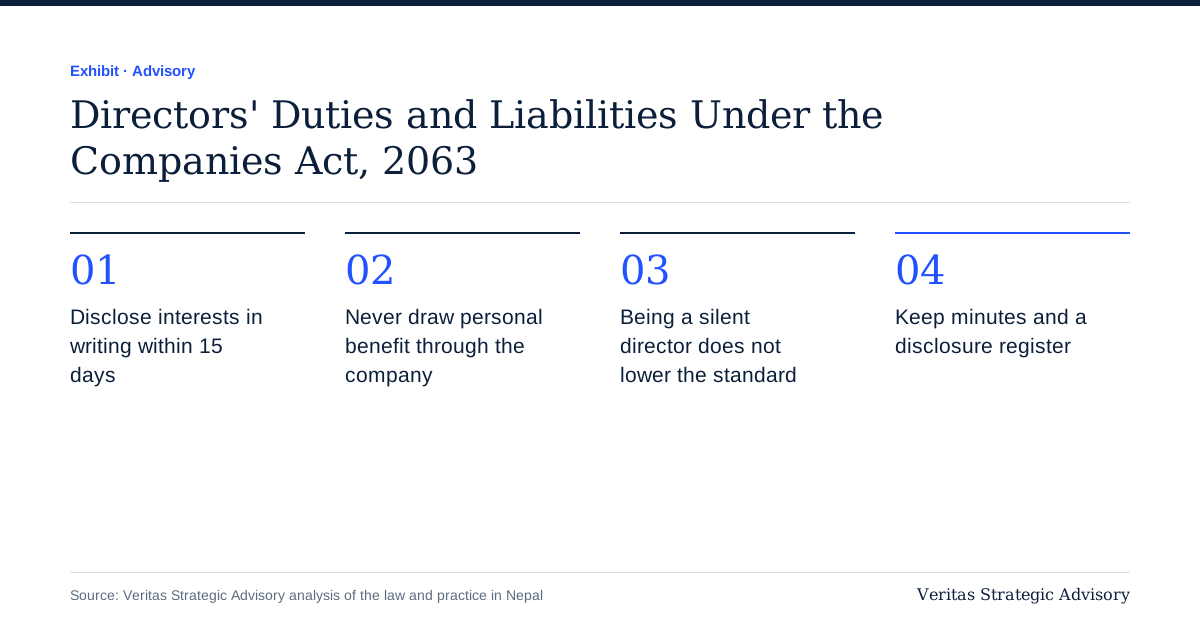
| Disclose interests in writing | Section 92 | Within 15 days of becoming a director, and promptly when a new interest arises |
| No personal benefit through the company | Section 99 | Benefit taken must be recovered from the director as if a loan |
| Honesty and good faith | Section 99 | Act with regard to the company's interests, not your own |
| Reasonable, prudent person standard | Section 99 | Care, judgment, diligence and efficiency, not just good intentions |
| Comply with the law and the documents | Section 99 | The Act, the memorandum, the articles of association and any consensus agreement |
| Related party approval and lending limits | Sections 93 and 101 | Approval thresholds for public companies, and a bar on loans to officers and substantial shareholders |
What must a new director disclose, and by when?
Section 92 requires a director to give the company written disclosure within fifteen days of becoming a director. The disclosure covers four things:
any personal interest that the director or a close relative has in a sale, purchase or other contract connected with the company's transactions, where direct involvement includes being a promoter of, or holding more than ten percent of the shares in, a company, private firm or partnership that is a party, or being a director of such a company;
any interest in the appointment of the managing director, the company secretary or another officer;
any directorship held in another company; and
any dealings made in the shares or debentures of the company, or of its holding or subsidiary company.
The director must attach any written agreement between the company and themselves or a close relative. If there is no written agreement, the essential details of the transaction must be set out. The company must then send the information to the Company Registrar's Office within seven days, where it goes into a separate register.
The duty does not stop after fifteen days. A director who has a direct or indirect interest in any existing or planned contract, lease, transaction or agreement with the company or a subsidiary must disclose it promptly, including its nature and extent. A director can also give a standing written notice that they should be treated as interested in dealings with a named person, which counts as disclosure of future dealings with that person.
Can a director take a benefit from the company?
Section 99 is direct: a director or officer must not use the company, or their position in running its business, to obtain a personal benefit. If a benefit has been obtained in breach, the company must recover that amount from the director, treating it as a loan.
In our experience this is where small companies fall. Personal expenses paid by the company, a director's loan account that grows unrecorded, family travel booked as business, and private assets bought in company funds are all benefits in the ordinary sense. The Section 99 consequence is that the amount is recoverable from the director. The tax consequence is separate and often worse, because an expense without a business purpose is unlikely to be allowed as a deduction. We deal with the loan side in our piece on family business governance, where Section 101's bar on loans to officers and shareholders is explained.
What standard of care applies?
Section 99 also sets the standard. Directors and officers must act honestly and in good faith with regard to the company's interests, and must apply the care, judgment, diligence and efficiency that a reasonable, prudent person would. If a director, acting with an ulterior motive, breaches that standard and causes the company loss, the company may recover damages from that director.
Two points deserve emphasis, because they are the points owners most often misread.
First, the standard is objective. "I did not know" is not a complete answer if a reasonable, prudent person in your position would have asked. A director who signs a loan document, a guarantee or a financial statement without reading it is taking a risk that the standard does not excuse.
Second, the statute ties the damages remedy to an ulterior motive. We read that as a meaningful limit: an honest business judgment that turned out badly is different from a decision taken to benefit the director or a friend. It is our reading of the text, not a decided rule, and we would not rely on it as a shield for careless decisions.
Does a public company director carry more?
Yes, in one visible respect. Section 99 requires a person appointed as a director of a public company to take an oath of secrecy and honesty in the prescribed form before taking office. Public companies also face the director count and independent director rules in Section 86, and the general meeting approval requirement for related party transactions in Section 93. A private company is not bound by Section 93, but the threshold in it, more than one lakh rupees or five percent of total assets, whichever is less, is a sensible internal benchmark, as we explain in the family business article above.
A worked example (illustrative, not a client case)
Take a private company with three directors: a founder, his spouse and an outside friend who joined to make up numbers. The founder's sister owns a warehouse, and the company rents it for NPR 40,000 a month. Over time the company also pays the founder's personal vehicle insurance and a family trip through the books.
Disclosure. The sister's warehouse is a contract in which a close relative of a director has an interest. If no written disclosure was made within fifteen days of the founder's appointment or when the lease began, the register is incomplete and the Registrar's copy is missing.
Personal benefit. The vehicle insurance and trip are benefits drawn through the company. Under Section 99 they are recoverable from the founder as if a loan, so they belong on a director's loan account, not in expenses.
The silent director. The outside friend never read the accounts. If the company later fails and a lender asks who reviewed the guarantee, the friend cannot say a reasonable, prudent person acted differently. They share the exposure even though they never touched the cash.
Cleaning this up costs a few hours of paperwork. Leaving it costs credibility with the next bank officer or tax officer who reads the file.
What checklist should a Nepali director follow?
Write down every interest, relative and outside directorship, and file the Section 92 disclosure within fifteen days of appointment.
Update it promptly when a new contract, lease or loan involving you or a relative is proposed, before it is signed.
Keep minutes that record who attended, what was tabled and who approved, including a note when you asked for more information.
Run personal and family spending outside the company, or put it on a documented director's loan account with a repayment plan.
Read what you sign: loan agreements, guarantees, tax returns and financial statements.
Check the company's memorandum, articles and any consensus agreement. Section 99 makes compliance with them a director's duty.
Review the register of disclosures once a year, at the same time as the annual compliance calendar.
Our view

This is judgement, built on the sections above. In our view the most expensive misunderstanding in Nepali private companies is the belief that a director's liability is proportional to their involvement. The statute does not say that. A reasonable, prudent person standard applies to everyone who accepts the title, so a nominal director who takes no part is not safer, only less informed.
What we would do first is the simplest thing: a one-page disclosure for each director, a minute book that actually exists, and a clean separation between company money and family money. Those three steps resolve most of the questions a lender or tax officer will ask. The practical answer is usually not more rules, it is evidence that the rules already in the Act were followed. Where the law is unsettled, for example how far a court will extend the ulterior motive limit on damages, we would not plan around the gentler reading.
Frequently asked
Do I have to be a shareholder to owe these duties?
No. Section 99 speaks of directors and officers by role. A director who holds no shares still has to act honestly, in good faith and with prudent care.
What if I joined as a favour and take no salary?
The duties apply to the office, not to the pay. An unpaid director who signs documents or approves payments is held to the same Section 99 standard as a paid one, so disclose, read and keep records.
Can the company ask me to repay personal expenses it paid?
Yes. Under Section 99, where a director has obtained a personal benefit through the company, the company must recover the amount from the director as if it were a loan. Tax treatment of the expense is a separate question.
Is a verbal disclosure to the other directors enough?
Section 92 requires the initial disclosure in writing to the company. Verbal understanding is not what the section asks for, and it is hard to prove later.
Who holds the register of director interests?
The company sends the information to the Office within seven days of receipt, and the Office keeps it in a separate register. The company should also keep its own copy with the minutes.
Does this article replace legal advice?
No. It reads the statute as published and gives our practical view. A dispute, a claim against a director or a regulatory notice should go to a Nepali corporate lawyer with the current consolidated text.
Where we help
We help Nepali companies put the director paperwork in order: interest disclosures, a related party register, director loan account clean-ups and board minute templates, alongside the tax and annual compliance work. We provide support and assistance on internal audit and control reviews; we do not perform statutory audits. See internal audit and control support, read our company act compliance checklist, or get in touch. For related reading, see transfer pricing explained for Nepal.
General information only, not advice.