- steps in a transfer
- 5
- approvals for a capital increase
- 3
- authenticated document set
- 1
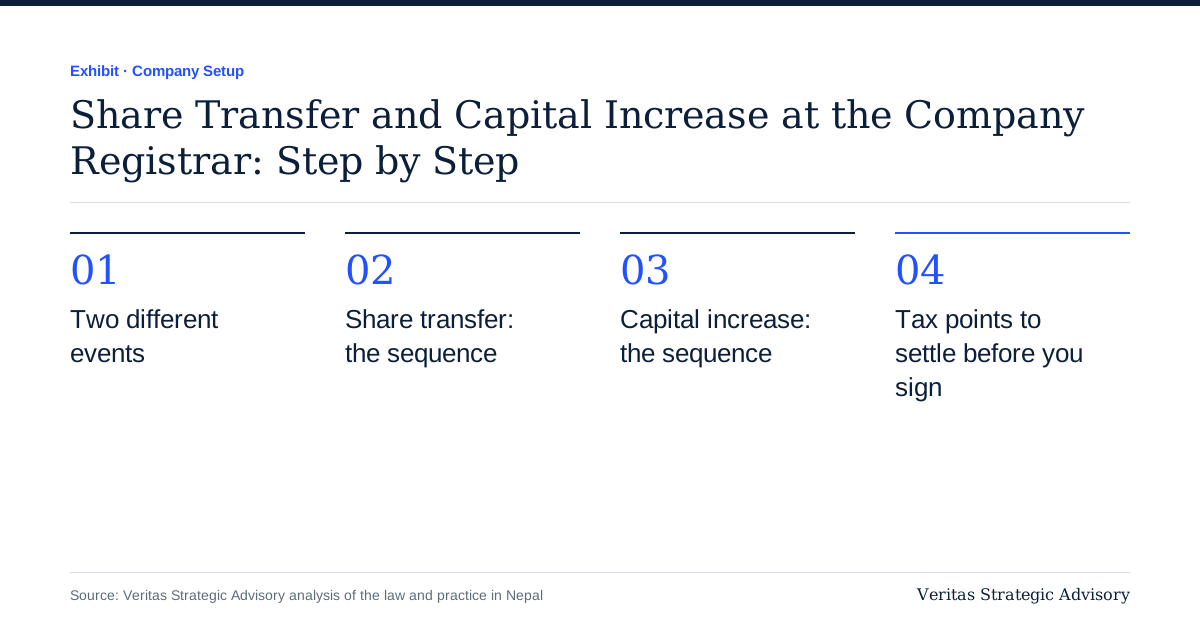
Two different events
A share transfer changes who owns existing shares. A capital increase creates new shares, either by raising authorised capital, issuing new shares, or both. Founders often treat them as one job. They are not, and the paperwork, tax and approvals differ.
Share transfer: the sequence
Check the articles and any shareholder agreement for pre-emption rights, approval requirements and lock-ins.
Agree the price and sign the share purchase agreement and transfer instrument.
Pass the board resolution approving the transfer. A company may refuse a transfer only on grounds the Act and articles allow, such as unpaid calls or fees.
Update the share register and issue new certificates; cancel the old ones.
Notify the Company Registrar with the authenticated documents, and file through the online system. Transfer documents must be authenticated by a licensed legal practitioner or notary.
Ownership is confirmed by the share certificate and register entries as verified by the Registrar. Until then, the paper is evidence of an agreement.
Capital increase: the sequence
Decide the structure: new authorised capital, a fresh issue to existing holders (rights) or new investors, or conversion of loans.
General meeting resolution to increase authorised capital and amend the memorandum and articles.
Receive the money through a bank, and record it as share capital against named subscribers.
Issue shares and certificates and update the register.
File with the Registrar: the resolution, amended documents, bank evidence and forms. Fees depend on the capital; fee waivers have been offered from time to time, so check whether one applies.
If a foreign investor is involved, the Department of Industry or the Investment Board must approve the investment first; see the FDI approval guide.
Tax points to settle before you sign
Capital gains tax for the seller on an unlisted share, at the rates in force.
Valuation that supports the price. A price far from fair value can draw questions on both sides; see how to value a private company.
Change in ownership, which can affect carried-forward losses; see section 57.
Stamp duty and other fees, where applicable.
Where it stalls
Missing bank evidence of the capital paid in.
Share register out of date compared with the Registrar's record.
Names and numbers that do not match across the agreement, certificates and filings.
An annual return not filed, which can block new filings.
We prepare the resolutions, valuation and filing set, and run the process end to end. See company registration and changes and the company law checklist. Confirm the current forms and fees with the Registrar before you file.
A worked example: a founder sells 20% to an investor
Three founders each hold 100,000 shares of a private company with 300,000 shares issued at a face value of NPR 100. An investor will buy 60,000 shares from the founders, in equal parts, and also subscribe for new shares. Illustrative.
Step 1: Agree the terms. The investor and founders sign a term sheet: price per share, conditions, representations, the governance rights of the investor and the timeline.
Step 2: Check the articles and agreements. The articles contain a right of first refusal for existing shareholders and require board approval for any transfer. The shareholders agree in writing to waive the right of first refusal for this deal.
Step 3: Due diligence. The investor reviews the accounts, tax filings, contracts and registrations; see buying a business: financial due diligence. Problems found here change the price or the conditions.
Step 4: Valuation. The parties agree a valuation with support, since the price sets the capital gain for each seller and may be tested by the tax office; see how to value a private company.
Step 5: Sign. The parties sign the share purchase agreement and the transfer instruments. Payment is made through the banking system.
Step 6: Company actions. The board approves the transfer, the register is updated, old certificates are cancelled and new ones issued.
Step 7: Capital increase. The investor subscribes for new shares. The general meeting approves the increase in authorised capital if needed, and the company issues the shares against payment.
Step 8: Filings. The company files with the Registrar the notices and documents of both the transfer and the issue, with the bank evidence and the authenticated papers.
Step 9: Tax. Each founder computes the capital gain and pays tax by the due date. The company updates its tax records.
Step 10: Close. The parties hold a completion meeting, file the closing documents and update the shareholder register.
Documents for each step
Transfer: the share purchase agreement, transfer instruments, board resolution, shareholder waivers, new and cancelled certificates, updated register, authenticated copies and proof of payment.
Capital increase: the general meeting notice and resolution, amended memorandum and articles, bank evidence of subscription, share certificates, registrar forms and fee receipts, and for foreign investors the investment approval.
Tax: the valuation, the computation of gain, payment receipts and the return.
A complete set, indexed and signed, makes the Registrar's review quick and helps any later buyer.
Choosing the structure of the investment
Investors and founders often discuss several options.
Buying existing shares only gives money to the founders and not to the company. It suits a founder exit, but the company gets no new cash.
Subscribing for new shares only puts money into the company and dilutes everyone, including the founders. It suits growth funding.
A mix balances founder liquidity and company funding, and is common in venture deals.
A convertible loan postpones valuation and converts later; see founder and investor equity structuring.
Preference shares give investors special rights on dividends or liquidation, subject to the Companies Act and the articles.
Each has different approvals, tax and accounting treatment, so decide with advice before the term sheet is signed. See also before bringing in an investor.
Common problems
Old registers that do not reflect past transfers, which leads to disputes about who owns what.
Missing board or shareholder approvals required by the articles.
A price that does not match valuation, which attracts questions from the tax office.
Unpaid share capital from earlier issues, which blocks a transfer in some cases.
No bank trail for payment of capital.
Late annual returns at the Registrar.
Foreign investors without approvals or remittance records; see FDI approval.
Pledged shares where a bank holds security over the shares.
Questions people ask
Can shares be transferred for no money? A gift or transfer for no consideration is possible but has its own tax and valuation questions. Take advice before documenting it.
Can a private company restrict transfers? Yes, through its articles, within the Act. The restrictions must be followed.
How long does the Registrar's process take? It depends on the completeness of the file and the office's workload. A complete file is processed faster.
Do we need a lawyer? Authentication by a licensed practitioner or notary is needed for some documents, and a lawyer helps with the agreement. An accountant handles tax and the accounts.
What if the buyer is a foreign company? The investment approval and the remittance rules apply, and the Registrar will ask for them.
We help with valuations, tax computations, the register clean-up and the filing set; see company registration and changes and business valuation. Confirm forms and fees with the Registrar before you file.
Special situations
Transfer on death or by inheritance. Shares of a deceased shareholder pass under the law of succession and the articles. The company needs documents proving the right of the heirs, such as a succession certificate or a court order, before it can register the change. Plan family business succession in advance; see family business governance and selling a family business.
Transfer between spouses or family members. The tax and registration steps may differ from a sale. Check the exemptions and conditions, and document the relationship and the consideration.
Pledge of shares to a bank. A lender may take a pledge over shares as security. Record the pledge in the register, and make sure the transfer provisions in the loan agreement are followed when shares are sold.
Buy-back and reduction of capital. A company that wants to return capital or buy shares must follow the Act's conditions, including solvency tests and approvals. These are not casual steps.
Conversion of loans into shares. A shareholder loan can be converted into equity, but it needs a resolution, valuation and registration, and may need approval for foreign investors.
Bonus shares. When a company capitalises reserves into bonus shares, the register and the capital change, and tax rules apply to the shareholders; see dividends, bonus shares and retained earnings.
Employee shares. Issuing shares or options to employees needs a plan, valuation and tax analysis; see employee share schemes.
Timing and cost: what to budget
The cost of a share transfer or capital increase has several parts, and owners often underestimate them.
Professional fees for the agreement, valuation, tax and filings.
Government fees at the Registrar, which depend on the capital and the type of filing.
Tax for the sellers on gains, and any taxes triggered for the company.
Authentication costs for documents.
Management time to gather records and respond to queries.
Bank charges for inward remittances or conversions.
For timing, allow several weeks for a transfer with a complete file and longer if approvals or foreign investment are involved. Build the timeline backwards from the completion date and the funds you need.