- Amount the Department asked the importer to pay within 7 days, in NPR
- 7,45,551.54
- Largest gap between the sale bill and the declared value, as the Department argued
- 197.70%
- Date of the importer's customs declaration
- 2065.5.28
- Date of the Supreme Court decision
- 2076 Magh 20
Importers in Nepal are used to meeting customs at the border. Fewer plan for meeting it again months later, in the form of a post-clearance audit. The Customs Act, 2064, gives the Department power to examine an importer's records after goods have been released, and to claim extra duty if the declared value or quantity turns out to be wrong.
This case shows where that power ends. It is useful for both sides: importers learn what evidence they must be ready to meet, and customs teams learn what evidence the Court expects before a post-clearance demand will stand.
The case in outline
The petitioner was the Ministry of Finance, Customs Department, acting through its Director General, Toyam Raya. The respondent was Rukmani International Pvt Ltd, acting through its authorised director. A joint bench of Justice Bishwambharprasad Shrestha and Dr. Justice Manojkumar Sharma decided the case on 2076 Magh 20. It is reported at pages 160 to 162 of the Institute of Chartered Accountants of Nepal's collection of Supreme Court decisions on the Customs Act, 2064.
One limit should be noted straight away. The printed report leaves blanks where the name of the goods and the declaration numbers should appear. This article therefore does not name the goods or any declaration number, and it does not guess.
The chronology
The sequence of dates, as printed, was this:
2065.5.28: Rukmani International lodged its customs declaration (pragyapanpatra) for an import with the customs office.
2065.9.3: the company issued sale bill no. 159. The Department later relied on this bill.
The Department carried out a post-clearance audit of the import.
2066.2.4: the Department decided that extra customs duty and a penalty should be collected under s.34(2) of the Customs Act, 2064.
2066.2.5: the Department wrote to the customs office to collect the amount within seven days. The amount demanded from the importer was NPR 7,45,551.54.
2066.2.16: the customs office wrote to the importer to pay within seven days.
The importer appealed to the Revenue Tribunal. On 2067.6.14, the Tribunal reversed the Department's decision.
The Department petitioned the Supreme Court, which decided against it on 2076 Magh 20.
The Department's case
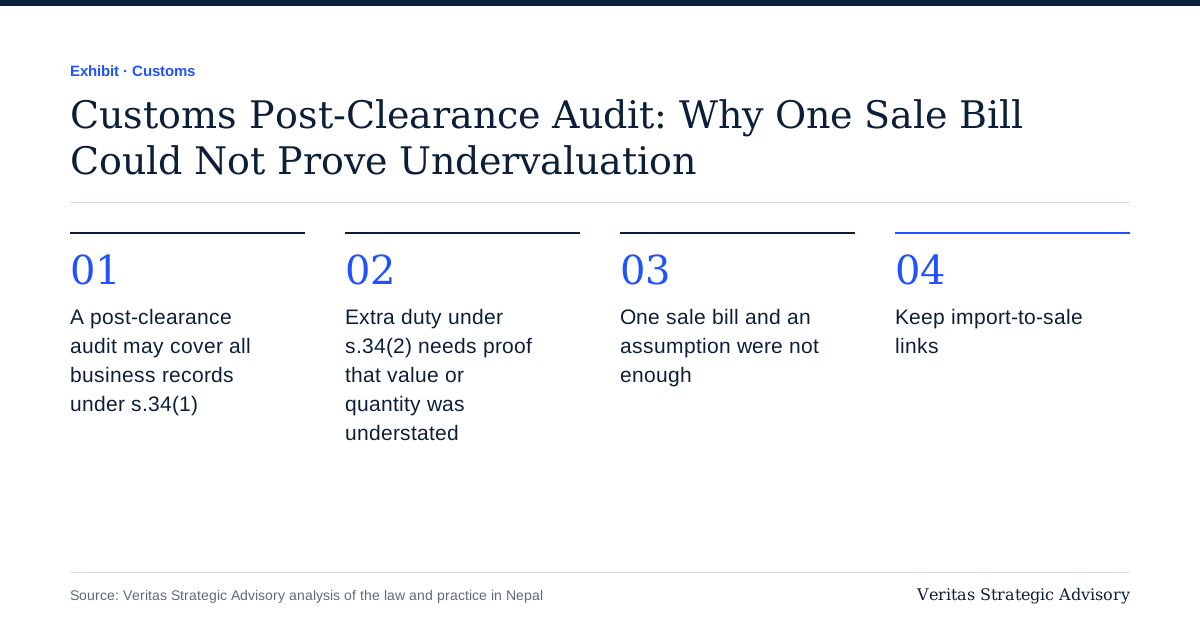
The Department's lawyers argued that the Customs Act, 2064, s.34(1) allows the Department to examine the importer's declaration and the records of its business. These include accounts, ledgers, books, documents, bank records and the computer system. They said that after such an audit, the Tribunal's decision was wrong.
The Department's case on the facts was as follows. The importer had declared a value on its declaration and in its invoices. The sale bill no. 159 of 2065.9.3 showed goods sold at a price that was much higher. The Department assumed that the goods sold on that bill were the goods imported under the declaration. Comparing the sale price with the declared value, the Department found a difference of up to 197.70 percent. It said the importer should therefore pay the extra duty and penalty under s.34(2), and it asked the Court to reverse the Tribunal.
What the Customs Act says
The Court set out the legal frame.
Section 34(1) and 34(2)
Section 34(1) allows the Department to carry out a post-clearance audit. It covers the importer's declaration and the records of its business: purchase, storage and sales accounts, ledgers, documents, bank records and the computer system, in short all records connected to the business.
Section 34(2), as the Court read it, lists four situations in which the Department may collect the shortfall:
the goods imported are different from what was declared;
the importer's own declaration is found not to match;
the transaction value is found to have been declared lower; or
the quantity of goods is found to have been declared lower.
In those cases, the Customs Officer may collect from the importer, at once, the duty that was short-paid on the true value or quantity, and may take action under the Act.
Transaction value
The Court looked at the meaning of "transaction value" in s.2(kha) of the Act. It means the amount the importer actually pays, directly or indirectly, to the seller, plus the freight, insurance and other related costs of bringing the goods to the Nepal border. The Court noted that where the importer pays through a bank, the foreign exchange transferred to the seller is the starting point, and freight, insurance and other charges are added. Section 15 allows the officer to collect customs on the estimated freight and insurance, with later adjustment.
The point is that transaction value is a price at the border. A domestic sale price is a different thing. It includes the importer's costs in Nepal and its margin, and it cannot be treated as if it were the import price without evidence.
What the Court decided
An assumption is not proof
The Court's central finding was that the Department had not proved, by objective evidence, that the goods sold on the bill came from the import in question. The Department's case rested on the nature and similarity of the goods and on a single sale bill. That was an assumption.
The Court noted that the Department had not carried out a post-clearance audit of all the goods the importer had imported. It set aside the idea that one bill, taken alone, could prove that the whole import was under-declared. In the Court's words, as reported, the Department had decided that the declared value should be disregarded and extra duty and penalty collected on the basis of one bill, without having audited the whole import.
The burden lies on the person who accuses
The Court also looked at the burden of proof. Under s.25 of the Evidence Act, 2031, the burden lies on the person who accuses. In a case where the Department says the declared value is false, it is the Department that must prove the case. It is not enough to ask the importer to disprove it.
The Court said the Department had not shown that the sale on the bill was a sale of the goods imported under the declaration, and it had not shown that the declared value was false.
The result
For those reasons, the Court found that the Department's decision of 2066.2.4 could not stand, and that the Tribunal had been right to reverse it on 2067.6.14. It upheld the Tribunal's decision and ruled that the Department's petition could not succeed.
What the decision does not say
It does not say that post-clearance audits are limited or that sale bills are irrelevant. Section 34(1) gives the Department wide powers to examine records, and a sale bill could, with the right evidence, be part of a valid case.
It does not say that the declared value was right. The Court did not find that the importer's declaration was accurate in every respect. It found that the Department had not proved the contrary.
It does not set a figure for what proof is enough. The Court's reasoning is that the Department had two weaknesses together: a single bill with no link to the import, and no audit of the whole import. A different file, with a full audit and a documentary link, would be judged differently.
It also concerns the Customs Act, 2064, as it was in the relevant years. Section numbers and valuation rules should be checked against the current law and the current valuation rules before this is relied on.
Practical lessons
This section is not from the judgment. It is a working method drawn from what the Court examined.
For importers
Keep the whole import file together: declaration, commercial invoice, bank remittance, freight and insurance documents, packing list and the customs receipt.
Link imports to sales. A stock register that shows which import lot each sale came from will help you answer a claim that a sale price proves under-declaration.
Keep price lists and quotations that explain a price gap, such as a different grade, a different quantity, a retail mark-up or a different market.
Respond in writing to every audit query, with documents, and keep a copy.
Watch the deadlines. The Department asked for payment within seven days. Check what appeal period applies and act within it.
For customs teams
Audit the whole import, not one bill.
Establish the link between the sale and the import with records such as stock books and lot numbers.
Compare like with like. A domestic selling price is not the border transaction value.
Record the reasoning for any disregard of the declared value so that it can be defended on appeal.
An illustrative example
This example is invented. An importer declares a consignment of goods at a certain value. Months later, an auditor finds one sale bill for goods of a similar kind at a much higher price, and demands extra duty on the gap. If the importer's stock register shows the billed goods came from another lot, bought in another season at a different price, the single bill proves nothing about the first declaration. If the auditor has instead reviewed all purchases and sales and found that the importer's declared values were consistently well below the amounts remitted through the bank, the Department's case is far stronger.
Our view
The decision is a good reminder that a power to audit is not a power to assume. It is also a reminder to importers that the best defence is a clear file, assembled before anyone asks.
For importers, the work is dull but valuable: keep import, payment and sales records that connect to each other. When a customs query arrives months after clearance, the file is what answers it.
For customs teams, the case shows the cost of a thin audit. A demand that rests on one document and a presumption invites reversal, and the time spent defending it is wasted.
Frequently asked
Can customs examine my records after clearance?
Yes. The Court set out s.34(1), which allows an audit of the declaration and the business records, including accounts, bank records and the computer system.
What did the Department claim in this case?
It asked the importer to pay NPR 7,45,551.54 within seven days as extra duty, and a penalty, based on a sale bill and a difference of up to 197.70 percent from the declared value.
Why did the Department lose?
The Court found no objective proof that the sale on the bill was of the imported goods, and no audit of the importer's whole import.
Is a domestic sale price the same as transaction value?
No. The Court read transaction value as the price paid to the seller plus freight, insurance and related costs to the border.
Is the decision still current?
It was decided on 2076 Magh 20 under the Customs Act, 2064. Check the current Act and valuation rules before relying on it.
Sources and limits
Source: the Institute of Chartered Accountants of Nepal's collection of Supreme Court decisions on the Customs Act, 2064, pp.160 to 162 (Ministry of Finance, Customs Department v. Rukmani International Pvt Ltd). The amount demanded and the percentage gap were checked by enlarging the printed page. The names of the goods and the declaration numbers are blank in the print and are not given. Section numbers are as quoted by the Court.
General information only, not advice.