- tools: reschedule or restructure
- 2
- minimum interest recovery reported in a 2026 directive
- 10%
- minimum provision reported on restructured loans
- 5%
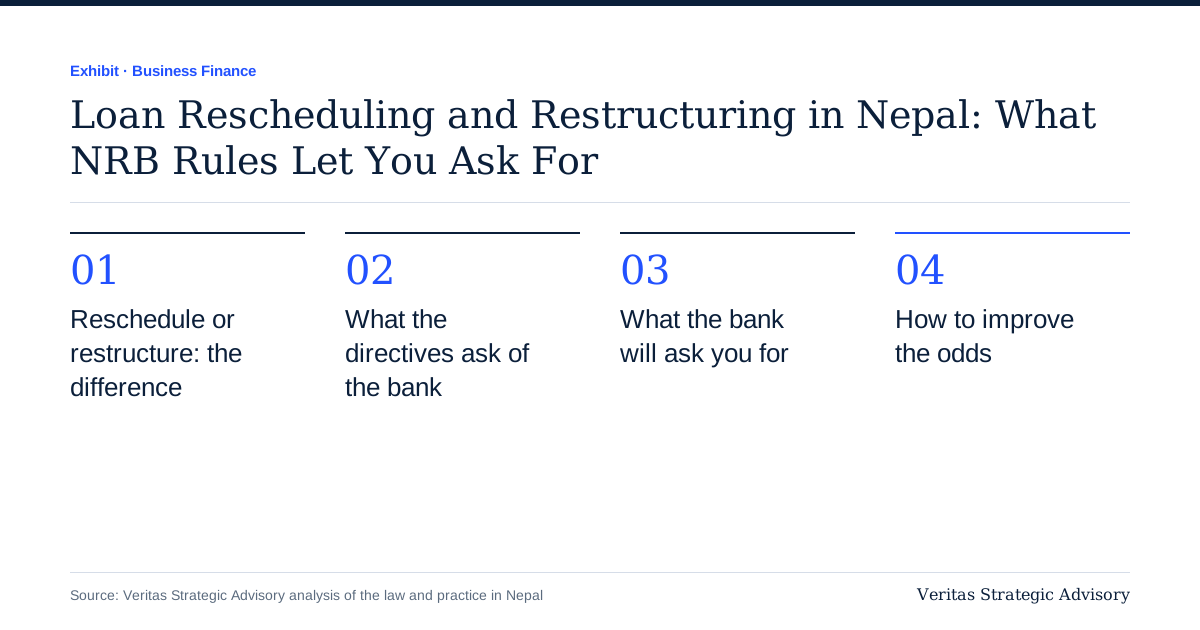
Reschedule or restructure: the difference
| Rescheduling | Restructuring | |
|---|---|---|
| What changes | The repayment calendar: longer tenor, grace period, new instalment dates | The terms: interest rate, collateral, converting part of the debt, a new repayment source |
| When it suits | Temporary cash squeeze, business model sound | A structural problem, or the business has changed |
| Effect on the borrower | Lower instalments, more total interest | Wider changes, often with new security |
What the directives ask of the bank
Conditions change by circular, and the exact text matters. Reported conditions in recent directives include:
The bank must analyse the borrower's cash flow before agreeing, not just extend the dates.
A minimum share of accrued interest (reported as 10% in a 2026 directive) is recovered before the account can be rescheduled.
A minimum provision (reported as 5%) is kept against rescheduled or restructured loans.
Time limits: several windows required completion by a stated date, for example mid-Ashoj 2083, and the working-capital window closed at the end of Asar 2026.
Disaster or disruption relief often lets the account keep its earlier risk classification.
Because the bank carries the provision and the reporting risk, it will approve only where the numbers show the loan can be repaid.
What the bank will ask you for
A written request that states why payments failed and what changes.
Cash-flow projections that show the new schedule is affordable. See our note on what to calculate before taking a loan.
Up-to-date financial statements and tax clearance.
A statement of dues and your offer: partial payment, new security or both.
Sometimes, an independent review of the projections.
How to improve the odds
Ask before the account goes bad. Once classified as non-performing, the options narrow and the cost to the bank rises.
Show the cause is temporary and fixed: a lost contract that has been replaced, a seasonal gap you now plan for.
Offer something: a lump-sum payment, extra collateral or a cost reduction plan.
Keep the numbers consistent across your VAT returns, bank statements and projections. Gaps are the first thing a credit officer finds.
If the loan is already blacklisted
Restructuring and blacklisting are linked. See how to get off the CIB blacklist. Our team prepares the cash-flow case and the supporting file; see bank loan documentation and restructuring a loss-making company. Check the current directive before you rely on any deadline named here.
A worked example: a manufacturer asks for rescheduling
A food manufacturer has a term loan of NPR 2 crore with a 5-year tenor and a working capital line of NPR 80 lakh. A key customer delayed payments for six months, and the company missed two instalments. The owner approaches the bank before the account is classified as overdue beyond the limit.
What the owner brings.
A short explanation: one large customer, now paying again, and a delay in a government payment that has now been received.
Financial statements for the last three years, which show profits and steady margins.
Management accounts for the last six months, with receivables ageing.
A 12-month forecast that shows monthly sales, collections, purchases and instalments under three structures: the original schedule, a six-month grace on principal and a longer tenor.
A proposal: pay the overdue interest now, take a six-month principal holiday and extend the tenor by one year.
What the bank does. The credit team checks the forecast against bank and VAT data, calculates the recovery of interest required by the directive, determines the provision it must hold and recommends the option that keeps the loan performing. It then seeks approval from its committee.
The outcome. The bank approves a rescheduling that gives six months' relief on principal and a longer tenor, with a higher interest payment up front and a covenant to maintain minimum receivable collections. The loan stays classified as performing, subject to the rules.
The owner succeeded because the request was early, evidence-based and realistic. Late, vague requests are the ones that fail.
Rescheduling and the cash-flow test
The central question the bank asks is: after the change, can the borrower pay? The forecast must answer this with discipline.
Start from actual collections, not from sales. Use the last six months of bank credits and the receivables ageing.
Build costs from the ledger, including payroll, raw materials, rent, utilities and taxes.
Include all debt service, not just this loan: other bank loans, hire purchase, supplier credit and overdraft interest.
Test downside cases. What if sales are 15% lower, or collections slip by 30 days? If the plan only works in the best case, the bank will notice.
Show the minimum cash balance in each month. A forecast that goes negative, with no explanation of how it will be funded, fails the test.
Reconcile with taxes. The VAT returns and income tax figures should agree with the sales in the forecast.
Use the cash flow calculator and the EMI calculator to test structures before you propose one.
Options to ask for
| Option | What it does | When it fits |
|---|---|---|
| Grace period on principal | Pays interest only for a period | Temporary cash squeeze |
| Longer tenor | Lowers the instalment | Stable business, high instalments |
| Step-up repayments | Smaller instalments now, larger later | Seasonal or ramping businesses |
| Converting overdue interest | Capitalises interest into the loan, within the rules | Where allowed and the cash flow supports it |
| Additional collateral | Strengthens the bank's position | Where the bank is reluctant |
| Partial settlement from asset sale | Reduces the debt | Where non-core assets exist |
| Equity or promoter funds | Adds cash and shows commitment | Larger problems |
The directive limits what the bank may do and how many times, so ask what is possible for your category of loan.
Pitfalls
Asking late. Once an account is classified as non-performing, the range of options narrows and the provision rises.
Optimistic forecasts. Credit officers have seen many. They check against banking and tax data, and a forecast that does not reconcile loses credibility.
Ignoring other lenders. Cross-defaults mean a problem at one bank can spread; plan the conversations in sequence and in a consistent way.
Neglecting taxes. Overdue VAT or TDS will be found in due diligence. Clear or arrange them first.
Not reading the covenants in the new agreement. A breach can bring back the original problem with added cost.
Not preparing for the blacklist. If the account is already listed, see removal from the CIB blacklist.
After the rescheduling
The agreement is a new start, and the bank will watch. Provide monthly management accounts, keep payments on time and communicate early about any shortfall. A borrower who gives the bank warning, with a revised plan, is treated better than one who misses a payment without a word. Use the period to fix the cause: collect receivables faster, cut cost, improve margins or add a product. See profitable but short of cash and how much working capital your business needs.
We prepare rescheduling and restructuring proposals, build the forecasts and support meetings with the lender. See bank loan documentation, virtual CFO and financial advisory and modelling. NRB directives and windows change often, so confirm the current rules and deadlines with the bank.
Questions people ask
Does rescheduling hurt my credit record? A rescheduled loan is treated differently from a defaulted one, and under some directives it retains its earlier classification, but banks keep a record of the change, and another lender may see it. Handled early and paid as agreed, it is far less damaging than default.
Can I reschedule more than once? Directives limit the number of times and conditions apply. A second request needs stronger evidence and may carry a higher provision for the bank.
Will the bank charge a fee? Banks may charge processing fees and legal costs. Ask for the cost in writing before you agree.
What if I have loans from several banks? Each bank decides for its own exposure, but they watch each other through the bureau. Share the same plan with all of them and avoid giving one bank different numbers from another.
Do I need extra collateral? Not always. It helps where the forecast has risk, and banks may ask for it as a condition of a longer tenor.
Can interest be waived? Waivers are limited by directives, and the bank must still recover a minimum part of the interest. Do not assume a waiver; ask what the bank can do.
What about a personal guarantee I gave? It continues to apply. Make sure the guarantor understands any changes in the terms.
Is a government relief package different? Relief for disasters or disruptions often has its own rules, with deadlines and eligibility. Check the circular before you rely on it.
A checklist for the proposal
A one-page summary: what happened, what has changed and what you ask the bank to do.
Three years of financial statements and current management accounts.
Receivables and payables ageing, and the stock position.
A monthly forecast with the proposed structure and a downside case.
A list of all borrowings with balances, rates, instalments and security.
Tax clearance or proof of tax compliance.
A plan for the underlying problem, with milestones.
Contact details of one person who can answer the bank's questions within a day.