
- practice areas
- 6
- sector groups
- 5
- industries covered in this guide
- 30
What management consulting means in Nepal
In larger markets, management consulting, strategy consulting, financial advisory and tax advisory are sold by different firms. In Nepal most businesses are owner-managed and mid-sized, and the same owner faces all of those questions in the same month. A useful consulting firm here therefore does two things together: it advises on the decision, and it can do the groundwork the decision depends on, because advice built on books nobody trusts is not worth much.
Three terms are often mixed up.
| Management or strategy consulting | Accounting and tax practice | Statutory audit | |
|---|---|---|---|
| Question it answers | What should we do, and what will it take? | Are the books, filings and returns right? | Do the financial statements give a true and fair view? |
| Output | A decision, a plan, a model, a working process | Accounts, returns, registrations | An independent audit opinion |
| Who it serves | Owners, boards and management | The company and the tax authority | Shareholders, lenders and regulators |
| Looks | Forward | At the current period | Backward |
Veritas Strategic Advisory is a management consulting firm in Kathmandu run by chartered accountants. We advise and we do the finance and tax groundwork. We do not sign statutory audits; where a client is being audited, we offer audit support, which means preparing the company for its auditor.
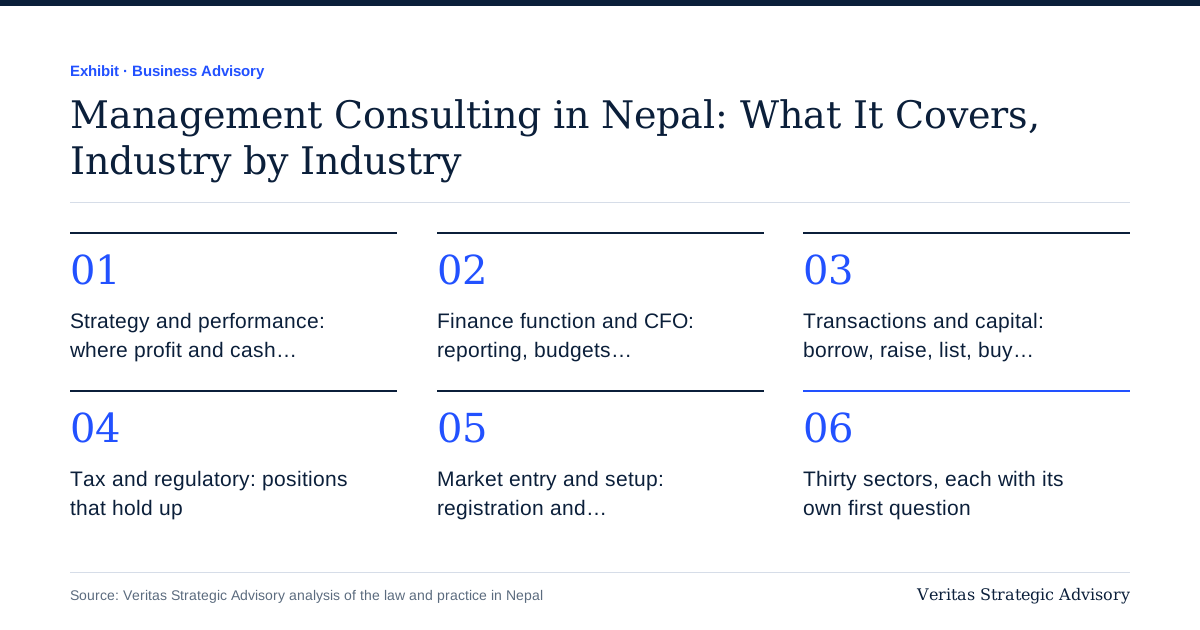
What it covers: six practices
Strategy and performance. Which products, customers and branches earn their keep, and what to change. See financial strategy and margin and cost diagnostics.
Finance function and CFO. Monthly reporting, budgets, forecasts and controls. See virtual CFO and financial modelling.
Transactions and capital. Preparing to borrow, raise, list, buy or sell. See bank loan documentation, business valuation, due diligence and mergers and acquisitions.
Tax and regulatory. Positions that hold up, and a defence when the tax office disagrees. See tax advisory and IRD assessment defence.
Market entry and setup. Company registration, foreign direct investment, bookkeeping and payroll.
Global delivery. Accounting and reporting work delivered from Kathmandu to firms abroad. See outsourcing and virtual CFO.
The list of services is the same for every client. What changes by industry is which question matters first. The rest of this guide sets that out sector by sector, and each sector links to a page with more detail.
Trade and manufacturing
Margin in this group is decided in cost, before a sale is made.
Import and distribution. Landed cost by product, including duty, freight, LC charges and exchange rate; working capital between the LC and the customer's payment; credit terms by customer. See landed cost and LC margins.
Manufacturing and processing. Cost per unit by product and line, yield and wastage, stock accuracy, capacity against fixed cost, and tax incentives claimed correctly.
FMCG and consumer goods. What a sale is worth after schemes, discounts, returns and distributor credit, and which distributors and lines are worth the terms they get.
Construction materials. Pricing against volatile input costs, credit to contractors and dealers, and collection discipline.
Automobile and spare parts. Stock financing, slow-moving parts, margin by line between vehicles, parts and service.
Agro and food processing. Seasonal purchasing and the cash it needs, yield, cold-chain and wastage cost, and available exemptions and concessions.
Services and hospitality
Capacity is the constraint, and unused capacity cannot be stored.
Hotels and resorts. Contribution per available room across the season, channel cost, payroll against occupancy and a cash plan for the lean months. See seasonal cash flow in hotels.
Restaurants and food service. Food cost by dish, wastage, daily cash and billing controls, and outlet-level profit.
Travel, trekking and tourism. Advance receipts, foreign-currency income, package costing and the VAT position of each service.
Education and training. Fee collection, cost per student, scholarship and discount policy, and governance. See schools and colleges.
Healthcare and clinics. Revenue completeness by department, doctor payments, pharmacy stock and equipment planning. See hospitals and clinics.
Professional services. Pricing, utilisation, partner arrangements and collection of fees.
Financial and regulated
Two sets of numbers must hold at once: the accounting standard and the regulator's.
Banks and financial institutions. NFRS reporting, impairment and provisioning, management information and regulatory returns. See NFRS reporting.
Insurance and reinsurance. Reporting under the applicable standards, investment and solvency reporting, and finance process design.
Microfinance and cooperatives. Loan classification, governance, member reporting and tax. See cooperatives.
Remittance and payments. Reconciliation at volume, settlement controls, commission economics and licensing requirements.
Capital markets and investment. Valuation, portfolio reporting and the tax treatment of gains. See IPO readiness.
FinTech. Unit economics, licensing readiness, investor reporting and controls that scale.
Infrastructure and energy
Long horizons, heavy capital and returns that rest on assumptions tested only years later.
Hydropower. The project model, tariff and hydrology cases, debt service coverage and the tax position over the licence period. See hydropower finance.
Real estate and housing. Project-wise costing, customer advances, the cash forecast to completion and tax on gains or business income. See real estate and land development.
Engineering and contracting. Contract accounting, retention, variations, tax deducted at source and bid costing. See contract accounting.
Logistics and transport. Cost per trip or per kilometre, fleet financing and replacement, and fuel and maintenance controls.
Telecom and connectivity. Capital planning, revenue assurance, and licence and regulatory fee accounting.
Renewables. Project models for solar and other sources, financing structure and available incentives.
Technology and emerging sectors
Costs are mostly people, revenue is often earned abroad, and a foreign parent or customer is common.
IT services and software. Margin by contract, foreign-currency earnings, and the tax treatment of exports. See IT exporters.
Outsourcing and shared services. Pricing between group companies that can be defended, and the reporting pack a parent abroad needs.
E-commerce and digital platforms. Unit economics per order, returns, payment reconciliation and registration. See e-commerce registration and tax.
Media and creative. Project costing, rights and royalty income, and irregular cash flow.
NGOs, INGOs and development. Donor reporting, fund accounting, approvals and compliance. See NGO and INGO finance.
Foreign-invested subsidiaries. Approval and entry, group reporting, transfer pricing and repatriation of profit. See foreign direct investment.
The full list, with the questions each sector turns on, is on the industries page.
How a consulting engagement works
A good engagement is small enough to finish and specific enough to measure.
A first conversation. The owner describes the situation. We say whether we can help, and how.
A defined question. For example: "Which of our four product lines should we stop?" or "What can we borrow, and on what terms?"
The company's own data. Ledgers, sales records, stock, bank statements and contracts. If the books cannot answer the question, cleaning them up is the first stage of the work.
Analysis and a recommendation. Findings are shown with their working, so management can check them.
Implementation support. A reporting pack, a model, a policy or a negotiation, depending on the question.
Review. Results are compared with the plan after an agreed period.
Typical first projects are a margin and cost diagnostic, a cash forecast, a loan file, a tax position review, or a monthly reporting pack through a virtual CFO arrangement.
How to choose a consulting firm in Nepal
Ask who will do the work, and what their qualification and experience are.
Ask what you will hold at the end. A decision and a working tool are worth more than a long report.
Check that the firm works from your numbers. Generic frameworks without your data are a warning sign.
Check independence. A firm advising you should say plainly what it does not do. Statutory audit, for instance, must be independent of advisory work for the same client.
Agree scope and fee in writing. See what drives advisory fees.
Be wary of promises. No adviser can guarantee a loan approval, a tax outcome or a valuation.
Frequently asked questions
What does a management consulting firm in Nepal do?
It advises owners and boards on strategy, performance, finance, capital, tax and market entry, using the company's own numbers, and helps put the decision into practice.
Is management consulting different from strategy consulting?
Strategy consulting is one part of management consulting, concerned with where to compete and how to grow. In Nepal the two terms are used almost interchangeably, and most firms that offer one offer the other.
Is a consulting firm the same as an audit firm?
No. An audit firm gives an independent opinion on past financial statements. A consulting firm advises management on future decisions. Veritas provides audit support and assistance, and does not perform statutory audits.
Which industries need management consulting most?
Any business facing a decision larger than its routine: a new branch, a loan, an investor, a tax dispute, a fall in margin or a foreign partner. The sector changes the question, as the lists above show.
Do small and mid-sized businesses use consultants?
Yes. Most owner-managed businesses do not need a full-time finance director, which is why arrangements such as a virtual CFO exist.
How much does consulting cost in Nepal?
Fees depend on scope, the condition of the records and the seniority of the people involved. A defined project is usually priced as a fixed fee, and ongoing work as a monthly retainer.
Can foreign companies use a Nepali consulting firm for market entry?
Yes. Entry work covers the approval route, company registration, tax registration, banking and the first year's compliance. See foreign direct investment.
Where is Veritas based?
In Banasthali, Kathmandu. We work with businesses across Nepal and with firms abroad. To discuss a situation, book a free call.
This guide is general information. Regulatory and tax rules differ by sector and change with each budget, so confirm the position for your business before acting.