- reporting tiers
- 3
- ICAN roadmap approved
- Sep 2013
- paid-up capital in the first wave
- NPR 5 bn
- banks begin
- FY 2015/16
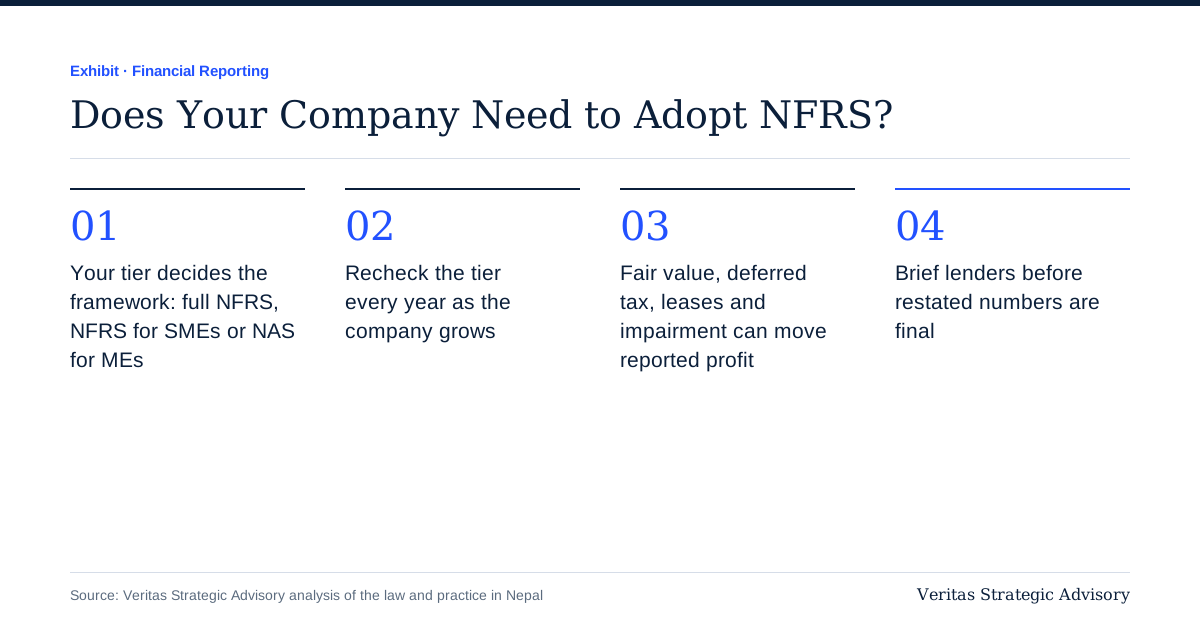
Nepal Financial Reporting Standards (NFRS) are Nepal's adoption of IFRS, issued and phased in by the Institute of Chartered Accountants of Nepal (ICAN). Whether your company must apply full NFRS, the simplified NFRS for SMEs, or the older Nepal Accounting Standards for Micro Entities (NAS for MEs) depends on which category the company falls into, not on preference.
The ICAN roadmap and entity categories
ICAN's Council approved the NFRS roadmap in September 2013, applying it in phases by entity type. The earliest phases covered large listed and state-owned enterprises, then commercial banks, with other regulated and public-interest entities brought in on their own timelines afterward.
For companies outside that first wave, ICAN's framework sorts entities into three broad tiers:
| Tier | Who it covers | Standard applied |
|---|---|---|
| Public Interest Entities (PIEs) | Listed companies, banks, insurers, large corporates, entities with significant public deposits or borrowings | Full NFRS |
| Small and Medium Entities | Entities without public accountability that are above the micro-entity limits set by the Accounting Standards Board | NFRS for SMEs |
| Micro Entities | Within the micro-entity limits (turnover up to about NPR 20 crore, among other conditions in the Accounting Standards Board's notice) | NAS for MEs (simplified, largely cost-based accounting) |
The tier turns on public accountability and on the Accounting Standards Board's size limits, which are revised from time to time, so confirm the current notice. A company can move between tiers as it grows, at which point its reporting framework has to move with it. If your company is a bank, insurer, or listed entity, full NFRS already applies regardless of size. If it does not fall in that first category, public accountability and the size limits above determine the tier, and it is worth checking this annually rather than assuming last year's classification still holds.
What actually changes when you move to NFRS
This is more than a change in accounting policy on paper. The figures in the financial statements themselves change:
Fair value measurement replaces historical cost for certain assets, so a property or investment can be revalued, which affects both the balance sheet and, through revaluation reserves or profit and loss, potentially reported earnings.
Deferred tax is recognised for the first time in many companies, an entry that exists because of timing differences between accounting profit and taxable profit, and which most owner-managed companies have never carried on their books before.
Lease capitalisation brings most leases onto the balance sheet as a right-of-use asset with a matching liability, rather than treating rent as a simple expense, which changes both the balance sheet size and the shape of the profit and loss statement.
Impairment testing requires assets to be reviewed and written down if their recoverable value has fallen, an exercise many companies have not previously performed on a regular basis.
Consolidation becomes a requirement where a parent has control over one or more subsidiaries, producing a single set of group financial statements in place of standalone ones.
The net effect is that reported profit, and the balance sheet itself, can move meaningfully in the year of first adoption, purely from the change in framework, before anything about the underlying business has changed at all.
What management should prepare before starting
Confirm the applicable tier against the ICAN thresholds above, rather than assuming.
Inventory long-term contracts, leases and related-party arrangements, since these are where the largest adjustments typically arise.
Identify assets that may need fair valuation, particularly property, plant and investments carried at historical cost.
Build a first-time-adoption reconciliation, comparing the opening balance sheet under the old framework against the restated opening balance sheet under NFRS, so the board and any lenders understand the transition, not just the end result.
Brief lenders in advance if loan covenants are tied to reported profit, equity or leverage ratios, since those figures can shift on transition even though nothing about the business's cash generation has changed.
A full first-time-adoption exercise typically takes a defined project, not a single closing entry, and is best scoped with enough lead time before an audit deadline forces it. See our NFRS and financial reporting capability for how we scope and run a first-time-adoption project once you have confirmed the transition applies to you.