
- months of fixed costs to fund
- 12
- revenue lines to track separately
- 3
- standard VAT rate
- 13%
- steps in a seasonal cash plan
- 5
Hotels, lodges, resorts and homestays share one financial trait: income arrives in waves, costs do not. A property can look profitable on its annual statement and still miss a salary run in the lean months. This guide sets out how an owner or finance manager can plan for that pattern, handle VAT correctly on guest bills, and keep records that stand up under NFRS and in front of a bank or tax office. It is general information for Nepali hospitality businesses; the numbers in the worked example are illustrative.
Why does a hotel run short of cash in the lean months?
Because most costs are fixed and most revenue is seasonal. In Nepal, trekking and tourist demand clusters around the autumn and spring windows, with domestic demand around festivals and holidays. Between those windows occupancy can fall sharply. Meanwhile the following keep running:
Salaries and staff benefits. Dismissing and rehiring trained staff each season is costly, so most properties carry the team year-round.
Loan instalments and interest. A bank does not reduce the instalment because the season is quiet.
Utilities, maintenance and licences. Electricity, water, repairs, insurance and renewals are due regardless of occupancy.
Pre-season spending. Repainting, linen, kitchen stock and marketing must be paid before the guests arrive, which means cash leaves before it comes in.
The result is a cash curve that rises fast in peak months and sinks below zero in the lean ones unless the peak surplus is deliberately held back.
How do you build a seasonal cash plan in five steps?
List twelve months of fixed costs. Salaries, loan service, utilities, insurance, licences, and a normal maintenance allowance. This is your monthly "survival number".
Forecast revenue by month, not by year. Use your own occupancy history by month and the average room rate. If you are new, build three cases: weak, expected and strong, and plan on the weak one.
Chart the running balance. Subtract costs from revenue month by month and carry the balance forward. The lowest point of the line is the cash you must have in reserve before the lean season begins.
Set aside the reserve from peak months. Move a fixed share of peak receipts into a separate account labelled as the lean-season reserve, so it is not spent on expansion or distributions.
Review the forecast monthly. Replace forecast with actual, update the next six months, and decide early whether you need an overdraft or a repayment holiday, not in the month the cash runs out.
A worked example (illustrative figures)
The numbers below are made up to show the method. They are not benchmarks for any property.
| Item | NPR |
|---|---|
| Fixed monthly costs (staff, loan service, utilities, upkeep) | 12 lakh |
| Fixed costs for 12 months | 1.44 crore |
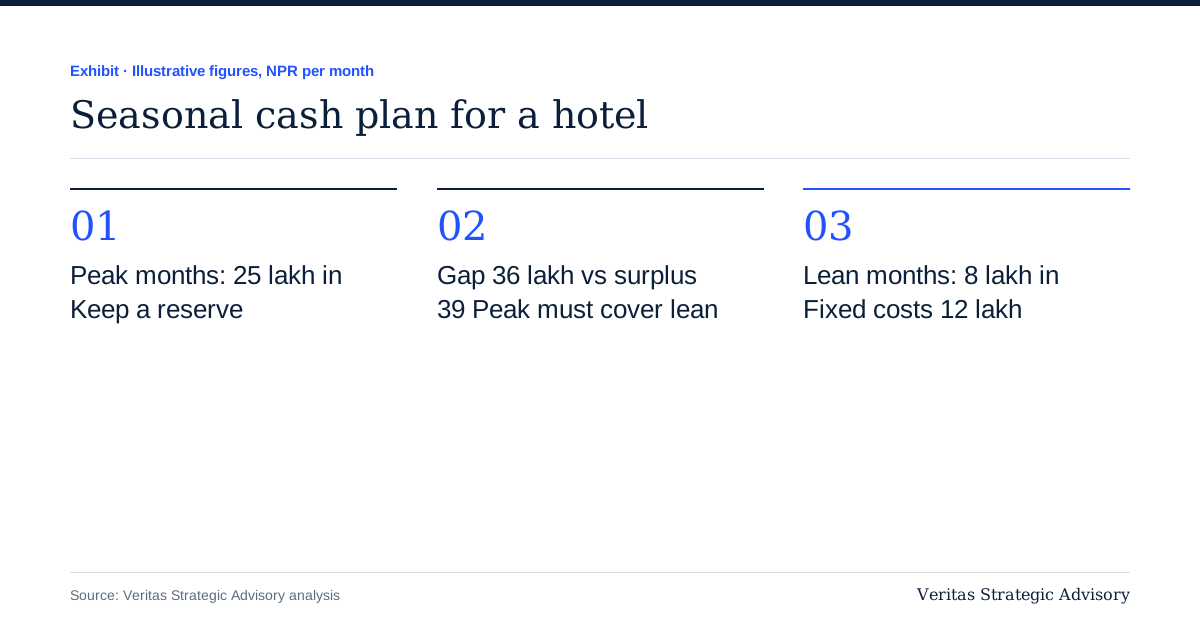
| Revenue in three peak months (average) | 25 lakh per month |
| Revenue in nine other months (average) | 8 lakh per month |
| Total annual revenue | 1.47 crore |
On paper the year is close to break-even. But in each of the nine other months the property is 4 lakh short, a gap of 36 lakh in total, while the three peak months produce a surplus of 13 lakh each, 39 lakh in total. The peak surplus covers the lean-season gap only if it is actually kept. If 15 lakh is withdrawn or spent in the peak, the property is short in the lean months and must borrow at a time when the bank sees weak turnover.
How does VAT work on hotel and restaurant bills?
The standard VAT rate in Nepal is 13% under the Value Added Tax Act, 2052, and it applies to hotel accommodation and restaurant sales for registered businesses. Check the current Finance Act and IRD notices for any change in the rate or threshold that applies to your registration. Three practical points matter for hotels.
Price to include VAT. Reporting by the Kathmandu Post on court rulings about bills describes a Supreme Court decision annulling the mandatory 10% service charge, with hotels and restaurants told to show menu prices that already include VAT rather than adding it on the bill. Read the current position with your adviser before changing menus, but the direction is clear: the price a guest sees is the price a guest pays.
Check what your margin looks like at the inclusive price. If a room is listed at NPR 5,000 inclusive, the taxable value is not 5,000. Divide by 1.13 to get the VAT-exclusive sales value; the rest is VAT you must pay over to the IRD. Owners who quote an inclusive price but record the whole amount as revenue overstate income and understate their VAT liability.
Keep input VAT claims clean. VAT paid on purchases such as food stock, linen, furniture and maintenance may be claimed against output VAT if you hold valid tax invoices in the business's registered name. Missing or incorrectly addressed invoices are the usual reason a claim is reduced. Our guide to VAT return filing and the monthly deadline sets out the monthly routine, and the VAT registration guide covers who must register.
If your bar sells liquor, that is a separate regime from VAT: a liquor-selling licence, excise stamps on the bottles you hold, and the rules on where and to whom you can sell. See our excise duty FAQ for the licensing and stamp rules that apply on top of your VAT registration.
Why separate room, food and event revenue?
A hotel is really three businesses under one roof, and each behaves differently:
| Revenue line | Cost behaviour | What to watch |
|---|---|---|
| Rooms | Mostly fixed; low cost per extra guest | Occupancy and average room rate by month |
| Food and beverage | Variable; stock, wastage, kitchen labour | Gross margin on each menu, wastage, stock count |
| Events, banquets, tours | Lumpy, deposit-driven | Advance deposits received, cancellation terms, direct costs |
Tracking them separately tells you which line carries the property and which one quietly loses money. It also supports better VAT records, because bookings, advance receipts and package prices can be allocated properly instead of lumped into one figure. Advance deposits deserve special care: money received for a future event is not yet earned revenue and should not be treated as free cash for running costs.
What does NFRS mean for a hotel?
Nepal Financial Reporting Standards (NFRS), issued by the Accounting Standards Board and based on IFRS, require entities that fall within their scope to prepare accounts on the accrual basis. The NFRS applicability guide explains who is in scope. For a hospitality business in scope, the practical effects are these:
Revenue is recognised when the service is delivered, not when the booking or advance is paid. A deposit for a December wedding is a liability in October.
Property and equipment are depreciated over their useful lives, and major refurbishment may need to be capitalised rather than expensed. Separate day-to-day repairs from improvements.
Loans are measured and disclosed properly, including interest accrued but unpaid at year end.
Inventory (food, beverage, consumables) is counted and valued at the reporting date, and slow or spoilt stock is written down.
Staff obligations such as accrued leave and gratuity are provided for as they build up.
Even a property that is not in NFRS scope benefits from accrual records, because lenders and investors increasingly ask for them. Our NFRS reporting capability page explains how we support this work.
Which numbers should the owner see every month?
A one-page monthly pack is enough. Include:
Occupancy rate, average room rate and revenue per available room.
Revenue by line: rooms, food and beverage, events.
Food cost as a percentage of food sales.
Payroll as a percentage of revenue.
Cash balance, receivables and loan instalments due in the next three months.
VAT payable or refundable for the month and the filing date.
Our guide to what a monthly management report should include gives a fuller layout. If you are planning a bank loan, see how lenders read your numbers in bank loan or investor: which is right.
Questions hotel owners ask
Can a seasonal hotel get a loan with uneven cash flow?
Yes, but lenders look at the annual cash flow and the lean-season low point. A repayment schedule that follows the season, and a documented cash forecast, make the request easier to assess.
Should advance booking money be treated as revenue?
No. It is a customer advance until the stay or event happens. Recording it as revenue early inflates profit and can create a VAT mismatch.
Do homestays and small lodges need to register for VAT?
It depends on turnover and the thresholds in force. Check the current Finance Act and IRD guidance, or ask us; see the VAT registration guide.
How big should the lean-season reserve be?
At least the lowest point of your running balance in the weak case, plus a margin. The five-step plan above shows how to find that number.
Is a hotel's income tax treatment different from other businesses?
Tourism businesses have in the past received specific concessions through the Finance Act, and these change year to year. We do not quote a rate here; confirm what applies to your registration for the current fiscal year before relying on any concession.
How Veritas can help
We help hospitality owners build the monthly cash forecast, tidy VAT and revenue records, and prepare lender-ready accounts. We provide audit support and assistance to your statutory auditor, not the audit itself. Start with our business performance capability or contact us.
General information only, not advice.