
The short version
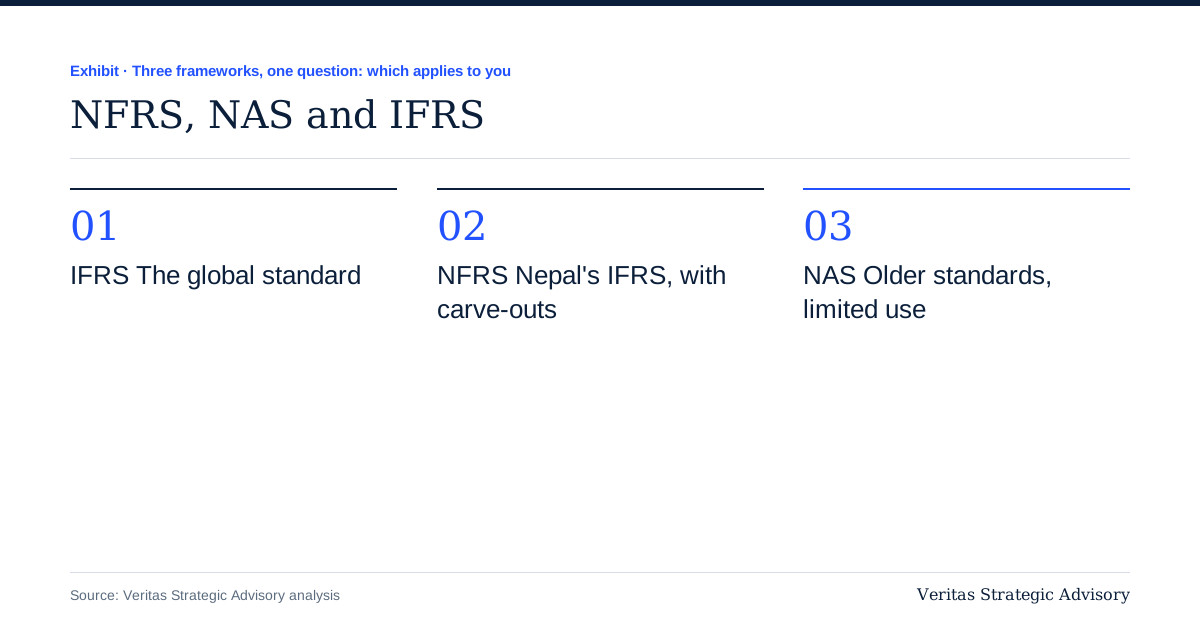
NAS (Nepal Accounting Standards) is the older framework, based on earlier international standards and still applied by entities outside the NFRS regime, including not-for-profit organisations under NAS for NPOs.
NFRS (Nepal Financial Reporting Standards) is the converged framework, developed from IFRS by the Accounting Standards Board, Nepal.
IFRS is the international standard itself, issued by the IASB.
NFRS is converged with IFRS. Converged is not identical.
Where NFRS departs from IFRS
Two sources of difference.
Carve-outs. The Accounting Standards Board issues permitted departures from the converged text, usually because applying the standard as written would conflict with local regulation or with market conditions in Nepal. The most significant concerns impairment of loans and advances for banks and financial institutions, where the measurement interacts with Nepal Rastra Bank's provisioning norms.
Timing. IFRS amendments are issued continuously. NFRS adopts them on its own cycle, so at any given moment the Nepali text may sit behind the international one. A standard amended by the IASB last year may not yet be effective here.
Why this matters commercially
Three situations where the gap becomes real:
A foreign investor asks for IFRS accounts. Your NFRS statements are not automatically compliant. The difference has to be identified, quantified where material, and explained. The explanation is usually short. Not having prepared it makes it look longer.
A parent company consolidates you. A foreign parent reporting under IFRS needs a reporting package on its basis, not yours. Where a carve-out applies to your figures, the group auditor will ask for the adjustment.
A lender works to international covenants. Covenant definitions written against IFRS numbers do not automatically read across.
Where NAS still applies
NAS has not disappeared. Entities outside the NFRS regime continue under it, and not-for-profit organisations apply NAS for NPOs, which is a distinct framework built around fund accounting and restricted contributions rather than a simplified version of the company standards.
The practical error is assuming everything has moved to NFRS. It has not, and applying the wrong framework produces financial statements that are wrong rather than merely differently presented.
The question to ask
Not "which standard do we follow" but "who reads these accounts, and what do they need them to be on."
If the answer includes anyone outside Nepal, the difference between converged and identical is worth understanding before year end rather than during it.
Which framework applies to whom
In broad terms, three groups of Nepali reporters sit under different frameworks, and mixing them up is the most common basic error:
Entities with public accountability (listed companies, banks and financial institutions, insurers and similar) report under full NFRS, converged with full IFRS.
Other companies may apply the simplified framework for smaller entities, converged with IFRS for SMEs, where they are eligible. It has far fewer disclosures and some simplified measurement.
Not-for-profit organisations apply NAS for NPOs, a separate framework built around fund accounting.
Eligibility turns on public accountability, size and the regulator's requirements, and it changes as thresholds and notices are revised. Confirm the current position with the Accounting Standards Board and ICAN before you choose, and re-test it every year.
Where a "compliant" set of NFRS accounts still needs bridging
Even when your accounts are correctly prepared under NFRS, an international reader may still need adjustments. Five places to look first:
Carve-outs. Any departure the ASB has permitted from the converged text. A reader asking for full IFRS needs the figure on the IFRS basis, so each carve-out you rely on must be quantified.
Effective-date lag. A standard amended in the IFRS Accounting Standards stream may not yet be effective in the NFRS stream. Maintain a short log of each international amendment and its local status.
Presentation and disclosure. Wording that claims compliance is a legal-style assertion. You may state compliance with IFRS only if you have complied with *all* the requirements of every standard. A note saying "prepared in accordance with NFRS" is accurate. A note saying "in accordance with IFRS" on the same numbers may not be.
Regulator overlays. Banks and insurers often report to a regulator on a basis that departs from the accounting framework. Keep the regulatory basis and the accounting basis visibly separate.
Judgements applied locally. Where NFRS leaves room for judgement (useful lives, impairment triggers, ECL overlays), a foreign group may require its own parameters for consistency.
Building the bridge
When a parent, lender or investor asks for IFRS-basis numbers, a structured bridge is faster, cheaper and more credible than a rework:
Gap analysis. Compare your accounting policies standard by standard with the current IFRS text. Most gaps are disclosure, not recognition.
Quantify what is material. For each carve-out or lag, estimate the effect on profit and on equity. Ignore what is clearly immaterial, but record why.
Reconcile. Present profit and equity under NFRS, each adjustment, and profit and equity under IFRS. One page, adjustments labelled.
Agree it with the reader early. A parent's group auditor will say whether they want a reporting package, a reconciliation or fully re-stated statements.
Keep it alive. Roll the bridge forward each year instead of rebuilding it.
First-time IFRS adoption is a separate exercise
A Nepali company that must produce its *own* statements, as opposed to a package, under IFRS for the first time is a first-time adopter of IFRS in its own right. That brings the transition-date and comparatives mechanics described in our guide to first-time NFRS adoption, and the framework you used before is treated as the previous framework. It is a project, not a footnote.
Questions to ask before the next year end
Who outside Nepal reads, or may read, our accounts: a parent, a lender, a development finance institution, a buyer?
Which of our figures depend on a carve-out or a locally permitted treatment?
Is there an international amendment that is already in force abroad but not yet here?
Do our notes claim more compliance than we have achieved?
If someone asked tomorrow for IFRS-basis profit and equity, how long would it take us?
Building and maintaining that bridge is part of the wider work covered in our NFRS services: statements, policies and the reconciliation a group auditor or lender abroad will ask for.

---
*Reviewed by Roshan Bhattarai, Strategic Advisory Lead, September 2026. Confirm the current position with ICAN, as carve-outs and effective dates are revised.*