The published guidance is accurate and almost unreadable: the authoritative source is a set of PDFs on the ICAN website written for people who already know the answer.
This is the readable version.
Does NFRS apply to you
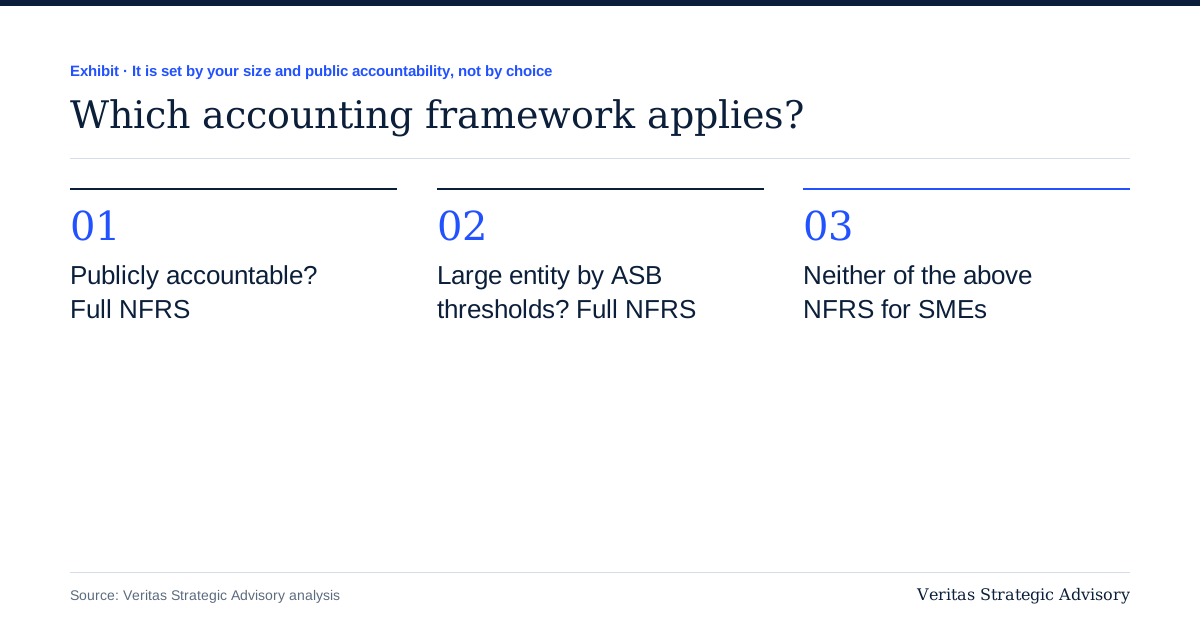
If your company is publicly accountable, yes. Publicly accountable means, broadly, that you hold assets in a fiduciary capacity for a broad group of outsiders, or your debt or equity instruments are traded in a public market. In Nepal that captures listed companies, banks and financial institutions licensed by Nepal Rastra Bank, insurance companies, and entities whose securities are publicly traded.
If you are a large entity by the thresholds set by the Accounting Standards Board, full NFRS applies whether or not you are publicly accountable.
If you are neither, you are almost certainly applying NFRS for SMEs, and a smaller entity may fall under the reduced regime below that. Not-for-profit organisations apply NAS for NPOs, which is a separate framework and not a simplification of the others.
The consequence people miss: this is not a choice. A company that applies NFRS for SMEs when full NFRS applies has misstated financial statements, not a differently presented set.
The three frameworks, and what actually differs
Full NFRS is the converged version of IFRS. Fair value measurement runs through it, disclosures are extensive, and the standards that cause most of the work are financial instruments, leases, employee benefits and deferred tax.
NFRS for SMEs is a self-contained standard, not a cut-down NFRS. It permits cost-based measurement in places where full NFRS requires fair value, removes most of the option-heavy choices, and reduces disclosure sharply. For a mid-sized trading or manufacturing company, the practical difference at year end is measured in weeks.
NAS for NPOs addresses fund accounting, restricted contributions and the things a charity does that a company does not.
The error we see most often is a growing company that outgrew NFRS for SMEs two years ago and nobody re-tested the threshold.
Nepal's carve-outs
This is where Nepal departs from IFRS, and it is the part least visible outside ICAN's own documents.
A carve-out is a permitted departure from the converged standard, issued by the Accounting Standards Board and applied for a defined period. Carve-outs exist because applying a standard as written would produce an outcome that conflicts with local regulation or with the state of local markets.
The most significant concerns NFRS 9 and impairment for banks and financial institutions. Rather than applying the expected credit loss model in full, financial institutions registered under the Bank and Financial Institution Act measure impairment on loans and advances at the higher of the amount derived under Nepal Rastra Bank's loan loss provisioning norms and the amount under the carve-out. The effect is a regulatory floor under the accounting number.
Two things matter about carve-outs generally:
They are time limited, and they get extended. A carve-out that applied last year may or may not apply this year. Check the current position rather than the one you learned.
They change the comparison with IFRS. A set of NFRS financial statements is not automatically IFRS-compliant, which matters when a foreign investor or lender asks for IFRS numbers.
What changes when NFRS applies
In rough order of how much work each creates:
Financial instruments. Classification and measurement, and impairment on receivables. Businesses that have never provisioned systematically feel this first.
Leases. Arrangements previously expensed as rent come onto the balance sheet as a right-of-use asset and a lease liability. This moves EBITDA and gearing, which matters if you have bank covenants written against them.
Employee benefits. Gratuity and leave encashment require actuarial measurement rather than a management estimate.
Deferred tax. Recognised on temporary differences rather than timing differences, which usually increases the number of items in scope.
Revenue. Recognition against performance obligations rather than against invoicing.
Each of these can change reported profit without anything changing in the business. Explaining that to a board is part of the work.
First-time adoption
Adoption is not a change applied from the start of the current year. It requires:
a transition date, being the beginning of the earliest comparative period presented
a restated opening balance sheet at that date
restated comparatives for the prior year
reconciliations of equity and of profit or loss between the previous framework and NFRS
In practice the opening balance sheet is the task. Everything else follows from it, and it is where adoption projects overrun, because it requires information about past transactions that nobody collected at the time.
Start it before the year end you intend to report under, not after.
Questions people ask
Does NFRS apply to a private limited company?
It depends on size and on public accountability, not on the form of the company. A large private company can be inside full NFRS, and a small one will normally apply NFRS for SMEs.
Is NFRS the same as IFRS?
It is converged with IFRS but not identical, because of the carve-outs. Where a lender or investor asks for IFRS statements, the carve-outs are the difference you have to explain.
Who decides which framework applies?
The Accounting Standards Board sets the framework and ICAN's pronouncements govern application. Your auditor will apply that determination; they do not set it.
We applied NFRS for SMEs and have now grown. What happens?
You move to full NFRS, with a transition date, a restated opening balance sheet and restated comparatives. It is a first-time adoption exercise, and it is easier if the move is anticipated rather than discovered during the audit.
Can we choose full NFRS voluntarily?
Yes, and companies preparing for investment or a listing sometimes do. Understand that it is a one-way decision in practice.
---
*Reviewed by Roshan Bhattarai, Strategic Advisory Lead, September 2026. Carve-outs are time-limited and are revised by the Accounting Standards Board. Confirm the position currently in force with ICAN before relying on it. This is general guidance, not advice on your circumstances.*
For a practical walk-through of how we support NFRS statements, policies and first-time adoption, see our NFRS reporting services.
Related: Construction contractors: contract accounting, retention money and TDS How long-running contracts are recognised over time under NFRS 15, and how retention money should be treated.