
That predictability is useful: it means the file can be built before fieldwork starts, and fieldwork then costs you days rather than weeks.
Before the auditor arrives
Accounting policies, written down. Not the disclosure note. The internal document recording what you chose, which options under the standard you took, and why. An auditor asking why a policy was applied is not challenging you; they are testing whether a decision was made.
Judgements, with reasoning and date. Under NFRS the significant ones are usually: lease terms and whether renewal options are reasonably certain, the discount rate used, expected credit loss assumptions, useful lives, and any fair value inputs. Record the reasoning when the judgement is made. Reconstructing it eight months later is the single most wasteful activity in a year-end close.
Actuarial report for employee benefits. Gratuity and leave encashment need actuarial measurement. Commission it early; actuaries are busy at the same time every year for the same reason.
Lease schedule. Every lease, with term, payments, options, discount rate, and the resulting right-of-use asset and liability. Include the contracts you concluded were *not* leases and why.
Expected credit loss workings. The model, the inputs, the historical loss data supporting it, and the reasoning where management overrode the output.
Fixed asset register at component level, with useful lives and the basis for them.
Deferred tax computation reconciled to the temporary differences in the restated figures.
Related party listing, complete. This generates more late queries than its size justifies.
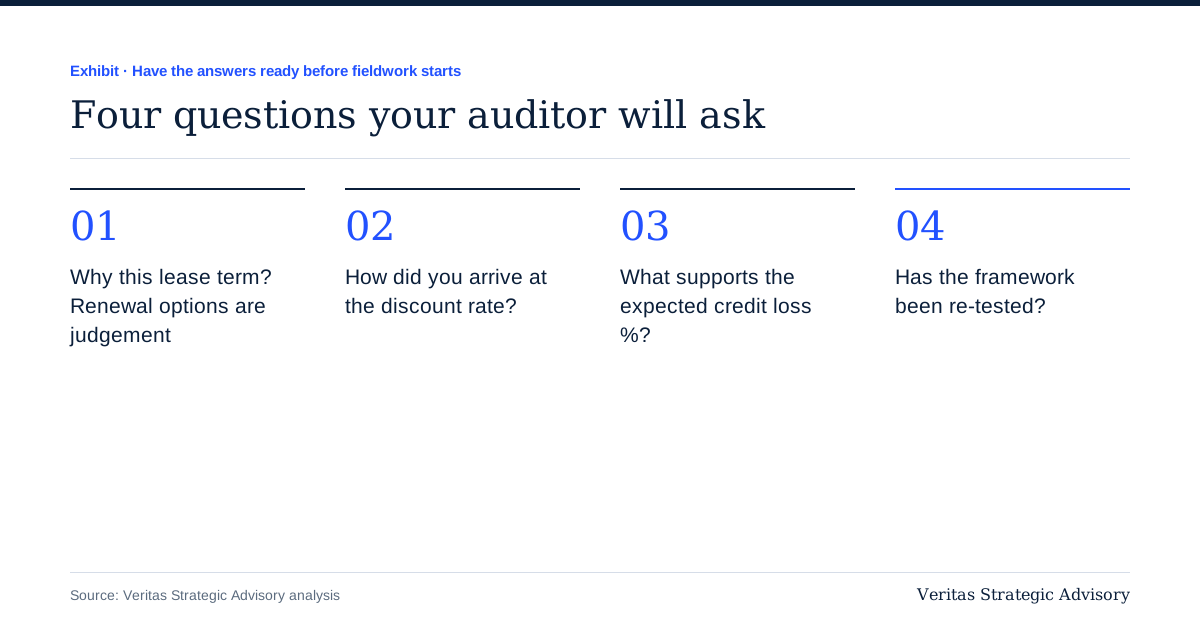
The four questions that come up every time
"Why this lease term?" Because renewal options are judgement and judgement needs a reason.
"How did you arrive at the discount rate?" An incremental borrowing rate needs a derivation, not an assertion.
"What supports the expected credit loss percentage?" Historical data, adjusted for forward-looking information. A round number with no working behind it will be challenged.
"Has the framework been re-tested?" Whether you still fall where you fell last year. Growing companies cross thresholds without noticing.
What separates a clean audit from a slow one
Not accuracy. Both companies get to the same numbers eventually.
The difference is whether the reasoning existed before the question was asked. A file where each judgement carries a short contemporaneous note closes quickly. A file where the numbers are right but the reasoning lives in someone's memory generates a fortnight of queries and a management letter point about documentation.
If your auditor raises the same points every year
That is a signal about the process, not the accounting. The same recurring point usually means a judgement that is being remade informally each year rather than documented once and reviewed. Fixing it is a half-day exercise that removes a recurring annual cost.
A readiness timetable
The checklist above is easier to run against a calendar. Counting back from the date the auditor starts fieldwork:
Ninety days before. Confirm the framework and the reporting entity. Confirm the list of significant judgements and who owns each. Commission the actuary. Ask for the auditor's request list now and agree the format.
Sixty days before. Lock the accounting policy document. Update the lease schedule, the fixed asset register and the expected credit loss model on year-end data. Draft the related party list from the ledger and from the board's own knowledge, not only from the ledger.
Thirty days before. Complete the trial balance. Reconcile every bank account, control account and inter-company balance. Prepare the deferred tax computation and tie it to the restated balances. Prepare confirmations: bank, receivables, payables and legal.
Two weeks before. Draft the financial statements and notes, with a disclosure checklist completed against them. Prepare the going-concern assessment. Prepare the draft management representation letter.
Fieldwork. One named contact, one shared folder, one log of questions with owner and due date. Answer in the order the auditor works, not the order you find easiest.
What the auditor is really testing
Behind each query sits a risk the auditor has to address. Knowing which one lets you answer the question that was meant.
Revenue. Cut-off, and whether income is recognised at the right point. Be ready with contracts, delivery evidence and credit notes either side of the year end.
Inventory. Existence and valuation. A count sheet, a cut-off test and a net realisable value review for slow lines.
Receivables. Recoverability. Ageing, subsequent receipts and the reasoning behind each provision.
Management override. The auditor will look at journals posted late, manually or by senior staff. Have a journal approval trail.
Going concern. A short, honest assessment of cash, covenants and commitments for at least twelve months from the signing date.
Related parties. Completeness. They always ask, and the answer must not appear piecemeal.
Subsequent events. What happened after the year end up to signing, and whether it needs adjustment or disclosure.
Documents that save the most time
The disclosure checklist, completed. Every disclosure in the standards either supplied, or marked not applicable with a reason.
A tie-out file. Each figure in the statements referenced to a working, and each working to a ledger.
Board minutes approving the accounting policies, significant judgements, related party transactions and the going-concern basis.
Contracts, in one place: loan agreements and covenant calculations, leases, customer and supplier terms with unusual clauses, and any guarantees given.
Legal and tax correspondence: open IRD matters, notices and outstanding assessments, with management's view on each.
Common ways a file stalls
Opening balances do not agree to last year's signed accounts, usually because of post-closing adjustments that were not carried forward.
A judgement is remade informally each year, so the auditor sees a different answer without a reason.
Estimates change without a note. A change in useful lives or in a credit loss percentage is a change in estimate and is disclosed, with the effect.
Evidence exists but sits in one person's inbox.
Management sees the draft statements for the first time at the closing meeting. Give the board the draft earlier than that.
Management letter points are a free lesson
Whatever the auditor writes in the management letter is a list of what to fix before next year. Treat each point as an item with an owner and a date, and review the list at the first board meeting after signing. A point that appears two years running means the process, not the accounting, still needs work.

---
*Reviewed by Roshan Bhattarai, Strategic Advisory Lead, September 2026. Veritas does not carry out statutory audit. This is guidance on preparing for one.*
For a practical walk-through of how we support NFRS statements, policies and first-time adoption, see our NFRS reporting services.