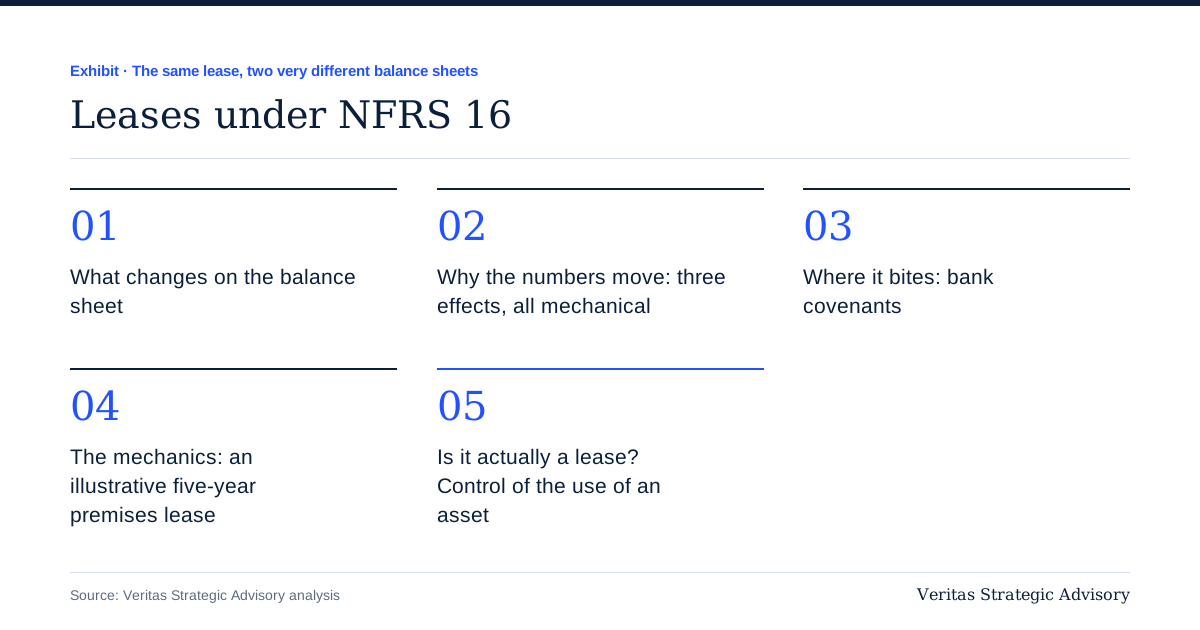
The accounts look materially different.
What changes
Under the old treatment, an operating lease was an expense. Rent was paid, rent was charged to profit, and nothing appeared on the balance sheet.
Under NFRS, a lessee recognises:
a right-of-use asset, being the right to use the asset for the lease term
a lease liability, being the present value of the remaining lease payments
The single rent expense is replaced by depreciation on the asset and interest on the liability.
Why the numbers move
Three effects, all mechanical.
EBITDA rises. Rent used to sit above EBITDA. Depreciation and interest sit below it. The same cash leaves the business and EBITDA improves.
Gearing rises. A liability appears that was not there before.
Profit is front-loaded. Interest is higher in early years as the liability unwinds, so total early-year charges exceed the old straight-line rent, and later years are lower.
A profitable business with long premises leases can show worse gearing and better EBITDA in the same set of accounts, for no operating reason.
Where this actually bites: bank covenants
This is the part worth attention.
Loan covenants written in Nepal are frequently defined against reported figures: a debt-to-equity ratio, an interest coverage ratio, a gearing cap. If those definitions reference the accounts without specifying the framework, adoption can breach a covenant while the business performs exactly as it did the year before.
Banks are generally reasonable about this when told in advance, because the breach is an accounting artefact. They are considerably less reasonable when it surfaces in audited accounts they receive after signature.
Raise it with the bank before the accounts are finalised, not after.
The practical work
Identify every contract that contains a lease. Some are obvious (premises, vehicles). Some are not: a service arrangement that gives you control of an identified asset can be a lease in substance.
Determine the lease term, including whether renewal options are reasonably certain to be exercised. This is judgement, and it drives the numbers.
Select a discount rate. Where the rate implicit in the lease is not readily determinable, an incremental borrowing rate is used, and it should be defensible.
Check the exemptions. Short-term leases and leases of low-value assets can be kept off balance sheet.
Renewal options and the discount rate are where two competent preparers reach different answers. Document the reasoning at the time, because the auditor will ask and memory will not serve.
The mechanics, with numbers
An illustrative five-year premises lease. Rent is NPR 1,200,000 a year, paid at each year end, and the incremental borrowing rate is 12%. These figures are for explanation only.
Day one. The lease liability is the present value of five payments of 1,200,000 at 12%, which is about NPR 4,325,700. The right-of-use asset starts at the same amount (plus any initial direct costs and prepayments, less incentives received). Nothing has been paid and nothing has been expensed, yet both sides of the balance sheet are NPR 4.3 million larger.
Year one. Interest on the liability is 12% of 4,325,700, about 519,100. Depreciation on the asset over five years is 865,100. The total charge is about 1,384,200, against the 1,200,000 of rent that used to be charged. The liability falls to about 3,644,800 after the year-end payment.
Year five. Interest has shrunk to about 128,600. The total charge is about 993,700, below the old rent. Across the five years the charge totals exactly the 6,000,000 of rent paid. Only the timing moves: later years carry less than they used to, earlier years carry more.
EBITDA improves by the full 1,200,000 in every year, because neither depreciation nor interest sits above it. Operating profit improves by the part of rent that is now classed as interest. Profit after interest falls in the early years.
Is it actually a lease?
The standard asks whether a contract conveys the right to control the use of an *identified asset* for a period in exchange for consideration. Three tests do most of the work:
Is there an identified asset? A specified floor, vehicle or machine is. A right to some capacity of a pool of interchangeable assets is not. If the supplier has a *substantive* right to substitute the asset and would benefit from doing so, there is no identified asset.
Do you get substantially all the economic benefits from using it over the term?
Do you direct how and for what purpose it is used?
Contracts that regularly turn out to contain a lease: dedicated warehouse space inside a logistics contract, a generator supplied with a power arrangement, vehicles with a named driver supplier, and telecom tower or fibre capacity that is physically specified. Contracts that usually do not: a licence to occupy shared co-working space with the right to be moved, and a managed service where the supplier chooses the equipment.
Measurement judgements that move the number
Lease term. It runs to the end of the non-cancellable period, plus any renewal period you are *reasonably certain* to take, plus any termination period you are reasonably certain not to use. Significant leasehold improvements, a break penalty that is high compared with the rent, and strategic importance of the site all point towards "reasonably certain". A shop with a fit-out you cannot move rarely has a short term in substance, even if the contract says one year, rolling.
Discount rate. Use the rate implicit in the lease if you can determine it, which lessees usually cannot. Otherwise build an incremental borrowing rate: what you would pay to borrow over a similar term, with similar security, to obtain an asset of similar value. A sensible build-up starts from a recent bank lending rate or quote, and adjusts for term, security and currency. Keep the build-up on file.
Variable payments. Payments that vary with an index or rate (for example an annual escalation tied to inflation) go into the liability at the current index level. Payments that vary with sales or usage stay out and are expensed as incurred.
Remeasurement. The liability is updated when the term changes, an option is exercised or the escalation clause bites. The asset is adjusted by the same amount. Build the schedule so a change is a single input, not a rebuild.
Exemptions. Leases of twelve months or less, and leases of low-value assets (the standard's guidance is built around the new price of the asset, not the rent), may stay as a straight-line expense. Apply the exemption consistently by class of asset and disclose that you have used it.
Tax and disclosure
Tax follows the contract and the tax law, not the accounting entries. The usual result is that tax deducts rent as the contract requires while the accounts charge depreciation and interest, so temporary differences arise and deferred tax has to be recognised on the right-of-use asset and the liability. Confirm the treatment of your lease payments under the Income Tax Act for your own facts.
The notes also change. Expect a maturity analysis of the liability, the depreciation and interest charges by class, the cash outflow for leases, and a statement of any exemptions used.
Mistakes we see
A schedule built from the *rent register* instead of the *contracts*, so embedded leases are missed.
A single discount rate used for every lease regardless of term and currency.
Renewal options ignored because "we haven't decided", when the fit-out and the business plan say otherwise.
Sub-leases overlooked: where you sub-let space you lease in, the sub-lease is assessed against the head lease asset, and the two are accounted for separately.
Nobody telling the lender.
What to do with the covenant
List every facility with a financial covenant and read the definition. Does it say "in accordance with accounting standards as at the date of the agreement", or "as applied from time to time"?
Run the covenant ratios on the new basis in a pro forma, before year end.
If the business breaches or comes close, take the pro forma to the bank. Ask either for the covenant to be defined on the previous basis (frozen GAAP) or for the thresholds to be reset on the new basis.
Get the amendment in writing before the accounts are signed.
If the lease schedule is one piece of a wider first-time adoption or an ongoing reporting cycle, see our NFRS services for how we support the statements, the policies and the covenant conversation together.

---
*Reviewed by Roshan Bhattarai, Strategic Advisory Lead, September 2026. General guidance, not advice on your circumstances.*