

- assessment types under the Act
- 3
- limit for an amended assessment
- 4 yrs
- order and notice
- Sec 101-102
- steps in the right order
- 5
The single most damaging thing a business owner can do after receiving a tax notice is nothing, and the second most damaging thing is to respond immediately without first understanding exactly what has been issued. Both reactions come from the same source: not knowing which of the three assessment types under the Income Tax Act, 2058 the notice actually represents, and therefore not knowing what the legal clock is actually doing.
First, identify which kind of notice this is
The Income Tax Act, 2058 recognises three types of assessment: self-assessment, done by the taxpayer; jeopardy assessment; and amended assessment, the latter two made on the judgment of the tax office. A notice you receive from the tax office will fall into one of the latter two categories, and the correct response is different for each.
Jeopardy assessment. This is issued only in specific, narrow circumstances: where the taxpayer has become bankrupt, is in serious debt, or is going into liquidation; where the taxpayer is about to leave Nepal for an indefinite period; where the person is about to stop the ongoing activity in Nepal for any reason; or where the IRD otherwise considers it appropriate given a genuine risk that tax due will not be collected. A jeopardy assessment is, by design, the tax office moving early because it believes the normal assessment timeline itself is at risk.
Amended assessment. This is far more common in ordinary business practice. The IRD may amend a self-assessed tax return where it has reasonable grounds to do so, following a review, audit, or discrepancy identified in filed returns. Critically, an amended assessment for a given tax period must be made within four years from the due date for filing the return for that period. Outside that four-year window, the IRD cannot ordinarily reopen a period through an amended assessment. The tax officer issues the amended assessment order under Section 101, and the taxpayer is formally notified of it through a notice under Section 102 of the Act.
Knowing which type you have received changes everything about the urgency and the strategy: a jeopardy assessment usually signals the tax office believes there is a live risk to collection and moves fast; an amended assessment is a more structured process with defined review and appeal channels, and the four-year limitation itself can be a valid ground of challenge if the tax office has stepped outside it.
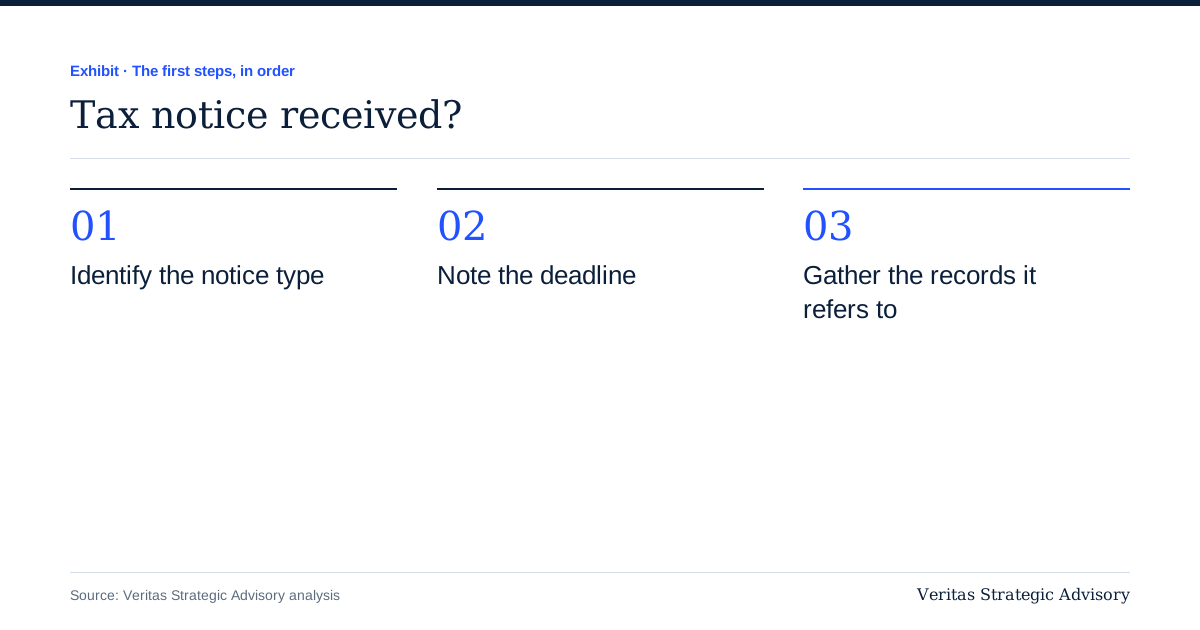
The first five steps, in order
1. Read the notice completely before doing anything else. Identify the tax period covered, the specific adjustment being made (income reclassified, an expense disallowed, a deduction disputed), the assessed amount, and, most importantly, the response deadline stated on the notice itself. Missing a stated deadline can close options that would otherwise have been available.
2. Verify the notice is procedurally valid. Check that it is issued under the correct section, that it identifies the correct tax period, that the period actually falls within any applicable statutory limitation, and that it was served through a valid channel. A notice issued outside the four-year amended-assessment window, for example, is a procedural point worth raising immediately, not discovering later.
3. Gather the underlying records for the period in question, not just the return itself: sales and purchase ledgers, bank statements, supporting invoices for any disputed expense or deduction, and any correspondence already exchanged with the tax office on the same issue. The strength of any response rests entirely on how completely and quickly this evidence can be assembled and reconciled against what the notice claims.
4. Prepare a substantive, technical response, not a general objection. A response that engages with the specific legal and factual basis of each adjustment, citing the relevant provision and the supporting documentation, carries far more weight at the administrative review stage than a general statement of disagreement, and sets up a stronger position if the matter proceeds further.
5. Track every deadline in the appeal chain from this point forward. If the position is not accepted at the first response, Nepal's tax procedure provides for administrative review and then appeal to the Revenue Tribunal, each with its own filing window. Missing any one of these deadlines can forfeit the right to escalate, regardless of how strong the underlying technical position is.
What businesses most often get wrong
Responding emotionally instead of technically. A notice citing a large assessed figure is alarming, but the assessed figure is frequently a starting position built from an incomplete review, not a final number; a well-documented response often reduces it substantially.
Assuming silence is safer than a response. It is not. Failing to respond within the stated window generally allows the assessment to stand, closing off the administrative review option that a timely response would have preserved.
Treating every notice as an emergency requiring immediate settlement. An amended assessment inside a normal review cycle and a jeopardy assessment reflecting an urgent collection risk call for genuinely different postures; conflating them leads either to unnecessary panic or, worse, dangerous complacency.
Not checking the limitation period. A notice attempting to amend a period outside the four-year window from the original filing due date is vulnerable on that basis alone, and this is one of the first things worth checking, not the last.
Preparing before a notice ever arrives
The strongest position in any tax dispute is one built before the dispute exists: a tax health check that reviews VAT, TDS, and income tax positions against the underlying records well before year-end catches most of the issues that later turn into assessments. See our companion piece on tax health check: 15 things every business should review for that preventive process.
How Veritas supports a live assessment
We unbundle the assessment line by line, rebuild the reconciliation against your actual records, and build the technical and factual position for administrative review or appeal. See our IRD tax assessment defence service for how this engagement works from the day a notice arrives through to resolution.
Frequently asked
How much time do I actually have to respond?
The exact number of days is stated on the notice itself and varies by the type of notice and the stage of the process; the first and most important step is to read that specific deadline, not to assume a standard number.
Can an old tax period always be reopened by the tax office?
No. An amended assessment must generally be made within four years of the due date for filing the return for that period; a notice attempting to go beyond that window is worth challenging on that basis specifically.


