- items reviewed
- 15
- areas covered
- 4
- review points a year
- 2
- full review before year-end
- 1
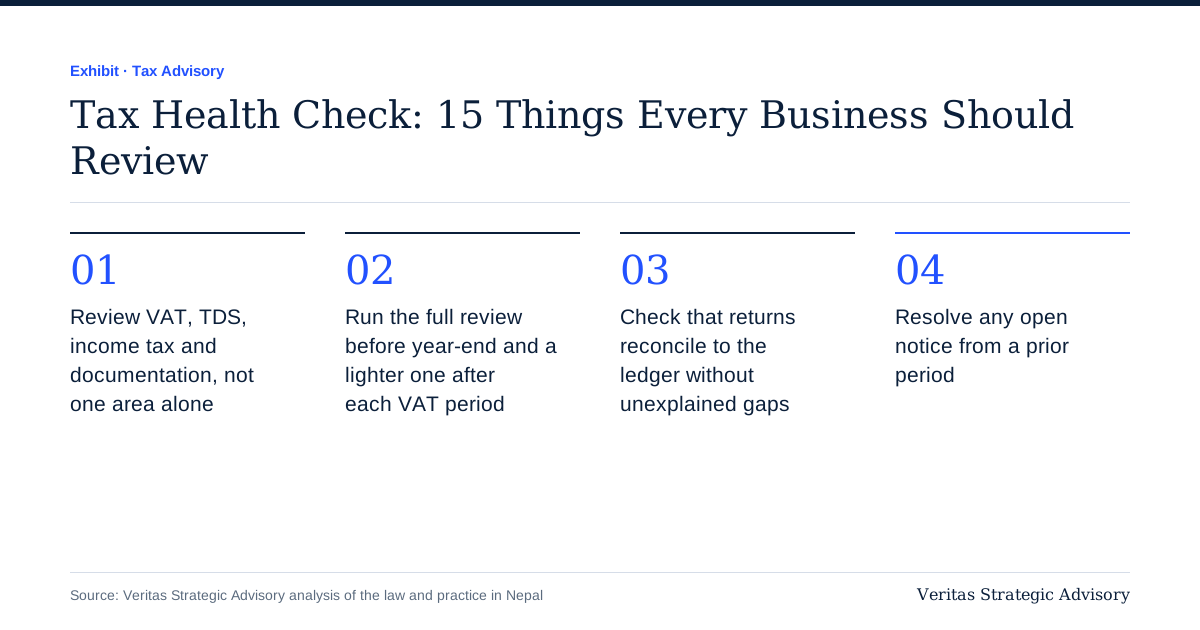
Every tax assessment we have defended started the same way: a position that could have been identified and corrected a year, sometimes several years, before the notice arrived. A tax health check is simply the discipline of finding that same position on your own schedule, with time to correct it, instead of on the tax office's schedule, with a penalty attached. What follows is the review we actually run, organised into four areas.
VAT
1. Output VAT reconciliation. Confirm that VAT charged on every invoice issued during the period reconciles exactly to VAT reported and remitted. A gap here, even a small one, compounds across periods and is one of the first things a VAT audit checks.
2. Input VAT eligibility. Review claimed input tax credits against the categories of expense that are actually eligible, and confirm every claim is backed by a valid VAT invoice bearing the correct PAN and VAT registration details.
3. VAT registration threshold monitoring. For a business approaching the mandatory VAT registration threshold, confirm registration is filed before the threshold is crossed, not after, since late registration itself carries exposure independent of any underlying tax due.
4. Zero-rated and exempt supply classification. Where the business supplies goods or services that are zero-rated or VAT-exempt, confirm the classification is being applied correctly and consistently, since misclassification affects both output VAT and the proportion of input VAT that can be claimed.
TDS
5. TDS deduction rates by payment category. Payments to contractors, rent, professional fees, and commission each carry a different prescribed TDS rate; review a sample of payments across categories to confirm the correct rate was actually applied, not just that TDS was deducted at all.
6. TDS deposit timing. Confirm TDS deducted was deposited to the government within the statutory timeline for each period, since a pattern of late deposit is one of the more common and most avoidable TDS exposures found in a review.
7. TDS certificates issued to payees. Confirm certificates were issued correctly and on time to every party from whom tax was deducted, since disputes with vendors or employees over TDS credit are a frequent, entirely preventable source of friction.
8. TDS on payments to non-residents. Where the business has made any payment to a foreign vendor, consultant, or lender, review whether TDS was correctly withheld and whether any applicable double taxation avoidance treaty provision was correctly applied, an area where errors are common and technically complex.
Income tax
9. Advance tax instalment accuracy. Confirm advance tax instalments through the year were calculated against a realistic estimate of annual taxable income, not a stale prior-year figure, since a significant shortfall against the final liability can itself trigger interest exposure.
10. Disallowable expense review. Review the expense ledger for items that are commonly disallowed for tax purposes, personal expenses run through the company, entertainment beyond permitted limits, or expenses without adequate supporting documentation, before they are claimed in the return rather than after an assessment disallows them.
11. Depreciation schedule accuracy. Confirm the depreciation claimed matches the prescribed rates and asset pooling method under the Income Tax Act, and that assets disposed of during the year have been correctly removed from the pool.
12. Related-party transaction pricing and disclosure. Review whether transactions with related parties, group companies, or the owner personally are priced on an arm's-length basis and correctly disclosed, an area of increasing scrutiny and the subject of transfer pricing rules where the relationship crosses a threshold of significance.
Documentation and process
13. Supporting documentation completeness. For every material deduction, expense, or credit claimed, confirm the underlying invoice, contract, or agreement actually exists, is properly dated, and is retrievable, not simply that the amount appears correctly in the ledger.
14. Reconciliation between management accounts and filed returns. Confirm the figures in the filed VAT, TDS, and income tax returns tie back to the management accounts and the general ledger without unexplained gaps, since a mismatch here is one of the first things a review or audit will surface.
15. Prior notices and unresolved positions. Review whether any prior tax notice, query, or partially resolved position from an earlier period remains open, since an unresolved item from a previous year is exactly the kind of gap a future assessment will reopen. If a review turns up a position that relies on structure rather than substance, test it against our note on where tax planning ends and avoidance begins.
When to run this
The highest-value time to run a tax health check is before year-end closing, while there is still time to correct a position within the same tax period rather than after the return has already been filed. A second, lighter review immediately after each VAT filing period catches smaller issues before they compound. Running the full review only once a notice has already arrived means correcting from a defensive position instead of a planned one. See our companion piece on your company received a tax notice: what to do first for what happens once that defensive position becomes necessary.
How Veritas runs this review
We run this checklist against your actual filed returns and underlying ledgers, not against a generic template, and flag exactly which items need correction before the next filing or year-end close. See our tax advisory and compliance service for how a structured health check is scoped and delivered.
Frequently asked
How often should this be done?
At minimum once a year, well before year-end closing; a business with more complex operations, multiple revenue streams, related-party transactions, or recent growth benefits from a lighter quarterly check as well.
Does a clean health check guarantee no future assessment?
No review eliminates the possibility of a future notice entirely, since the tax office can query any period within the statutory limitation window. What a proper health check does is ensure that, if a query does arrive, the position is already documented, correct, and defensible, which is the single biggest factor in how quickly and cheaply such a matter is resolved.
Related: does the income heading change your tax? A reclassification review.