Those prices are transfer prices, and they decide which country gets to tax the profit.
That is why tax authorities care. The price is set by people who sit on the same side of the table, so nobody is negotiating it down.
The one idea everything rests on
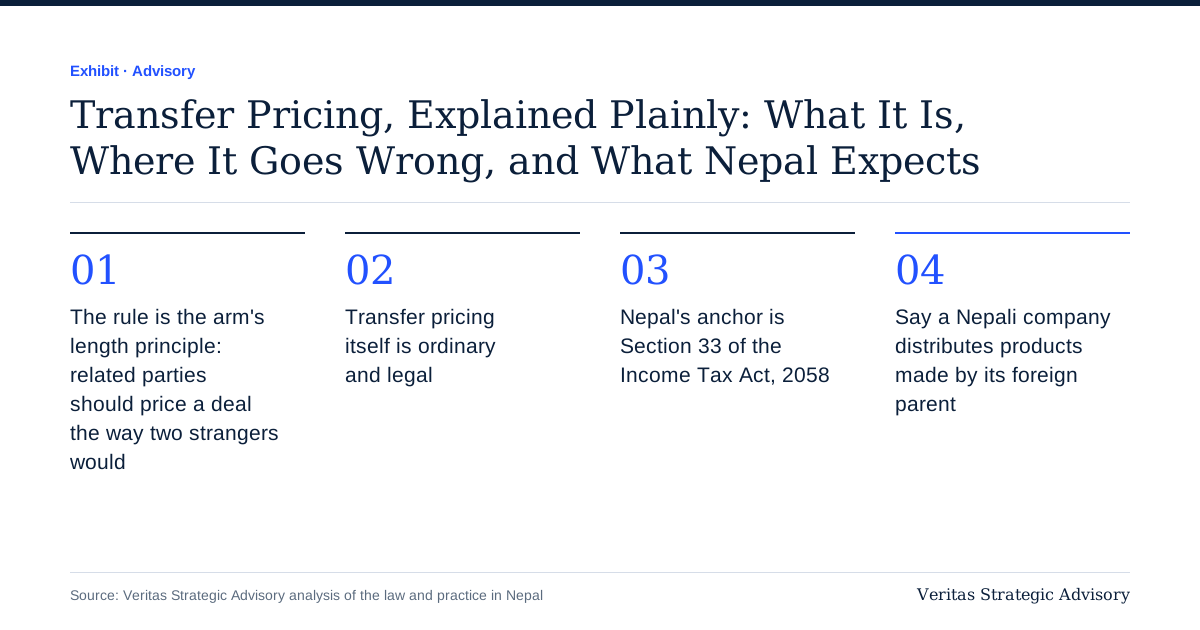
The rule is the arm's length principle: related parties should price a deal the way two strangers would. If an independent buyer would pay 150 for a product, selling the same product to your own subsidiary for 100 moves profit out of the seller's country without any commercial reason.
Getting to an arm's length price is a three-part exercise, and it is worth doing in this order:
Functional analysis. Who does what, who carries which risks, who owns which assets? A company that only assembles to order is not the same as one that designs, funds and bears the market risk.
Pick the method that fits the transaction.
Benchmark against independent transactions or companies, then write the whole thing down.
The five methods, in human terms
Comparable uncontrolled price (CUP). Find the same thing sold to an unrelated party and use that price. Cleanest method, but it needs genuinely comparable goods. Works for commodities.
Resale price. Start from what a distributor charges its end customer and subtract a normal distributor margin. Suits pure resellers.
Cost plus. Take the supplier's cost and add a markup that comparable independents earn. Suits contract manufacturing and routine services.
Transactional net margin (TNMM). Compare the net profit margin on the related-party business with what comparable independents earn. The workhorse in practice, because margins are easier to compare than individual prices.
Profit split. Pool the profit from a tightly integrated activity and divide it by each side's real contribution. Used when both sides bring something unique.
No method is "best". The skill is matching the method to the facts and being able to defend why.
Where it goes wrong
Transfer pricing itself is ordinary and legal. The trouble is the handful of patterns that regulators look for:
Intangibles parked offshore. Brand or technology sits in a low-tax entity, and operating companies pay royalties to it. Hard to challenge because unique intangibles have no obvious market price.
Management and service fees that are large, vague, or paid for support nobody can show was delivered.
Heavy related-party debt. The local company is funded with loans instead of equity, so interest deductions shrink local profit.
Goods bought dear or sold cheap to affiliates in lower-tax places.
Permanent losses in a local entity while the group as a whole does well. Authorities ask a fair question: would an independent company keep operating at a loss for years?
The famous European cases (Apple, Starbucks, Amazon and others) were variations on these themes: royalties, intra-group charges and structures with little substance behind them. The lesson is less about any one company and more that structure without substance does not survive scrutiny.
What Nepal expects
Nepal's anchor is Section 33 of the Income Tax Act, 2058. It lets the Inland Revenue Department adjust, reallocate or recharacterise income and expenses between associated persons where the dealing is not at arm's length. A Transfer Pricing Directive, 2081 adds the practical detail, built on OECD thinking.
As we read it, the points that matter most for a Nepali company or a foreign investor's local entity are:
It applies to cross-border dealings between associated persons, where at least one party is taxable in Nepal.
The arm's length price is set by the most suitable method, tested against comparables. The Directives use a range test (the 35th to 65th percentile) where there are seven or more comparables, and an average test (within 5% of the average) where there are six or fewer. A price inside the acceptable result is generally left alone; outside it, the adjustment is made.
Documentation is the real battleground. There may be no separate filing for many taxpayers, but when the IRD asks, you must be able to show the functional analysis, the method chosen and the comparables behind it.
Advance pricing agreements and safe-harbour style simplifications are being introduced or discussed. Their exact scope, eligibility and thresholds change with each Finance Act, so confirm the current text before relying on them.
Treat the thresholds and reliefs above as things to verify against the latest directive and Finance Act rather than as fixed numbers.
A practical routine for a group with Nepal exposure
List every cross-border dealing with a related party: goods, services, royalties, loans, guarantees, cost sharing.
For each type, write down who does what and who carries the risk. This is the functional analysis, and it should match reality, not the legal paperwork.
Choose and justify a method, then benchmark it. Keep the comparables and the date you ran the search.
Make sure the written agreements match how money actually moves. Mismatches between contract and conduct are what the IRD notices first.
Keep fees explainable: what was delivered, to whom, and why a stranger would have paid for it.
Revisit the file each year. Margins move, and so do the rules.
For large or recurring flows, consider whether an advance agreement would buy certainty.
A worked example, in numbers
Say a Nepali company distributes products made by its foreign parent. It buys at 80 and resells at 100 to local customers, then covers its own running costs of 14. Its operating profit is 6, a margin of 6% on sales.
Now suppose independent distributors of similar products, doing similar work and carrying similar risk, earn between 4% and 8% on sales. The Nepali company sits inside that range, so the price it pays the parent is defensible. This is TNMM at work.
Change one fact: the parent raises its price to 88. Profit falls to -2, a margin below zero. A distributor that loses money year after year while its supplier earns well is exactly the pattern a tax officer wants to examine. The question will not be "is 88 a nice number" but "why would a stranger accept it?"
Intra-group services and loans deserve their own attention
These two are where small and mid-sized groups most often get caught, because the amounts feel routine.
Services. For a management or support fee to hold up, you generally need to show three things: the service was actually received, it benefited the Nepali entity (not just the group), and an independent party would have paid for it. Evidence helps more than a contract alone: deliverables, emails, time records, reports. A flat "head office charge" split by turnover, with nothing behind it, is the weakest version.
Loans. Interest between related parties should look like a market rate for that borrower, currency and term. Also ask whether the borrower could genuinely carry that much debt on its own. Funding that is really equity dressed up as a loan invites a challenge on the interest deduction, and, separately, on foreign-exchange and repayment terms under Nepal's foreign investment and exchange rules.
What a decent transfer pricing file contains
You do not need a hundred pages. You need a file that someone unfamiliar with your group can follow in an afternoon:
A short description of the group, the Nepali entity, and the business it runs.
A list of every related-party transaction, with amounts and counterparties.
The functional analysis: who does what, who bears which risk, who owns which assets.
The chosen method and a plain reason why the others were set aside.
The benchmarking: how comparables were searched for, what was excluded and why, and the resulting range.
The conclusion: where the actual price or margin sits against that range.
The signed agreements, plus a note of any year-end adjustments.
Date the file. A study written after a notice arrives reads very differently from one prepared when the transactions happened.
Mistakes we would expect to see most
Treating the contract as the facts. The agreement says the local entity is a "low-risk distributor", yet it carries unsold stock and bad debts. Authorities look at what actually happens.
Benchmarking once and never again. A study from three years ago may no longer reflect the market or the entity's functions.
Mixing very different transactions into one margin, so a profitable product hides a distorted service fee.
Silent year-end true-ups that move profit between entities without paperwork explaining them.
No one owns the file. Finance, tax and the foreign parent each assume another will prepare it.
If the tax office asks questions
Stay calm and organised. Start by finding out exactly which transactions and which years are in question. Gather the file, the agreements and the supporting evidence for those items only. Answer in writing, in plain terms, and keep your explanation consistent with what you filed. If the amounts are large, getting a professional to prepare the response, and to support the discussion with the officer, is usually money well spent. A chartered accountancy team can help organise records, prepare working papers and support your position, but the commercial facts have to be yours.

The short version
Transfer pricing is not a loophole and not a threat. It is a documentation discipline: price related-party deals as strangers would, and be able to show your working. Groups that do this calmly and early rarely have a difficult conversation with the tax office. Groups that start building the file after a notice arrives usually do.
*This article is general information, not advice on a specific structure. Rules and thresholds change; confirm the current position before acting.*