- VAT credit the firm claimed, in NPR
- 57,548
- Purchases that credit related to, in NPR
- 4,42,680
- Invoices the office rejected
- 3
- Time the preliminary order gave to produce proof
- 15 days
Read the Bhatbhateni decision, and the reaction of a careful finance team is easy to predict. We pay our suppliers by cheque, never in cash. The cheque clears, the supplier banks it, and the supplier's own bank statement will show the money. Surely that is the answer to "prove the payment".
There is a decision that tests exactly that reasoning. It was given by the same bench, on the same day, as the Bhatbhateni case. The facts are smaller, the sums are modest, and the buyer did what many businesses would call the right thing. It paid by cheque. The Supreme Court still dismissed its appeal.
The case in outline
The appellant was B.S. Bania Store, a proprietorship in Tinkune, Koteshwor, in Kathmandu Metropolitan City, run by Mahesh Bania. The respondent was the Inland Revenue Office, Kathmandu Area 1, at Babarmahal. The Supreme Court heard it as a joint bench of Chief Justice Cholendra Shumsher J.B.R. and Justice Prakash Kumar Dhungana. It is case no. 174841, decided on 2076 Poush 28, and it is reported at pages 16 to 18 of the Institute of Chartered Accountants of Nepal's collection of Supreme Court decisions on the VAT, Income Tax, Customs and Excise Acts.
The firm had bought cement from a supplier called Mukunda Enterprises. Three invoices were issued in the firm's name. It claimed VAT credit of NPR 57,548 on purchases of NPR 4,42,680. The tax office rejected those three invoices as not reflecting real transactions, assessed the tax, and added a penalty. The Inland Revenue Department upheld that on administrative review on 2069.3.31, and the Revenue Tribunal confirmed it on 2070.4.28. The Supreme Court then confirmed the Tribunal.
As a quick check on the figures, 13 percent of NPR 4,42,680 is NPR 57,548, so the credit claimed matches the standard rate on the stated purchases.
What each side argued
The firm's counsel put its case in three steps. It had bought the goods from Mukunda Enterprises and paid by cheque. The cheque amounts appeared in Mukunda's bank account, as the supplier's bank statement showed. The seller had sold the goods and the buyer had taken an invoice, so it could not be said that the buyer took an invoice without any goods or services behind it. The firm added that the tax office's assessment order had not set out the grounds required under sections 20(1) and 20(2) of the VAT Act, 2052, and that tax law should protect the taxpayer's interest (p.16, para 1).
The Inland Revenue Office answered that a person taking an invoice on a genuine transaction must prove it by evidence. The firm could not describe the sale of goods under the invoices it held. Even where it produced the supplier's bank statement, it had not put forward a written reply to go with it. Having an invoice, the office argued, is not enough. The transaction under the invoice must appear certain, and the invoice must be seen to reflect a real transaction in goods. The office also stressed that it had not rejected all dealings with the supplier, only the invoices issued without a real transaction behind them (pp.16 to 17, para 2).
What the Court looked at
The supplier's own filings
The Court's first observation was about the supplier, not the buyer. On examination, the supplier had filed no income tax return and, after Ashadh 2068, had filed NIL returns for VAT. A NIL return says the supplier made no taxable sales in the period. The firm's invoices from that supplier were therefore invoices for sales the supplier had told the tax authorities it did not make (p.17, para 3).
The Court treated this as the reason for suspicion. An invoice, it said, is the complete record of the goods bought, their value and the tax paid. It is issued after goods are sold. When the supplier's own sales return shows NIL, suspicion on the invoice is natural. The Court recorded that three invoices were issued for cement, that the supplier had filed no income tax return and had filed NIL VAT returns after Ashadh 2068, and concluded that the buyer's claim that it bought from that seller was not seen as real (p.17, para 4).
The opportunity to respond
The procedure matters as much as the facts. A preliminary assessment order had been issued asking the firm to submit any concrete evidence within 15 days of receiving it, under rule 29(1) of the VAT Rules, 2053. The firm received the notice on 2068.12.29 and replied on 2068.12.30. In that reply it said it had paid the supplier by cheque, that the VAT on the NPR 4,42,680 purchase had been entered in the purchase account, and it asked that the credit be accepted and the assessment corrected.
The Court's comment on this stage is worth quoting in substance. The firm had been given the chance to defend itself, but it did not put forward sufficient evidence for the question the office had raised (p.17, para 3).
The passage on bank statements
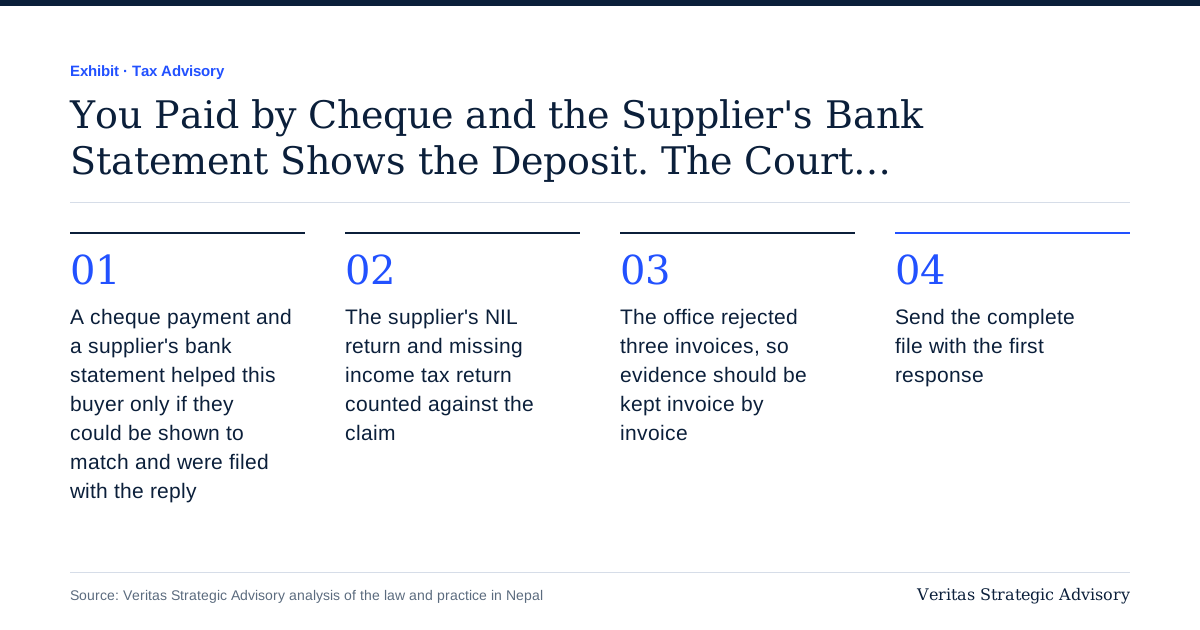
The sentence that matters most for practice comes at the turn from page 17 to page 18. The Court said that the buyer had not filed, with its written reply to the first office, the evidence to prove that the cheque amount was deposited into the supplier's account. It then added that a supplier's bank statement can be regarded as reliable only where the statement issued in the supplier's name and the evidence of the buyer's cheque payment to the supplier are seen to be related to each other. It said that this relationship was not apparent from the reply sent and the papers filed (pp.17 to 18, para 4).
The Court did not set out a formal test, so what follows is our reading of it, not the Court's words. We read the passage as requiring three things at once. The supplier's statement must show a credit that matches the buyer's payment in amount, date and instrument. The buyer's own records must show the corresponding payment out. And both must be put before the office together, with the reply, in a form that lets the office see the match. A bank statement dropped into a file, or produced later without a connecting explanation, does not do that work.
Invoice by invoice
The Court noted that the firm said it had not claimed credit on false or fake invoices and had claimed only on a real transaction. It then recorded that the three invoices looked suspicious, that after investigation the office found them not genuine, that the firm was given a chance to refute that at the initial assessment, and that it could not disprove the office's conclusion. It also noted that the administration had not rejected all of Mukunda Enterprises' invoices, only these three (p.18, para 5).
That detail shapes how a file should be built. The dispute was invoice by invoice, not supplier by supplier. Evidence organised by supplier, in a general folder, is harder to defend than evidence organised by invoice.
The statutory route
The Court then set out the law. Under section 17(1) of the VAT Act, 2052, a registered person may deduct the tax paid on goods or services related to its taxable transactions from the tax it has collected. Under section 17(6), the claim must be proved by the prescribed documents, meaning the invoice. The firm could not prove its truth. The duty to prove, by evidence, that it received goods or services lay on the firm itself, and that was not in dispute. A claim proved only by assertion is not enough, because there must be a basis, a reason and evidence for it (p.18, para 6).
The outcome
The Court held that the firm had not refuted the assessment with objective evidence. It had not proved that it sent money by cheque into the supplier's account, and the supplier was seen to have filed NIL VAT returns after Ashadh 2068. The office's decision of 2068.12.30 imposing tax and penalty, the final assessment order of the same date, the Department's review of 2069.3.31 and the Tribunal's decision of 2070.4.28 were all upheld, and the appeal ground could not succeed (p.18, para 7).
Two cases, one bench, one day
The two decisions are best read together.
| Bhatbhateni | B.S. Bania Store | |
|---|---|---|
| Scale | 152 suppliers, assessment of NPR 22,79,08,198 | 3 invoices, credit of NPR 57,548 |
| How it paid | Bearer cheques, some claimed cash | Cheque, with the supplier's bank statement |
| What the supplier looked like | Many untraceable, some non-filers | One supplier, no income tax return, NIL VAT returns |
| What was missing | Purchase account, supplier details, receipts | Evidence that tied the statement to the payment, filed with the reply |
| Result | Assessment upheld | Assessment upheld |
The comparison cuts two ways. It shows the principle does not depend on scale, because the Court applied the same logic to a very large and a very small claim. It also shows that paying by cheque, while better than paying by bearer instrument, is not a complete answer by itself. In our earlier article on the Bhatbhateni case, The invoice is not the proof, we set out the burden of proof. This case adds the practical question of what a payment record has to look like.
What the decision does not decide
It does not hold that a cheque payment to the supplier's account is worthless. It holds that the statement did not do its job on the record put before the office.
It does not say a supplier's NIL return automatically defeats a buyer's claim. The supplier's filings were one fact, alongside the failure to connect the payment evidence to the invoices.
It does not state the amount of the penalty that was imposed.
It does not tell us what the buyer could have done with a fuller reply, because it never had one. We cannot say what result a complete file would have produced.
The events date from around Ashadh 2068, and the rules on procedure and penalty may have changed. The current Act must be checked before applying any step to a present case.
It is one bench, one day, and one line of authority with Bhatbhateni.
A worked illustration
The figures below are invented to show the point. They are not a client case.
A hardware wholesaler in Butwal buys cement worth NPR 6,00,000 from a supplier in three consignments. The supplier's invoices show VAT of NPR 78,000 at 13 percent, which the wholesaler claims as credit. The wholesaler pays by three cheques of NPR 2,00,000.
Two years later the supplier is found to have filed NIL VAT returns for the months of the sales.
Evidence set one. The wholesaler holds the three invoices, three cheque stubs and its own bank statement showing the three debits. Nothing more.
Evidence set two. For each invoice the wholesaler keeps a single bundle: the purchase order, the invoice, the delivery or transport record, the cheque number and its debit on the wholesaler's statement, the supplier's signed receipt for that cheque, and a copy of the supplier's bank statement obtained with the supplier's written confirmation that lists the invoice numbers and cheque numbers. The credit on the supplier's statement has the same amount and date as the wholesaler's debit, and the cheque number appears on both. The wholesaler's stock records and its later sales tie the cement to customers.
If an officer questions the credit, set one invites exactly the finding in the Bania decision: a payment claimed but not connected. Set two lets the wholesaler hand over three bundles that each answer the question, with the first reply, within the time allowed.
The supplier's NIL return would still be a problem in both cases. In set one it is the whole story. In set two it becomes one awkward fact set against a complete record. The illustration is not a promise of how an officer or court would rule. It shows where the weight of the argument sits.
Our view
In our view, the useful lesson here is the one about timing and form. The Court did not say the firm's payment was fictitious. It said the firm had not put proof in front of the office in a form that made the payment and the statement match, when it had the chance, with its reply. The opportunity to respond is the moment the file is built or lost.
The practical answer is usually to prepare the evidence pack before anyone asks, and to treat the first reply as the final reply. A business that holds back a document for the appeal, or sends a thin response intending to supplement it later, takes a real risk, because the decisions in this collection are made on what was shown to the office.
We would also say plainly that a cheque is not a substitute for knowing your supplier. The Court took the supplier's own filings into account. A buyer cannot control a supplier's returns, but it can choose to check before the first order that the supplier is registered and active, and can notice when an established supplier suddenly goes quiet. We would treat a supplier that stops filing as a reason to review the evidence for that supplier's invoices, not as someone else's problem.
What we would not advise is relying on the cheque alone. A cheque proves a payment from your side. The decision requires more than that: a payment that can be seen to arrive.
Practical action points
Build a bundle per invoice, not per supplier. The office rejected three invoices, not a relationship.
Record the cheque number, date and amount on the invoice file, and keep the matching debit from your own statement.
Ask each material supplier for a written confirmation, with its bank statement, that lists your invoice and cheque numbers.
Keep delivery and transport records that tie the goods to the invoice, and stock and sales records that carry them on.
When a notice arrives, treat the response window as the deadline for the whole file. The notice in this case allowed 15 days.
Send the full bundle with the first written reply and keep proof of what you sent and when.
Review any supplier that stops filing or goes inactive, and look again at the evidence for its invoices.
Do not wait for a dispute. Build the pack in the month of the purchase.
Frequently asked
Is paying by cheque still better than paying in cash?
Yes. The Court contrasted payments by bearer instrument in the Bhatbhateni decision. A cheque to the supplier's own account gives you something to build on. This decision shows that it is a starting point, not a finished answer.
What does it mean for the statement and the payment to be "related to each other"?
The Court did not define it. Our reading is that the supplier's statement should show a credit that matches your payment in amount, date and instrument, and that you should present the two together, in your reply, so the match is visible without anyone having to reconstruct it.
Can I get a copy of my supplier's bank statement?
You can ask. Whether a supplier agrees is a commercial question. The decision does not give a buyer a right to the statement, and we do not state one. Obtaining it with the supplier's written confirmation is the form we would prefer.
Does it matter that only three invoices were rejected?
It tells you how the dispute was framed. The office did not reject the supplier relationship as a whole. Organising your evidence invoice by invoice mirrors that.
What if my supplier files NIL returns without telling me?
The decision treated a NIL return as a reason for suspicion on the invoices, not as an automatic bar. A complete evidence bundle is the answer to that suspicion. We would review the invoices of any supplier whose filings change.
Is the 15-day period still the rule?
The notice in this case allowed 15 days under rule 29(1) of the VAT Rules, 2053. We have not checked the current rules, so confirm the period in the notice you receive and in the provisions in force.
Does the decision tell me what penalty applies today?
No. The assessment included a penalty, but the page does not state the amount, and the present penalty rules must be taken from the Act in force.
Sources and limits
B.S. Bania Store (proprietor Mahesh Bania) v. Inland Revenue Office, Kathmandu Area 1, Supreme Court of Nepal, joint bench of Chief Justice Cholendra Shumsher J.B.R. and Justice Prakash Kumar Dhungana, case no. 174841, decided 2076 Poush 28, reported at pp.16 to 18 of the Institute of Chartered Accountants of Nepal's collection of Supreme Court decisions on the VAT, Income Tax, Customs and Excise Acts (2079/2080). Every statement about the decision was read from the published page images, and the two rupee amounts were checked against an enlarged image and against each other.
We did not review the VAT Act, 2052 or the VAT Rules, 2053 themselves. Sections 17(1), 17(6) and 20 and rule 29(1) are described as the judgment cited them.
General information only, not advice.