- Suppliers the company said it had bought from
- 152
- VAT assessed in NPR over three fiscal years
- 9,33,70,125
- Penalty charged on top, before an additional fee and interest
- 100%
- Total the Court left standing in NPR
- 22,79,08,198
A finance manager in Kathmandu opens a drawer of purchase files before an audit meeting. Every invoice is there. Each one carries a supplier name, a PAN, a date, an amount and 13 percent VAT. The purchase ledger agrees with the invoices. The VAT returns were filed on time and the tax was paid. The manager is confident, because on its face the file is complete.
The tax officer asks a different set of questions. Who is this supplier, and where can I reach them? Show me where your payment went. Show me the supplier's account of the same sale. None of these questions is about whether the invoice exists. They are about whether the purchase did.
The example above is hypothetical. The case behind it is real, and it is one of the clearest statements the Supreme Court has made about what a VAT credit actually rests on.
Why most finance teams think the invoice is enough
The reasoning is natural and, for most purchases, it works in daily practice. A supplier issues a tax invoice. The buyer records it, pays it, and claims the VAT shown as credit against its own output tax. Nepal's system runs on self-assessment, which means the taxpayer works out its own tax and files a return without an officer approving each number first.
From inside that system it is easy to conclude that the invoice is the evidence. If it is wrong, the argument goes, the fault lies with whoever issued it, and the administration can pursue the issuer. The appellant in this case made exactly that argument, and added that monitoring registered firms is the Department's duty. It did not succeed.
The reason it did not succeed is the whole subject of this article.
The case in outline
The case is Bhatbhateni Super Market Department Store Pvt. Ltd. against the Inland Revenue Department, its Investigation and Development Branch and the Large Taxpayers Office. A joint bench of the Supreme Court, Justices Cholendra Shumsher J.B.R. and Prakash Kumar Dhungana, decided it on 2076 Poush 28 in case no. 177705. It is reported in the Institute of Chartered Accountants of Nepal's collection of Supreme Court decisions on the VAT, Income Tax, Customs and Excise Acts, at printed pages 6 to 10.
The assessment covered the fiscal years 2064/65 to 2066/67, from Shrawan 2064 to Magh 2067. It was made up of four parts:
VAT of NPR 9,33,70,125.
A penalty of 100 percent of that VAT.
An additional fee of NPR 1,64,47,497.
Interest of NPR 2,47,20,451.
The four items add up to NPR 22,79,08,198, roughly 2.4 times the tax itself. The company had shown purchases from 152 firms, companies, trade links and suppliers. The Large Taxpayers Office and the Inland Revenue Department upheld the assessment, the Revenue Tribunal in Kathmandu confirmed it, and the Supreme Court dismissed the further appeal.
What the Court actually said
The principle it started from
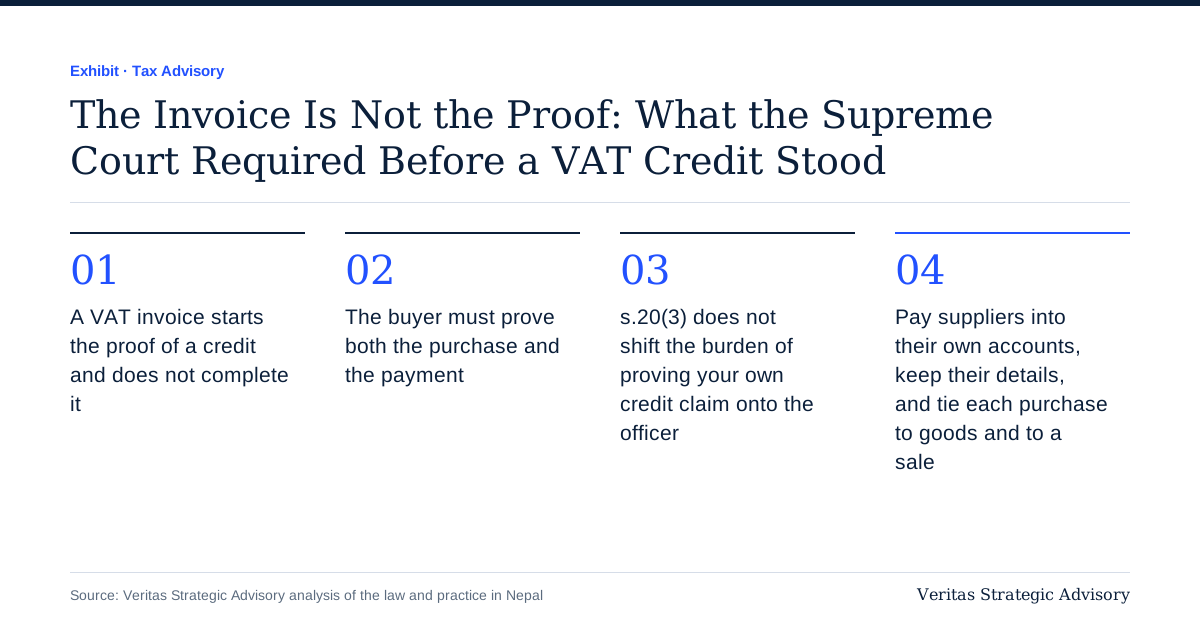
The Court began with the design of the system itself. In its words, the essence of Nepal's self-assessment is that the taxpayer assesses its own tax, and so the taxpayer must itself prove the truth of its transactions. Producing bills, ledgers and books is not enough. The payment of the transaction value for the goods or services supplied under the bill must also be proved. The Court recorded that this proposition was not in dispute (p.8, para 6).
That one passage carries most of the weight. It treats the invoice as the start of the proof, not the end of it.
What proves a supply
The Court was specific about the evidence. The basis for proving a supply, it said, is the seller's sales account and the buyer's purchase account. The company could not prove its purchase account. It could not give the supplier's principal person, address or contact details. Its own director and representative partly admitted that goods were taken from one place while bills were issued from another. Data on a computer hard disk seized during the investigation did not prove the supply either (p.9, para 10).
What proves a payment
The Court then turned to money. The payments had been made by bearer cheques issued in the names of various firms. A bearer cheque can be taken and cashed by anyone, so it shows that money left the buyer but not that it reached the seller. The Court contrasted this with account-payee cheques, which might have supported authenticity. The suppliers named on the invoices had not themselves received the cheque payments. For the cash payments the company said it had made, up to NPR 50,000, it produced no receipts (p.9, para 11).
Where the burden of proof sits
The company argued that its suppliers were non-filers and that overseeing them was the tax administration's job. The Court answered by turning to s.20(3) of the VAT Act, 2052. It accepted that s.20(3) places the burden of proof on the tax officer. It then held that the burden of proving the invoices on which the company claimed its VAT deduction did not lie with the officer. Payment and the transaction under the bill had to be proved by the company. Proof that a purchase and a payment happened had to be furnished by the buyer. A buyer could not escape that duty by pointing at the firms named as sellers (pp.9 to 10, para 12).
The Court also noted what the administration had not done. It had not rejected all of the company's transactions. It had rejected only those that did not appear to be real.
The outcome
The Revenue Tribunal's decision of 2074.3.29, which had upheld the Large Taxpayers Office decision of 2069.5.1 and the Inland Revenue Department decision of 2069.9.6, was confirmed. The appeal grounds could not succeed (p.10, para 13).
The facts that decided it
A reader should not take the principle without the facts, because the facts are why it applied. The record showed:
A very large number of suppliers, 152, many of them untraceable by the company.
Bills from a firm that, on the Tribunal's findings, was not registered in VAT. The Court said VAT cannot be claimed on the basis of the bill of a firm that is not registered.
Statements by the principals of two supplier firms admitting that their dealings were wrong, and by one supplier's proprietor that there had been no dealings with the company and no bills issued to it.
Payment by bearer cheque, with no evidence that the named suppliers received the money.
No receipts for claimed cash payments.
Purchase and sales accounts that did not tie the disputed bills to goods.
Partial admissions by the company's own director and representative.
No single item on that list is the rule. Together they described a record in which the purchases could not be shown to be real, and the Court's holding is about what follows from that.
How this fits with the rent case
Readers of our earlier piece on VAT and building rent, Renting out your building and the guest house question, will have met s.20(3) before. In that Supreme Court decision, the burden of substantiating a discrepancy fell on the tax officer, and the officer could not infer a guest house from a landlord's poor filing.
The two decisions do not conflict, and it is worth being clear about why. In the rent case the officer was alleging a liability that the taxpayer denied, namely that a letting was really a commercial guest house. In this case the taxpayer was asserting a deduction, namely a credit on purchases. Section 20(3) protects a taxpayer against an unsupported allegation. It does not turn a taxpayer's own claim into the officer's burden. Anyone who quotes s.20(3) as a general shield should also quote this case.
What the decision does not decide
The limits matter as much as the holding.
It does not hold that every invoice from a supplier who fails to file returns is invalid. Non-filing was one fact among many, and the Court recorded that only transactions not shown to be real were rejected.
It does not set out a formal standard of proof beyond the evidence it described.
It concerned the fiscal years 2064/65 to 2066/67. Rates, penalties and procedure may differ now, and the Act in force must be checked before any figure is applied to a present case.
It is one bench, one line of authority.
We have read the decision as published and have not reviewed the Act itself. Section 20(3) is described here as the Court quoted it.
A worked illustration
The figures below are invented to show how the logic plays out. They are not a client case.
A trading company buys goods worth NPR 1,00,00,000 in a year from a single supplier. VAT at 13 percent on the invoices is NPR 13,00,000, which the company claims as credit.
File one. The company checked that the supplier was VAT-registered before the first order and kept a note of the check. Every payment went by bank transfer to the supplier's own account, and the statements show it. Delivery notes and transport records match the invoices. The goods appear in stock records and later in sales. The supplier's contact person and address are on file.
File two. The supplier is a name on the invoices and little else. Payment was by bearer cheque, cashed by someone the company cannot name. There is no contact person and no delivery record. Stock moved, but the company cannot link these invoices to those goods.
On file one, a question from an officer is answered in an afternoon. On file two, the credit of NPR 13,00,000 is at risk, and the company has no way to defend it except argument.
If the officer disallowed the credit in file two and the assessment had the same structure as in the Bhatbhateni case, with a penalty equal to the tax, the position would be NPR 13,00,000 of VAT plus NPR 13,00,000 of penalty, which is NPR 26,00,000 before any additional fee or interest. That is the structure of that assessment only. The penalty and interest regime in force today must be checked against the Act before anyone relies on it.
The point of the illustration is not the penalty. It is that two companies with identical invoices can end up in opposite positions, and the whole difference is the evidence behind the invoice.
Our view
In our view, the lesson of this case is not about fake invoices. Most businesses do not knowingly buy on false invoices. The lesson is about the quality of the evidence that sits behind genuine ones, and about when that evidence gets created. A purchase file can be built at the time of the purchase for almost nothing. Built years later, under audit pressure, it often cannot be built at all.
The practical answer is usually to treat the credit as something you will one day have to prove, and to make the proof a by-product of how you buy. We would advise a business to do the following before an officer ever asks:
Check registration at the start. Confirm that a supplier is VAT-registered before the first purchase and keep a dated record of the check. The Court said credit cannot be claimed on the bill of an unregistered firm.
Pay the supplier, not a bearer. Pay into the supplier's own bank account, by transfer or an account-payee cheque in the supplier's name. Avoid bearer cheques and avoid cash for anything that matters.
Keep the supplier's details. A named contact, a working address and a phone number. The company in this case could not produce them.
Tie the purchase to the goods. Delivery notes, transport records, goods-received notes, stock entries. The aim is a trail from the invoice to the physical goods and onwards to a sale.
Reconcile every month. Match bank statements to supplier invoices and purchase ledgers. A gap found in the same month is a question. A gap found in an audit is a finding.
Answer with the file. When an officer asks, respond with the evidence, not with an argument that the supplier or the Department should have acted. The Court was not persuaded by that argument here.
We would not advise relying on s.20(3) as the answer to a challenge on your own credit claim. In this decision it did not carry that weight. Where an officer alleges a liability that the taxpayer denies, the position can be different, as the rent case shows, and it is worth knowing both.
Practical action points
List your ten largest suppliers by VAT credit claimed and test each against the six steps above.
Identify any supplier you cannot contact today. Treat that as a finding to resolve, not a detail.
Find any payment made by bearer cheque or cash in the last three years and see what evidence exists that the supplier received it.
Check whether your purchase, stock and sales records can be tied together for a sample invoice, from supplier to customer.
Write down who in your finance team owns the supplier check, so it happens on every new supplier and not only some of them.
Keep this record as part of the monthly close, not as a special exercise before an audit.
Frequently asked
Does a supplier who files no returns automatically cost me my credit?
The decision does not say that. Non-filing was one fact among several, and the Court recorded that the administration rejected only those transactions that did not appear real. The practical point is that a non-filing supplier tends to go with other weaknesses, such as no traceable contact, so the buyer's evidence has to work harder.
Is paying by cheque enough?
The Court contrasted bearer cheques with account-payee cheques and observed that the named suppliers had not themselves received the payments. It did not lay down that any single payment method is sufficient. What matters is that you can show the money reached the supplier.
Can I rely on s.20(3) to make the officer prove my invoices are false?
For the invoices behind your own credit claim, the Court held that the burden of proof does not lie with the tax officer. The buyer must prove the purchase and the payment. Section 20(3) is more useful where an officer alleges a discrepancy that you deny.
What if the supplier deceived me?
The Court said a buyer cannot be relieved of its liability by pointing at the firms named as sellers. This decision gives no relief on that ground. What you can do about a deceiving supplier is a separate question this decision does not address.
Does this only apply to a business with 152 suppliers?
The statement of principle is not limited by size, but the outcome rested on a record with many problems. We would not assume that a small purchase is safe, and we would not assume it is treated differently either. The sensible course is to keep the same evidence for any credit you claim.
What about cash payments?
The company said it had made cash payments up to NPR 50,000 but produced no receipts. The point was the absence of evidence, not a rule about cash. If you pay in cash, you need a receipt that shows who received it.
Is this still the law?
We have read the decision, which covers the fiscal years 2064/65 to 2066/67. We have not reviewed the current Act or the present penalty and interest provisions. Check the provisions in force before applying any figure or procedure to a present case.
Sources and limits
Bhatbhateni Super Market Department Store Pvt. Ltd. v. Inland Revenue Department and others, Supreme Court of Nepal, joint bench of Justices Cholendra Shumsher J.B.R. and Prakash Kumar Dhungana, case no. 177705, decided 2076 Poush 28, reported at pp.6 to 10 of the Institute of Chartered Accountants of Nepal's collection of Supreme Court decisions on the VAT, Income Tax, Customs and Excise Acts (2079/2080). Every statement about the decision was read from the published page images.
We did not review the VAT Act, 2052 itself, the Revenue Tribunal Act, or the current penalty and interest provisions. Where this article describes s.20(3), it does so as the Court described it.
General information only, not advice.