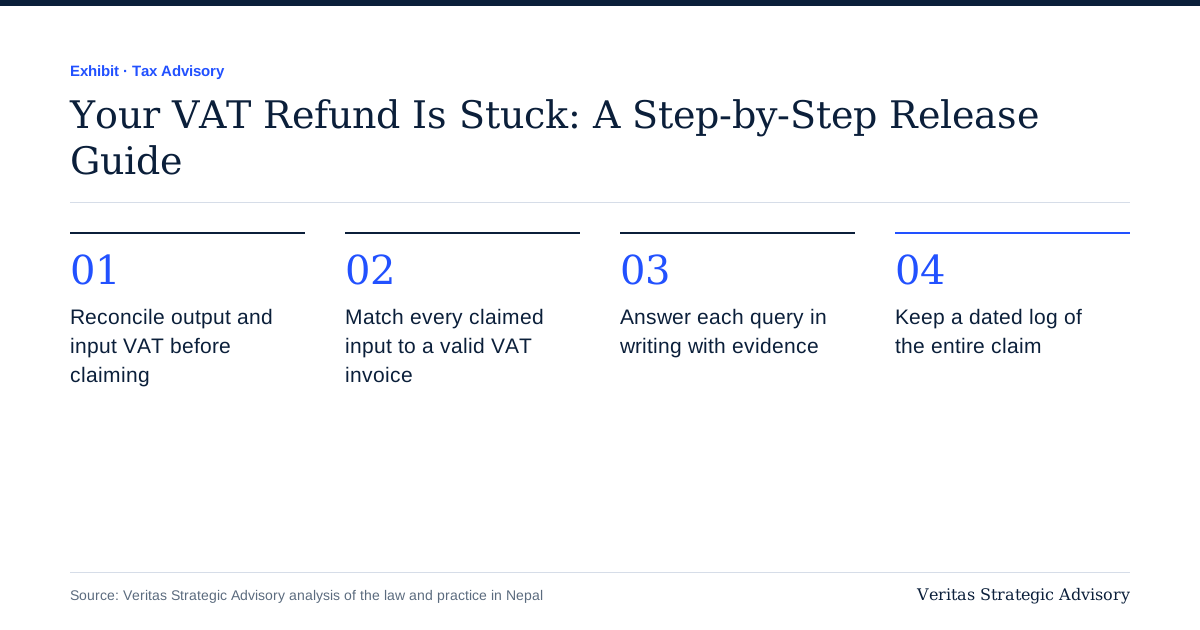
- release steps
- 5
- common causes
- 3
- complete reconciliation before claim
- 1
Understand what a refund claim is
When input VAT exceeds output VAT in a period, the excess may be claimed as a refund, subject to the VAT Act and its regulations. A refund is not automatic. The tax office checks that the input credits are valid and the return reconciles.
Most stuck refunds have one of three causes: the input invoices fail validity requirements, the return does not reconcile to the ledger, or a query has been raised and left unanswered. Diagnose which applies first.
Step 1: reconcile before you claim
Reconcile four things for the period: output VAT from the sales register against the return; input VAT from the purchase register against the return; both registers against the ledger; and purchases against bank payments.
Every gap here is a point the office will raise. Fix it before you press for a refund.
Step 2: check every input invoice
Each input credit must rest on a valid VAT invoice from a registered supplier. Check the supplier's registration number, the date, the taxable value, the VAT charged and your own registration details. Check the purchase is a business purchase and not an excluded category.
Remove invoices that fail the test rather than defend them. A smaller clean claim moves faster than a larger contested one.
Step 3: confirm the supplier side
Input credit depends on the supplier declaring the output VAT. A supplier who has not filed, or filed incorrectly, can make your valid credit questionable. Raise it with the supplier and ask for correction before you claim.
Keep a list of main suppliers and their filing status. For a large refund, this check often finds the real cause of delay.
Step 4: answer the query fully
If a query has been raised, the refund waits for your answer. Answer each point in writing, attach the evidence referenced, and state your conclusion. Partial answers restart the process.
Step 5: track and escalate in order
Keep a dated log of each submission, query and response, with reference numbers. Follow up on a schedule. If the claim is still unresolved beyond the normal period, escalate through the proper channel rather than repeating the same submission.
Escalation works best with a complete file. A clear reconciliation and an organised evidence bundle are resolved faster than a request that asks the office to do the work.
Preventing the next stuck refund
Reconcile monthly, not at claim time. Check each purchase invoice when received. Keep the supplier filing list current. Claim only when the return and registers agree.
For a business that claims regularly, run this as a standing monthly routine. The cost is small beside the working capital tied up in an unreleased refund.
What escalation cannot fix
Escalation cannot make an invalid invoice valid, make an ineligible purchase eligible, or override a supplier's filing failure. Where the entitlement is weak, accepting the reduced claim and moving on is often the sensible course.
Our VAT and tax filing service runs the reconciliation and claim preparation. Related: VAT registration in Nepal and tax health check: 15 things to review.
Why refunds stall even when the claim is valid
A valid claim can still stall for reasons unrelated to its merit. The system checks the return, the registers, the invoices and the supplier side, and a mismatch in any one can stop the release. Understanding where the checks happen lets you prevent the stall rather than chase it.
The most common silent cause is timing. A purchase recorded in one period and claimed in another can appear as an unmatched entry. Another is classification: an expense posted to a category that is excluded from input credit, even though the underlying item is eligible, or the reverse. A third is currency and rounding. Foreign-currency purchases converted at different rates in the ledger and the invoice produce small gaps that accumulate into a query.
Each of these is visible in a reconciliation. Build the reconciliation before the claim and most stalls never happen.
The reconciliation worked through
Start with the sales register. Total the taxable sales and the output VAT for the period. Compare the output VAT with the return. Investigate any difference by listing the invoices that make up the gap. Common differences come from credit notes issued in a later period, sales recorded before the invoice date, or exempt supplies wrongly included.
Move to the purchase register. Total the taxable purchases and the input VAT claimed. Compare the input figure with the return and then with the supplier invoices. Every claimed input should appear in the register with a matching invoice. An input claimed without a register entry is a query waiting to happen.
Next, compare the registers with the ledger. The totals should agree after accounting for timing differences, which you should list. Finally, compare purchases with bank payments for the period. Payments outside the period, advances and unusual settlements should each be explained.
Keep the reconciliation as a single schedule with one line per difference and its explanation. This schedule is also the most useful document you can attach to a response, because it shows the reviewer that the difference was understood and controlled.
Supplier-side risk and how to manage it
Your input credit depends in part on what your supplier did. If the supplier collected VAT but did not declare it, the output tax was not paid, and the input credit you claimed may be disputed. This risk is outside your control, but it is not outside your management.
Ask your main suppliers for their filing confirmation each period. Keep the confirmations in the file. For larger suppliers, consider making payments conditional on a valid invoice and confirmed filing. Where a supplier repeatedly fails to file, consider whether the relationship is worth the credit risk it creates.
Do not be drawn into disputes over a supplier's filing failure that you cannot resolve. Document what you asked for and when, and move the issue to the supplier. Your own claim should stand on the invoices you hold.
When to escalate and when to hold
Escalation is a tool, and like any tool it works best at the right moment. Escalate when the claim is complete, the reconciliation is clean, every query has been answered in full, and the normal period has passed without a result. Escalating earlier, with an incomplete file, invites a request for more information that restarts the timeline.
Hold rather than escalate where a query is still open and you have not yet answered it fully. A query answered in full and well referenced is the fastest route to a release. Escalation cannot replace an answer.
Where your analysis shows a part of the claim is weak, consider withdrawing that part. A reduced claim that is clean is often released faster than a full claim with a weak element that the office will investigate line by line.
Cash flow impact and how to plan for it
A stuck refund is a cash flow problem as much as a tax problem. The working capital it ties up can be significant, particularly for businesses with large capital purchases or export-like activity where input credits build up. Include the expected refund timing in your cash flow forecast, and treat it as uncertain until it is released.
If the refund is material, consider whether the business can carry the delay. Where it cannot, discuss the position with your bank early. A lender that understands the refund and its timing is more willing to bridge the gap than one that discovers the shortfall through a missed payment.
Keeping the process routine
The most effective refund discipline is a monthly routine that takes less than a day. Reconcile the registers and the ledger after each period. Check each new supplier invoice at receipt for validity and classification. Confirm supplier filings quarterly. Record the timing differences and their explanations as they arise.
Assign a named person to own the refund process and a second person to review it. Shared responsibility without a named owner is how a reconciliation slips for three months and then becomes a query. Keep the working papers together so that any reviewer can follow the trail without asking you to explain it.
What a clean refund file looks like
A clean file contains the period's reconciliation schedule, the register extracts, a list of invoices with their validity checks, the supplier filing confirmations, the bank payment evidence and the return as filed. Any query response is added to the same file with its date. A reviewer who opens this file should be able to answer their own questions within minutes.
That standard is achievable for any business that treats VAT as an ongoing process rather than a filing deadline. The refund then becomes a routine cash inflow, not a source of stress.
Frequently asked
How long does a refund take?
It depends on the office, the claim's complexity and whether a query is raised. A clean file with no query moves faster, which is the main reason to reconcile first.
Can I claim on capital purchases?
Eligibility depends on the asset and its use. Check the regulations for your specific asset before claiming.
What if my supplier is not registered?
Input credit generally requires a valid invoice from a registered supplier. Do not include an invoice from an unregistered supplier in the claim.