- Staff duty meal spending that year, in NPR
- 5,00,947
- Input VAT on it that the office refused, in NPR
- 65,123
- Entertainment spending on which the office charged VAT, in NPR
- 29,52,332
- Fiscal year of the assessment
- 2063/64
Taxpayers in hotels, hospitals, factories and schools all share one habit. They feed people. Staff get meals on duty, guests get complimentary food and drink, and a manager takes a client for lunch. The purchases carry VAT, and the question of what to do with that VAT is one that most finance teams answer by habit, not by analysis.
The Supreme Court took one such habit apart in a decision on a leading Kathmandu hotel. The result favoured the taxpayer. The reasoning, though, is narrower than the result, and anyone relying on the decision needs to read the reasoning.
The case in outline
The appellant was the Large Taxpayers' Office at Harihar Bhawan, Lalitpur, acting for Nepal Government. The respondent was Yak and Yeti Hotel Ltd. of Durbar Marg, Kathmandu. A joint bench of Justice Prakashman Singh Raut and Justice Dr. Manoj Kumar Sharma decided it in case no. 160467 on 2078 Mangsir 20. It is the first case reported in the Institute of Chartered Accountants of Nepal's collection of Supreme Court decisions on the VAT, Income Tax, Customs and Excise Acts, at pages 1 to 3.
For the fiscal year 2063/64 the Large Taxpayers' Office made two findings against the hotel.
Staff duty meals. The hotel had spent NPR 5,00,947 on staff duty meals. The office said that, computed proportionately under s.17(3) of the VAT Act, 2052 and rule 40(4) of the VAT Rules, 2053, the VAT of NPR 65,123 on that spending could not be claimed as credit. As a check, 13 percent of NPR 5,00,947 is NPR 65,123, so the figure is the full VAT on the meals.
Entertainment spending. The hotel had claimed NPR 29,52,332 under sales promotion and public relation and publicity, described in the judgment as entertainment, meaning food and beverage or consumption. The office said that no tax invoice had been issued and no VAT collected on that amount. It assessed tax under s.20(1) and added a penalty under s.29(2).
The assessment was made on 2066.01.31 and upheld by the Inland Revenue Department on 2066.03.12. The Revenue Tribunal, Kathmandu, reversed it on 2069.05.12. The Government appealed to the Supreme Court, which upheld the Tribunal (p.1, para 3; pp.2 to 3, paras 4 and 5).
The two arguments
Government's counsel argued that the hotel claimed the whole VAT paid on staff meals when it should have claimed only a proportionate part, and that VAT on the entertainment spending was properly imposed under s.8(1) of the Act.
The hotel's senior counsel argued that it was not the law that staff meals can be claimed only proportionately, and that no VAT should have been charged on the entertainment spending. The amount, he said, had not been spent under an income-generating head, and spending under those heads had been accepted in the income tax assessment (p.1, para 1).
A note on the printed pages. In the published collection, some English words in this judgment, including the words "Entertainment (Food and Beverage or Consumption)" and "Public Relation and Publicity", fall in blank gaps on the page image. We recovered them from the underlying text of the PDF. The rest of the passage was read from the page images.
What the Court decided on staff meals
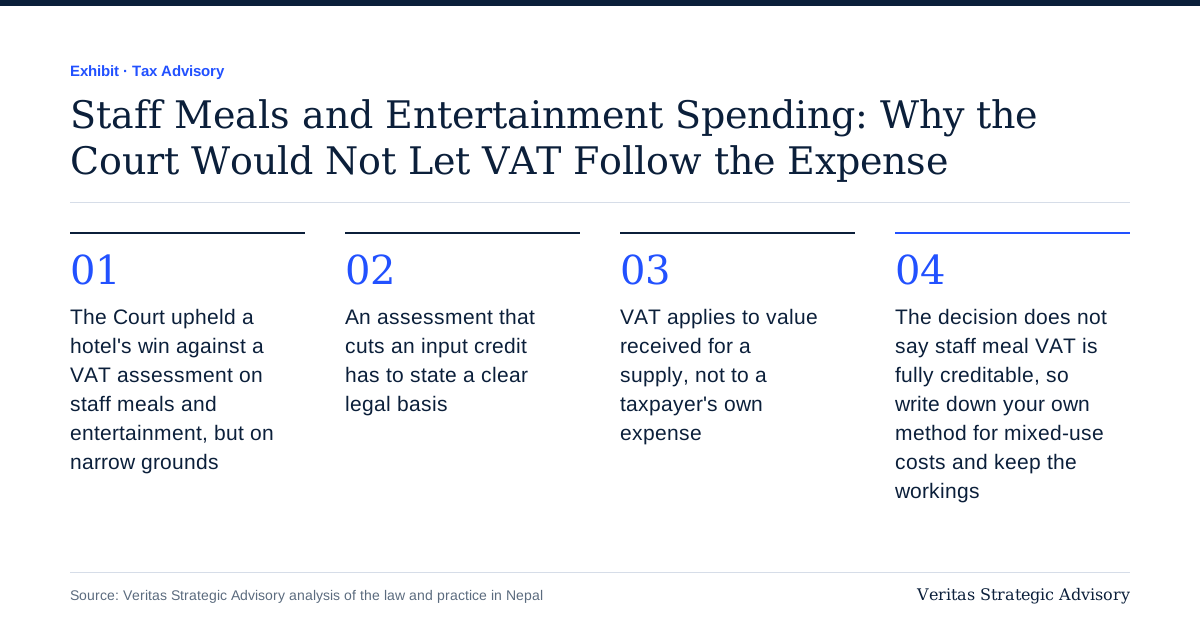
The Court noticed first what the office had not done. The office did not dispute the amount the hotel had shown as staff meal expense. Its complaint was that the hotel had claimed the whole VAT where only a proportionate part could be claimed, and it took tax and a penalty on that footing.
What the office's decision did not do, the Court said, was disclose a clear and objective legal basis and reason for allowing credit only at a proportionate rate. Where an officer decides that a taxpayer may deduct only part of the tax paid on a purchase, the officer has to state the clear legal basis for it. The decision did not, so the partial rejection of the VAT paid on the purchases was not seen to stand (p.2, para 4).
It is important to be exact about what this means. The Court did not interpret s.17(3) or rule 40(4). It did not say that staff meal VAT is fully creditable. It said that an assessment which cuts a credit has to explain why, with a clear legal basis, and this one did not.
What the Court decided on entertainment spending
The second finding was different in kind. The office had charged VAT, plus a penalty, on money the hotel had spent.
The Court went back to the structure of the tax. Sections 5 and 12 of the VAT Act apply tax to the value of a supply of goods or services. The office's decision did not say whether the amount the hotel claimed as expense was value it had received from selling goods or services, or was the hotel's own spending to promote its business. In the Court's words, there was no clear basis showing that the amount spent was value received as consideration for the sale of goods or services. Imposing tax and penalty on the hotel's expense amount was not seen to be proper (p.2, para 4).
The distinction is basic and worth stating plainly. VAT is charged on what a business receives for its supplies. An expense is what a business pays. The two can overlap in particular situations, but an officer cannot get from one to the other by assumption.
The outcome
The Court held that the office's decision of 2066.01.31 and the Department's review decision of 2066.03.12 were not in accordance with law and justice. The Tribunal's decision of 2069.05.12 reversing them was upheld, and the Government's appeal failed (pp.2 to 3, para 5).
The pattern behind the result
Read next to the other decisions we have discussed, this one stands out for the direction of its result. In the Bhatbhateni, B.S. Bania Store and Arbind Stores cases the taxpayer lost, because the taxpayer could not prove a purchase, a payment or a stock position. Here the taxpayer won. The difference was not a more sympathetic set of facts. It was a defect in the assessment.
We read the pattern like this, and it is our reading, not the Court's words. A taxpayer has to prove what it claims. A tax officer has to explain what the officer assesses. In the hotel case the officer's explanation was the weak point. Where an assessment asserts a rule, such as a proportionate credit, or a characterisation, such as an expense being a sale, without stating the basis, it is open to challenge.
The two sides of that principle appear in our other articles. The Saurabh Food decision, discussed in Four years to assess VAT, involved a business making both taxable and exempt supplies, where the dispute underneath was a proportionate input credit. The hotel case shows how a proportionate credit can fail on the assessment's own reasoning.
What the decision does not decide
It does not interpret s.17(3) or rule 40(4), and it does not say staff meal VAT is fully creditable. It held that the assessment lacked a clear legal basis.
It does not discuss the text of s.8(1) or define entertainment.
It does not say whether complimentary meals, or promotional supplies given free, are supplies for VAT. It says an expense amount is not automatically value received.
It does not state the VAT the office assessed on the NPR 29,52,332, or the amount of the penalty.
The assessment is for the fiscal year 2063/64. The relevant provisions and rules may have changed, and the hotel's counsel and the office disagreed about the proportionate rule itself, so that point is unresolved.
It is one bench, one decision.
A worked illustration
The figures below are invented, apart from the staff meal numbers taken from the case. They are not a client case.
Using the case's figures. The hotel's staff duty meals cost NPR 5,00,947. VAT at 13 percent is NPR 65,123. If the office had been able to state a clear legal basis for allowing no credit on that VAT, the cost to the hotel would have been NPR 65,123, plus any penalty. Because it did not, the assessment failed.
A different business. A garment factory in Hetauda runs a canteen that feeds its production staff. Canteen groceries for a year cost NPR 10,00,000, and VAT paid on them is NPR 1,30,000. The factory claims the whole NPR 1,30,000 as credit.
Version one. The factory has no written method. A notice arrives refusing the credit in full and citing no provision.
Version two. The factory has a written note, dated at the start of the year, setting out how it treats canteen VAT, with the provision it relied on, the workings, and a record of the amount it chose not to claim. Say the method leaves NPR 39,000 unclaimed and NPR 91,000 claimed. A notice arrives, with a stated legal basis, refusing more than that.
In version one, the factory can ask what the legal basis is, and the hotel decision supports the question. In version two, the factory is not relying on the absence of a reason in the notice. It has its own reasoned position to put against the officer's. The illustration does not say what the correct percentage is, because the law and not an illustration decides that. It shows why having a method, written before the dispute, makes a strong file.
Our view
In our view, there are two lessons here, and they pull in different directions.
The first is for the taxpayer facing an assessment. Ask for the legal basis. An assessment that cuts a credit or charges tax should say which provision it applies and why the facts fall within it. The hotel case is authority that a bare conclusion does not hold up. It is worth making that point early, in writing, in the response to a preliminary order.
The second is for the taxpayer preparing a file. Do not build a position on the weakness of an assessment that has not yet been written. The Court did not say the hotel was right about the law on staff meals. It said the office had not shown it was wrong. A better-drafted assessment, citing the provision and applying it with reasons, could produce a different result. The practical answer is usually to decide, in advance and in writing, how you treat each category of mixed-use cost, to apply that method consistently, and to keep the workings.
On entertainment and promotion spending, we would keep the supply analysis separate from the expense analysis. If a business gives goods or services away, or provides hospitality to clients, the question of whether that is a supply should be answered with advice on the facts and the Act in force. This decision tells you that an expense is not a sale. It does not tell you that nothing you give away is ever a supply.
Practical action points
List every category of cost that serves both taxable operations and staff or private use, including canteens, staff meals, vehicles, and promotional hospitality.
For each category, write down the method you use to decide what VAT to claim, the provision you rely on, and the workings. Date it.
Apply the method consistently and record any amount you choose not to claim.
If you receive a preliminary order that cuts a credit or charges tax, read it for a stated legal basis. If there is none, say so in your reply, and ask for it.
Separate expense analysis from supply analysis for entertainment, promotion and complimentary items.
Keep invoices for genuine supplies to customers. Do not let the supply side of the business depend on the expense records.
Reply to a preliminary order with the full file and your reasoning, not only a request for the officer's reasons.
Check the Act and Rules in force before relying on any of this, since the provisions cited here date from the assessment year 2063/64.
Frequently asked
Can I claim full input VAT on staff meals after this decision?
The decision does not say so. It held that the assessment did not state a clear legal basis for a proportionate credit. It did not interpret the proportionate provisions. Decide your treatment on the Act in force, and keep your workings.
Does this mean entertainment spending is outside VAT?
No. The Court held that an expense amount is not automatically value received for a supply. Whether a particular gift, complimentary meal or promotional item is a supply is a separate question the decision does not address.
What should I do if an assessment cuts my credit without citing a provision?
Ask for the legal basis in your reply to the preliminary order. The hotel decision supports the point that a clear and objective basis must be disclosed.
Why did the hotel win when other taxpayers in this collection lost?
In the purchase and stock cases, the taxpayers could not prove what they claimed. In the hotel case, the assessment did not explain its basis. The two kinds of failure are different, and they lead to different results.
Which provisions were involved?
As the judgment records them, s.17(3) of the VAT Act and rule 40(4) of the VAT Rules on the proportionate credit, ss.5 and 12 on the value of a supply, and s.8(1), s.20(1) and s.29(2) in the assessment and penalty. We have not reviewed the Act and Rules themselves.
Is this still the law?
We have read a decision about the fiscal year 2063/64. Provisions and rules may have changed, so check the present Act and Rules before applying any of it.
Sources and limits
Large Taxpayers' Office, Harihar Bhawan, Lalitpur v. Yak and Yeti Hotel Ltd., Durbar Marg, Kathmandu, Supreme Court of Nepal, joint bench of Justice Prakashman Singh Raut and Justice Dr. Manoj Kumar Sharma, case no. 160467, decided 2078 Mangsir 20, reported at pp.1 to 3 of the Institute of Chartered Accountants of Nepal's collection of Supreme Court decisions on the VAT, Income Tax, Customs and Excise Acts (2079/2080). Statements about the decision were read from the published page images, with the English words missing from the printed pages recovered from the PDF's text layer, and the rupee figures were checked against enlarged images and against each other.
We did not review the VAT Act, 2052 or the VAT Rules, 2053. Sections 5, 8, 12, 17, 20 and 29 and rule 40(4) are described as the judgment cited them.
General information only, not advice.