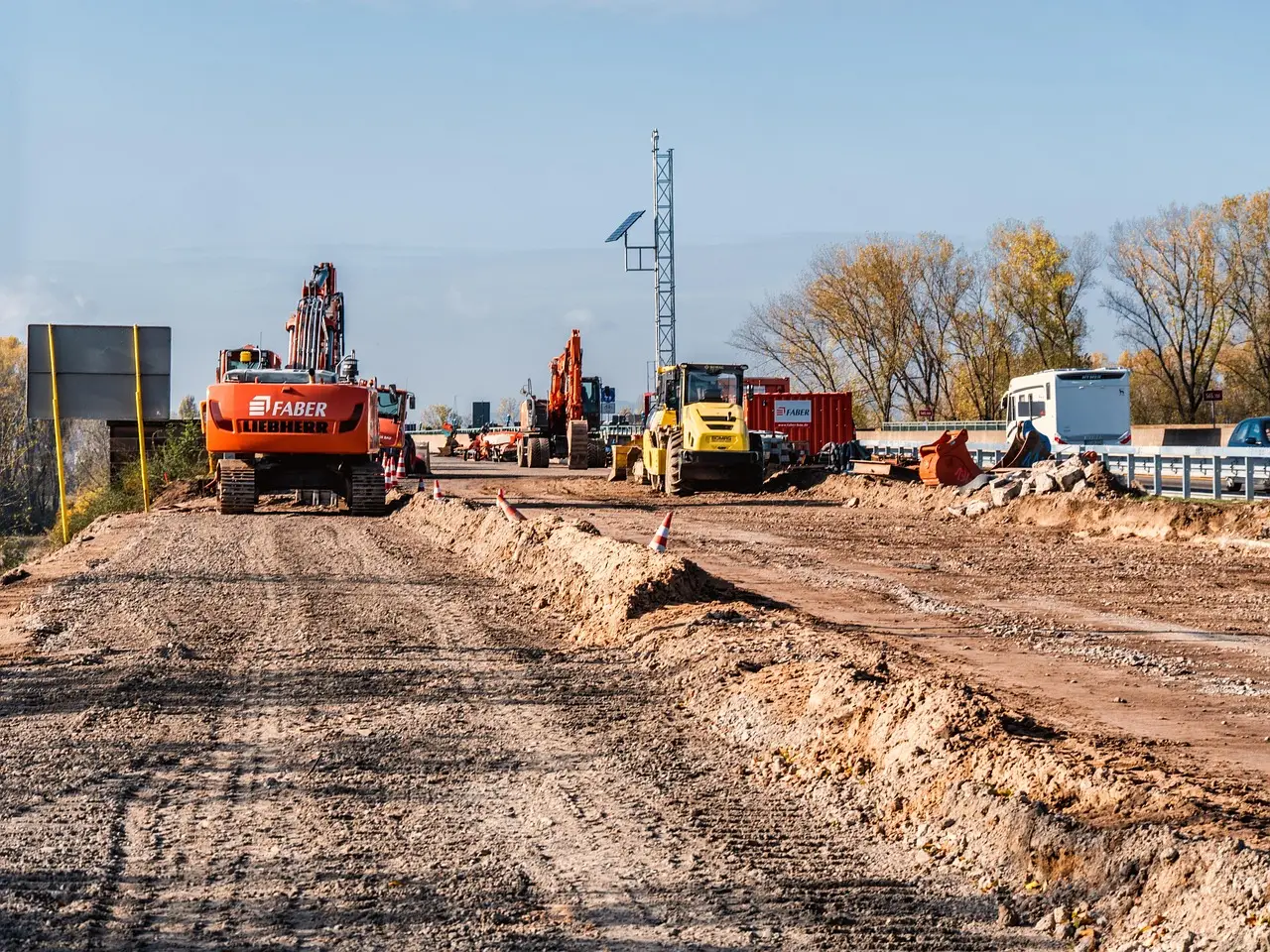
Capital spending has also been weak in practice, both in how much is budgeted and in how much actually gets spent.
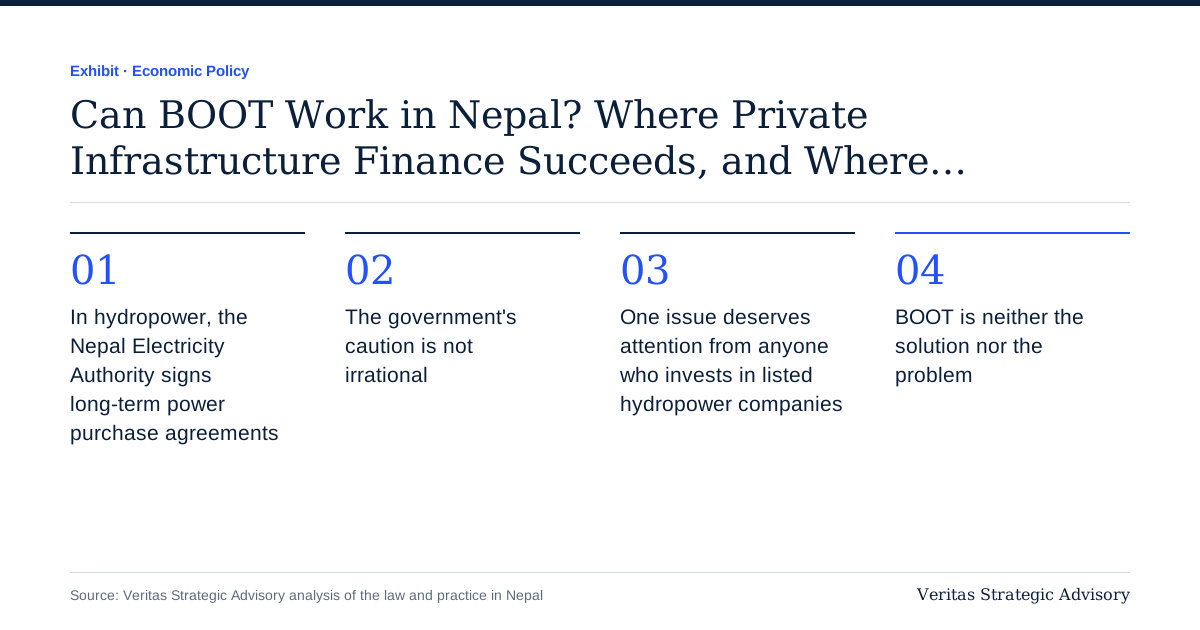
Build-Own-Operate-Transfer, or BOOT, is the model the country keeps returning to. It has been in Nepali policy for three decades and now sits under the PPP and Investment Act, 2019. Yet outside hydropower, few BOOT projects have reached financial close. So the honest question is not whether the model is good. It is why it works in one sector and stalls in the rest.
What BOOT actually asks of everyone
A private company builds an asset, owns and operates it for a fixed concession period, earns its return from tariffs, tolls or payments, and then hands it back to the state, normally at no charge.
For the government, the attraction is clear: less upfront spending, construction and operating risk moved to someone else, and private-sector discipline on cost and schedule. For the investor, the deal only works if three things hold for decades: a revenue stream they can rely on, a state that keeps its promises, and financing that matches the length of the project.
Nepal's difficulty is that these three conditions are met in hydropower and often missing elsewhere.
Why hydropower is the exception
In hydropower, the Nepal Electricity Authority signs long-term power purchase agreements. That gives a lender something concrete: a named buyer, a tariff formula and a term. Licensing, royalties and the hand-over terms are also well understood, and development banks have been willing to lend. Projects such as Khimti-1 and Upper Trishuli-1 show what the model looks like when these pieces are in place, with development-finance and political-risk cover alongside the equity.
Take the PPA away and the picture changes quickly.
Where it stalls
Revenue that nobody will commit to. A toll road or tunnel depends on traffic forecasts that are hard to trust and on tolls that are politically sensitive. Investors usually ask for a revenue guarantee or viability-gap support, and the state has been unable or unwilling to offer either consistently. Transmission is a live example: private builders depend on a wheeling charge, and uncertainty about that charge has been a repeated complaint.
Land and approvals. Land acquisition is slow and contested, often taking years because of outdated valuation, fragmented records and compensation disputes. If the concession puts that risk on the investor, the investor prices it in or walks away. Clearances from several agencies add to the delay, and the promised single window is still not a reality for most projects.
Weak project preparation. A bankable PPP needs a well-prepared project: demand studies, a risk matrix, a tender that competing bidders can understand. Nepal does not yet have a well-resourced central unit that does this consistently, and turnover among officials makes it harder to manage a concession over its whole life.
Policy that moves. A concession is a thirty-year promise. Investors look at how often priorities, tax rules and contracts change with governments, and at how reliably courts and arbitration enforce awards against the state. Surveys of firms regularly rank political instability among the biggest obstacles to doing business.
The wrong kind of money. Domestic banks lend for seven to ten years at high rates. A road or hydropower plant needs twenty or more. Without infrastructure bonds, long-term pension and insurance money, or a deep hedging market, the currency and tenor mismatch lands on the project.
What each side is really worried about
The government's caution is not irrational. Supporting a BOOT project means budget exposure, possibly through guarantees, at a time when it struggles to spend its own capital budget. Raising tariffs to make projects bankable is unpopular. And handing strategic assets to private operators, sometimes foreign ones, raises genuine questions about control.
Investors see the same project from the opposite end: large capital up front, a long payback, revenue in rupees against debt that may be in dollars, and an asset that returns to the state with no compensation. For them, risk that cannot be priced is risk that cannot be financed.
Both views are reasonable. The gap between them is a design problem, not a matter of goodwill.
A quieter problem inside hydropower
One issue deserves attention from anyone who invests in listed hydropower companies. Their shares are perpetual, but their licences are not. At the end of the licence, commonly described as around 30 to 35 years, the plant is meant to pass to the state free of charge.
Several commentators have pointed out that nothing in the current framework deals with this, such as redemption, amortisation or a buyback, and that share prices may not reflect a finite asset life. Promoters also tend to hold much of the equity during construction and sell down after the lock-in period, so later buyers carry the long-term risk. It is a fair concern and worth modelling before you invest: value the cash flows over the actual licence life, not forever. How large the problem becomes depends on future regulation, which has not yet been settled.
What would change the answer
For the government:
A viability-gap mechanism with clear rules, so that socially valuable but commercially thin projects have a transparent form of support instead of ad hoc negotiation.
Sensible risk allocation. The state should carry what it controls best, namely land, permits and policy change, and leave construction and operating efficiency with the private partner.
A properly staffed PPP unit that prepares projects, runs tenders and monitors contracts after signing.
A genuine one-stop clearance process with digital land records and standard valuation.
A fix for listed-SPV equity, for example time-bound instruments or holding-company structures, before the first licences expire.
For investors and sponsors:
Insist on a defined revenue mechanism before committing capital.
Build in development-finance partners, long-tenor debt and, where possible, political-risk cover.
Be wary of structures where the early sponsors exit and ordinary investors inherit the terminal risk.
Stay close to sectors with a clear buyer, such as hydropower and regulated transmission, rather than assuming roads and urban projects will follow.
Our view
BOOT is neither the solution nor the problem. It is a tool that works when the revenue is credible, the risks are sensibly shared and the state can honour a long contract. Nepal has shown it can meet those conditions in one sector. The task now is to reproduce them elsewhere, and that is mostly a matter of institutions and consistency rather than new law.
For a business thinking about a concession, a joint venture with a public body, or an investment in a listed BOOT company, the practical advice is to read the revenue clause first, then the hand-over clause, and to value the project over its real life. If you want help testing a project's numbers, structure or tax treatment, our team of chartered accountants can help you work through the questions.

*This article is general analysis, not investment or legal advice. Figures and policy positions change; confirm current sources before relying on them.*