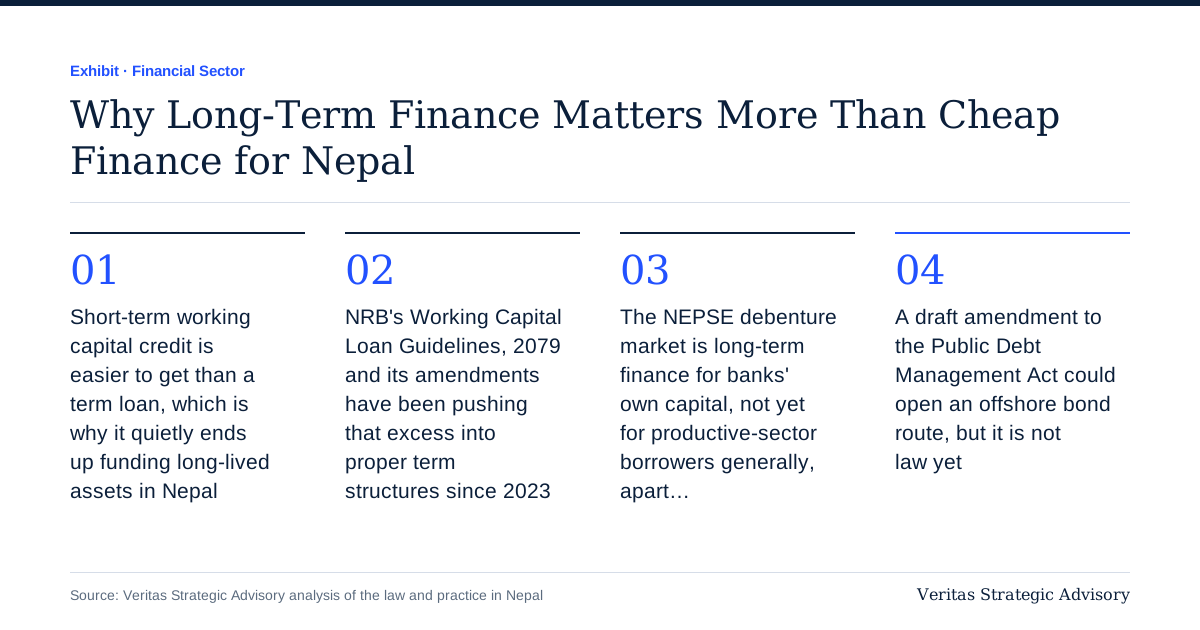
- listed debentures on NEPSE
- NPR 167.71bn
- of that maturing by Dec 2031
- NPR 109bn
- typical debenture tenor
- 5-10 yrs
- new usage threshold for working capital loans
- 30%
A business owner renewing a working capital facility for the sixth year running rarely stops to ask what that loan is actually for. If the honest answer is a production line, a warehouse, or a hydropower asset that will still be earning in year fifteen, the facility is wrong, not just imperfect, and the business is carrying a refinancing risk every single year that has nothing to do with how well it is run.
This is not a complaint about interest rates. It is a complaint about tenor, and it is the more expensive problem of the two.
The habit: funding long assets with short loans
A term loan requires the bank to commit for years, assess a project over its full life, and carry it on the balance sheet at a fixed tenor. A working capital facility, an overdraft or cash credit line, is reviewed annually, secured more simply, and easier for a relationship manager to approve and renew. For a bank, short-term credit is cheaper to underwrite and easier to pull back if something goes wrong. For a borrower, it is faster to get.
The result, across a lot of Nepali business lending, is that working capital facilities have quietly financed assets that are not working capital at all: a second production floor, additional plant, a fleet of vehicles, land. The loan gets renewed every year, the business treats the renewal as a formality, and nobody prices in what happens if a renewal is ever refused.
Nepal Rastra Bank has been narrowing this route for several years through the Working Capital Loan Guidelines, 2079, and its amendments. A 2023 revision stopped banks from simply rolling over short-term working capital loans indefinitely: once a borrower's outstanding balance exceeds the approved limit, the excess must either be repaid in instalments, or the loan must be reclassified as a term loan with a tenor of 3 to 10 years (Himal Press, "NRB revises working capital loan guidelines"). The same revision raised the documentation bar, requiring three years of financial statements to set the limit, and lifted the exemption threshold for the smallest facilities to NPR 10 million.
NRB's mid-term review of monetary policy for FY 2082/83, announced in February 2026, moved in the other direction on one point and tightened on another: banks can now set a working capital loan's tenure based on their own analysis of the borrower's cash flow and financial statements, rather than a fixed rule, but the "zero-balance" test, the requirement that a borrower bring the outstanding balance down for at least seven consecutive days a year, was raised from 10 percent of the limit to 30 percent (Sharesansar, mid-term monetary policy review coverage). Both changes point the same way: NRB wants the facility to match the actual cash cycle it is meant to cover, and it wants that judged properly, not assumed from the fact that last year's renewal went through without trouble.
Why the debenture market has not filled the gap
The textbook answer to a maturity mismatch is a bond or debenture market: instruments with a fixed long tenor, sold to investors who actually want to hold long-dated paper, such as pension and provident funds, insurers and citizen investment schemes. Nepal has such a market. It is just not aimed at productive-sector borrowers.
As of mid-2026, 70 debentures are listed on NEPSE with a combined value of NPR 167.71 billion. Eight worth more than NPR 12 billion have already matured, and 49 of the remaining 70, worth about NPR 109 billion, mature between July 2026 and December 2031 (Sharesansar, "Debentures in Nepal: Fixed Returns in an Uncertain Market"). Typical tenors run 5 to 10 years, with most issues at the 10-year end.
The issuers, though, are almost entirely NRB-licensed banks and financial institutions: Class A commercial banks dominate, with Class B development banks and Class C finance companies participating on a smaller scale. These debentures are mostly subordinated instruments issued to meet the institutions' own regulatory capital requirements, not debt raised to fund a hydropower plant, a factory or a hotel directly. A business that wants long-term debt capital cannot simply go to the NEPSE debenture market and issue its own; in practice that market has so far been a bank capital-raising tool, and it faces its own refinancing wall in the back half of this decade.
The exception, and the pattern worth watching, is purpose-built long-term paper for a single productive sector. Nepal Infrastructure Bank Limited issued a NPR 5 billion "6% Nifra Harit Urja Debenture 2088/89" in mid-2025, 5 million units at NPR 1,000 each, carrying a fixed 6 percent coupon out to a Nepali-calendar maturity roughly two decades away, and it was listed on NEPSE in July 2025. That is what long-term finance for a productive asset actually looks like: a tenor that matches the asset's earning life, raised once, at a fixed cost, from investors who want exactly that duration.
What would actually move the needle
A draft amendment to the Public Debt Management Act, reported in 2026, would let international financial institutions issue bonds in the Nepali market and let Nepali companies issue bonds abroad, both subject to NRB approval. It is still in consultation, not law, so nothing changes until it is enacted and the implementing procedure is published. If it goes through broadly as described, it is the first real channel for a Nepali productive business to reach long-term capital priced outside the domestic banking system's own balance-sheet constraints, rather than relying on a bank's willingness to carry a 10-year term loan or wait for the next infrastructure-specific debenture.

What this means for a business planning a long-gestation investment
Three practical implications follow from where things actually stand:
Ask what the asset's earning life is before you ask what loan to apply for. If the answer is more than three years, the facility should be a term loan or project finance structure with a matching tenor, not working capital labelled as a convenience.
Expect your bank to ask harder questions about tenor now, not fewer. The February 2026 shift to cash-flow-based tenor setting gives banks more discretion, which means a well-prepared cash flow projection and three years of financial statements matter more to your outcome than they used to, not less.
Treat a sector-specific debenture or the proposed offshore bond route as a real option for a large, long-lived project, not a theoretical one. Infrastructure and energy sponsors in Nepal have already used purpose-built debentures to raise fixed-rate, long-tenor capital; the mechanism exists, it is a question of whether your project is large and stable enough to use it.
Frequently asked
Is a working capital loan ever the right way to fund a fixed asset?
No, not as a matter of course. A working capital facility is designed to be reviewed and renewed against a cash cycle, not to carry a fixed asset over its useful life. Where it has been used that way, NRB's guidelines increasingly push the excess into a proper term structure with a 3 to 10 year tenor.
Why can't a mid-sized Nepali company just issue its own debenture?
In practice, the NEPSE debenture market has so far been used almost entirely by banks and financial institutions to raise regulatory capital, not by ordinary productive businesses to raise project debt. A single large, stable project, as Nepal Infrastructure Bank's hydropower-linked debenture shows, can access a dedicated long-term issue; a smaller or less predictable business generally cannot.
Does the February 2026 change make working capital loans more flexible?
It gives banks more discretion to set tenor based on cash flow and financial statement analysis rather than a fixed rule, and it raised the usage threshold for the zero-balance test from 10 percent to 30 percent. More discretion for the bank is not the same as more certainty for the borrower; the quality of your financial reporting now carries more weight in that decision.
Would the draft Public Debt Management Act amendment actually help a private Nepali company?
If enacted as reported, it would let Nepali companies issue bonds abroad and let international institutions issue bonds in Nepal, both with NRB approval. As of this writing it remains a draft under consultation, so the practical answer today is to track it rather than plan around it.
Our view
We would rather see a client walk into a bank asking for a properly structured term loan and be told the pricing is half a point higher, than see the same client get a working capital line approved in a week and discover three years later that the facility was never designed to carry what it has been carrying. The rate difference between a term loan and a working capital facility is usually small; the difference in what happens at the next renewal if the bank's view of you or your sector changes is not.
In our view, the single most useful thing a growing Nepali business can do this year is separate its facilities by purpose on paper, not just in practice: working capital sized to the actual cash cycle, with the zero-balance test genuinely met rather than engineered around it, and a term structure, bank term loan, project finance, or a sector debenture where the project is large enough, for anything with a multi-year earning life. We think the businesses that get caught out over the next renewal cycle will not be the ones NRB's guidelines were aimed at punishing; they will be the ones that never separated the two in the first place and are now being asked, for the first time, to show the cash flow analysis that justifies the facility they have had for years.
Where the law is genuinely unsettled, it is the offshore bond route. The draft amendment to the Public Debt Management Act is a sensible direction, and if NRB's approval process is workable in practice rather than only on paper, it is the first real competitive pressure on domestic bank pricing for long-tenor productive capital that Nepal has had. We would advise a business with a large, bankable, long-lived project to start building the documentation an international lender would want now, rather than waiting for the law to pass before thinking about it.
Where we help
We review facility structures against what they are actually financing, build the cash flow and financial projections a bank's term-loan or tenor decision now depends on, and model the project economics behind hydropower, manufacturing and other long-gestation investment. We provide support and assistance on this analysis and on internal financial review; we do not perform statutory audits. See financial strategy for how this work is structured, or read our companion pieces on hydropower finance, PPA economics and tax treatment, what the latest NRB monetary policy means for your loan, how much working capital your business actually needs, and what to calculate before taking a bank loan.
General information only, not advice.