The finance team offsets the profit against the old losses and reports no tax. Then the tax office points to Section 57 of the Income Tax Act, 2058, and the losses turn out to be unusable. *This is an illustration, not a specific case.*
Section 57 is one of the most consequential provisions in Nepali tax law for mergers, acquisitions and investment. It is also a good case study in a wider policy question: how should a country stop tax abuse without taxing the investment it wants to attract?
This article reads Section 57 from a policy angle. It is general analysis, not advice on any transaction, and the law and practice here are changing.
What the rule does
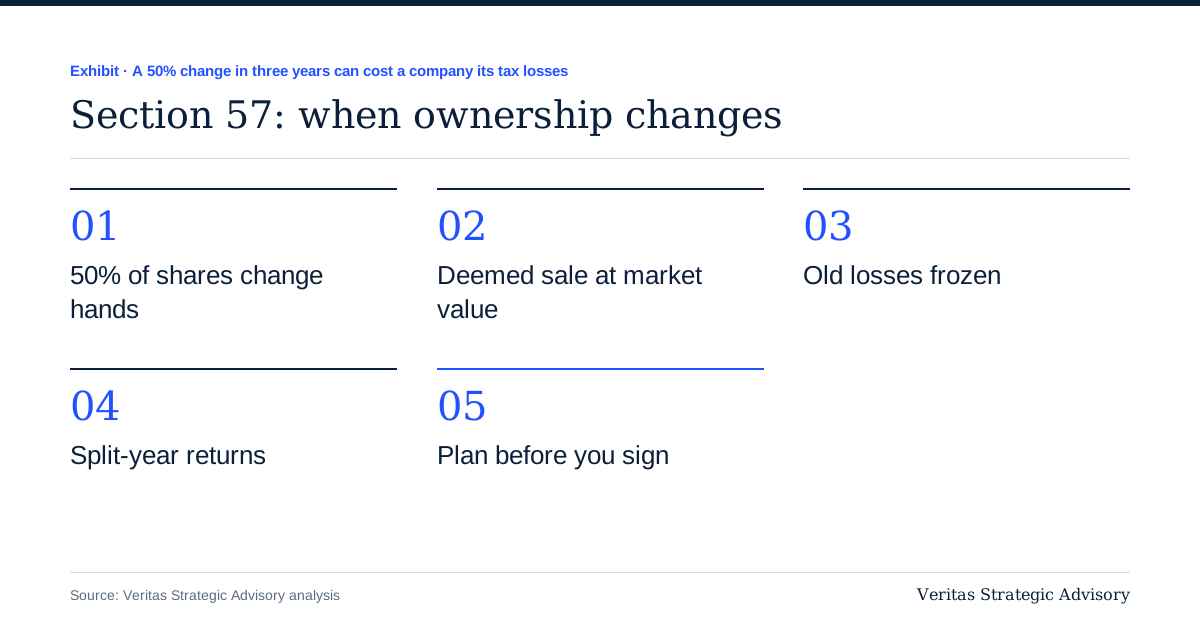
In outline, if the ownership of an entity changes by 50% or more compared with ownership before the last three years, the entity is treated as having disposed of its property and liabilities at market value. It also loses use of certain tax attributes that arose before the change, such as carried-forward losses. The income year is split into a pre-change and a post-change period (overview of the rule). Details such as which shareholders are counted, how associated persons are treated and filing deadlines should be checked against the current text of the Act for each transaction.
What the rule is for
Provisions like this exist to stop two things:
Trafficking in tax attributes. Buying a loss-making company only for its losses, so that profits elsewhere can be sheltered.
Indirect transfers of appreciated assets. Selling shares instead of assets, so that gains on land or other assets escape tax.
Both are real concerns, and a country with a thin tax base has good reason to guard against them. The policy question is not whether to have such a rule. It is how well this rule separates abuse from genuine commercial investment.
Where the design strains
| Design feature | The intended purpose | The policy strain |
|---|---|---|
| A single mechanical test: 50% or more in three years | Easy to apply and hard to avoid | It does not ask whether the business continues. A genuine turnaround investor and a loss trafficker are treated alike. |
| Deemed disposal at market value | Taxes gains that would otherwise escape | Tax can fall due with no sale and no cash. This is a liquidity problem for the company and a deterrent for investors. |
| Loss of past attributes | Stops buying losses | It also penalises long-standing companies being recapitalised or restructured for survival. |
| Moving three-year window | Catches staged sales | Gradual change of ownership across several rounds can trip the threshold unexpectedly. |
| Few explicit reliefs | Keeps the rule tight | Little room for family transfers, group reorganisations or internal restructurings that change no real control. |
The common thread is that the rule asks "did the shareholders change?" rather than "did the business and its economic substance change?" Most mature tax systems add some continuity or relief test for this reason. That is a general observation, not a claim about any one country's rules.
What recent developments show
The courts are looking at substance
In July 2024 the Supreme Court quashed a revised assessment in *Apollo Investment Pvt. Ltd. v. Inland Revenue Office*. The tax office had treated an internal, family share transfer as a change in control and taxed the gap between face value and market price, over NPR 310 million. The court held that tax cannot be levied on assumed or hypothetical income where no actual gain was received, and noted the transfer lacked the required Nepal Rastra Bank approval, which made it void from the start (Nitipartners summary). The ruling is fact-specific, but it signals that deemed gains will be tested against the idea of realised income.
The Ncell dispute showed the stakes
The Large Taxpayers' Office assessed about NPR 57.9 billion (about USD 433.6 million) under Section 57 in January 2021, in connection with a 2016 acquisition of an indirect shareholding in Ncell. The dispute went to investment arbitration under the UK-Nepal bilateral investment treaty. The ICSID tribunal issued its award on 9 June 2023 (ICSID case ARB/19/15). Press accounts of its effect on the domestic assessment differ, so anyone relying on the outcome should read the award itself. Axiata later concluded the sale of Ncell and exited Nepal (Axiata).
The policy lesson does not depend on who was right. A single assessment of this size, on a transaction priced years earlier, shows how a mechanical rule can create very large, uncertain exposures that investors weigh in deciding where to invest.
A targeted amendment drew criticism
The Economic Bill, 2081 added an exclusion for certain capital increases, where new investors come in and existing holders' shares and capital are unchanged. Critics, including a former finance minister, argued it was drafted to help a specific company, and the government said it was meant to encourage investment, responding to private-sector demands (Khabarhub). Reports describe its scope as narrowed after debate; the exact current wording should be checked before relying on it.
Whatever one thinks of the motive, the episode shows a design problem. When a general rule is softened through a narrow carve-out, the result looks like a favour to particular taxpayers rather than a principled change, and it adds doubt about what the rule will say next year.
Guidance by circular
In January 2026 the Inland Revenue Department issued a notice on preference shares. In broad terms, preference shares without voting rights, or with voting limited to matters concerning those shares, are not counted toward the 50% test, while preference shares that carry control-affecting votes may be (Nitipartners; Mondaq). It is welcome clarity, especially for private equity and venture investors who use these instruments. But it is guidance rather than law, and it can be changed or read differently by different officers.
The investment-policy angle
Nepal wants foreign and domestic investment, mergers that consolidate small firms, and private equity and venture capital for startups. Each of these usually involves a change in ownership. A rule that taxes the change itself, in a way that is hard to predict, works against those goals, particularly when the exposure is a tax with no cash to pay it.
Certainty matters here as much as the rate. Investors price uncertainty. A buyer who cannot tell in advance whether past losses will survive, or whether a deemed gain will arise, will lower the price, add indemnities or walk away. That cost is borne by sellers, by companies that need capital, and ultimately by the economy.
Reform options
| Option | What it would do | Trade-off |
|---|---|---|
| Continuity-of-business test | Preserve losses where the same business continues after the change | Needs rules to prevent a business being changed on paper |
| Defer tax on deemed gains | Charge tax only when assets are actually sold, or by instalments | Creates tracking work and delays revenue |
| Group and family relief | Exempt internal reorganisations with no real change of ultimate control | Needs a clear definition of control and associated persons |
| Put key clarifications into law | Move preference share and convertible instrument treatment from circulars into the Act | Takes legislative time |
| Advance rulings | Let a taxpayer confirm treatment before signing | Needs tax office capacity and deadlines |
| Principled treatment of primary capital | Distinguish genuine capital raising from disguised sales, for every taxpayer, not by investor type | Anti-avoidance rules still needed |
These are options for debate, not predictions of what policymakers will do.
What this means for businesses now
Until the rules improve, risk management sits with the parties to the deal:
Treat ownership change as a first-order tax issue, from the earliest negotiation.
Reconstruct ownership for the past three years and test staged changes together.
Do not value tax losses as a transferable asset until the analysis is done. See our guides on buying a business and financial due diligence and how to value a private company.
Model any deemed-gain tax and where the cash will come from.
Document the commercial purpose of capital raises and share transfers, so the substance is clear.
Get specific protections in the agreement for pre-deal tax and for loss of attributes.
How Veritas helps
We help buyers, sellers and investors model the tax effect of ownership changes before signing, including loss attributes, deemed gains and the cash needed to meet them, and we support companies in dealing with the tax office. See our due diligence and M&A advisory services, or talk to us.
Sources
Income Tax Act, 2058, Section 57
Nitipartners: taxation of mergers and acquisitions in Nepal
Nitipartners: Supreme Court on hypothetical gains under Section 57
Khabarhub: controversial amendment to Section 57
ICSID: Axiata Investments (UK) Limited and Ncell v. Nepal, ARB/19/15
Axiata: sale of Ncell concluded
Nitipartners: IRD on preference shares and Section 57
Mondaq: IRD clarifies treatment of preference shares under Section 57
*This article is general analysis, not tax, legal or investment advice. Section 57 is fact-sensitive, and the law, administrative practice and court decisions should be verified before any transaction or filing. Speak to a qualified adviser before acting on anything here.*