This article looks at Nepal's tax dispute system from that policy angle. It builds on our practical guide to appealing an IRD assessment.
It is general analysis. Figures cited are the latest we could find in published reports and may have changed.
How the system works, briefly
A taxpayer who disagrees with an assessment can seek administrative review within the Department, then appeal to the Revenue Tribunal, and in some cases take a question of law further. Under Section 116 of the Income Tax Act, appeal to the Tribunal requires the undisputed tax plus 50% of the disputed tax, charge and fine, or a bank guarantee for that amount, with the 25% paid at the review stage credited (Section 116).
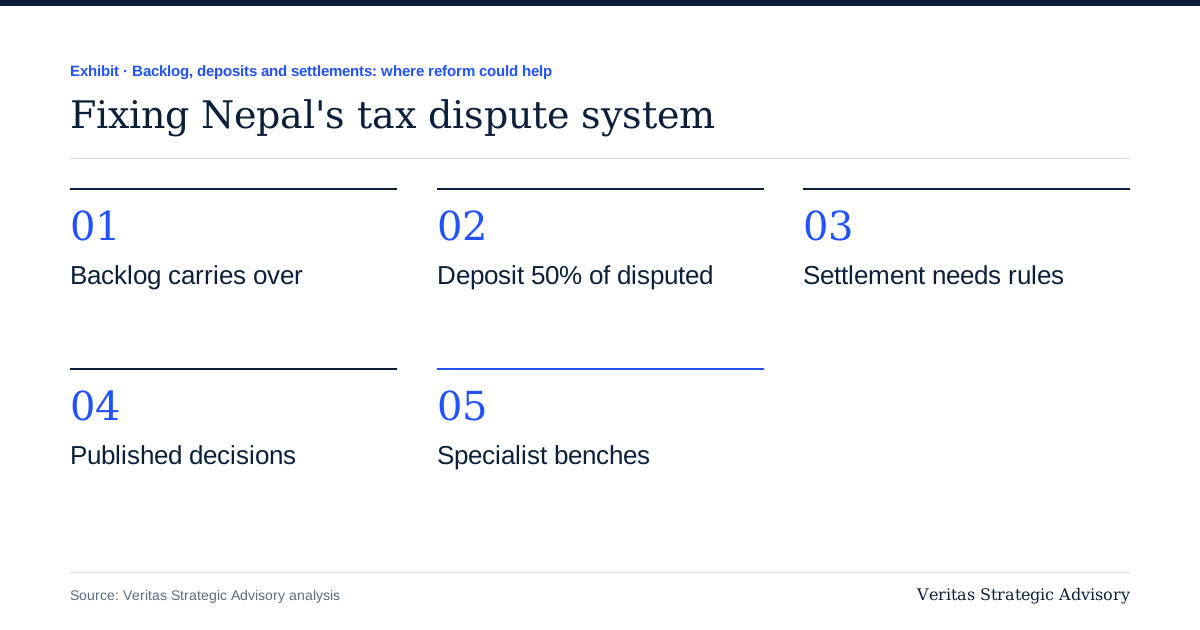
Pressure point 1: the backlog
Reports describe a heavy caseload. The Revenue Tribunal was reported to have 1,289 tax-related cases in a recent year, made up of 317 new appeals and 972 carried over, with 555 settled and 734 left (myRepublica). At the Department, about 1,350 cases were reported pending administrative review (Nepalnews).
| Reported figure | Number |
|---|---|
| Cases before the Revenue Tribunal in the year | 1,289 |
| New appeals registered | 317 |
| Carried over from earlier years | 972 |
| Settled in the year | 555 |
| Remaining | 734 |
| Pending administrative review at the Department | about 1,350 |
These figures are from reporting that may be dated, so treat them as an indication of scale. What matters for policy is that a large share of cases carries over from year to year. When a case takes years, the disputed amount sits locked up, interest keeps accruing and managers plan under uncertainty.
Pressure point 2: the deposit rule
Requiring a deposit before an appeal serves a purpose: it discourages appeals filed only to delay payment. But the Tribunal deposit is 50% of the disputed tax, charge and fine, on top of the undisputed tax and the earlier 25%. For a small or mid-sized business, that can mean tying up cash that was never due if the appeal succeeds.
The bank guarantee option in Section 116 softens this, because a guarantee does not drain working capital. But a guarantee has its own cost and needs a lender's willingness, which may not be available to a smaller firm with weak collateral.
The policy trade-off is plain: a high deposit protects revenue but can deny access to justice to taxpayers who are right but short of cash.
Pressure point 3: settlement outside the system
Governments sometimes try to clear a backlog through settlement schemes. A plan was reported to withdraw old lawsuits on payment of an additional 1% tax, with the aim of recovering more than NPR 100 billion (Nepalnews). Settlement can be efficient. But it has also been controversial: there were reports of disputes involving more than 30 firms being settled outside the Tribunal, and a wider public debate about the tax settlement process (myRepublica; Nepalnews explainer).
The lesson is about design. Settlement works best when it is open, rule-based and available to every similar taxpayer on equal terms. It loses legitimacy when it looks selective or when it replaces the formal process rather than supplementing it.
Pressure point 4: predictability
Taxpayers and advisers learn how the Tribunal reasons mainly from published decisions. When decisions are not published systematically, every appeal begins without a clear map of how similar issues were decided. Court rulings also matter. In the *Dish Media* case, the Supreme Court treated denial of an administrative review to a gravely ill taxpayer as a breach of the right to a fair hearing, and held that civil procedure rules can fill gaps where tax law is silent (Sushil Parajuli). Rulings like this clarify the system but are found only by those who search for them.
Reform options
| Option | Benefit | Trade-off |
|---|---|---|
| Publish anonymised decisions in a searchable database | Consistency and predictability for taxpayers and officers | Needs administrative effort and care over confidential details |
| Stronger case management: early issue lists, agreed facts, document timetables | Shorter hearings and fewer adjournments | Needs staff and training |
| Specialist tax benches | Better handling of accounting, valuation and statutory questions | Needs specialised appointments |
| Targeted deposit relief: a hardship rule or wider use of guarantees | Keeps appeals open to cash-poor taxpayers | Risk of delay tactics; needs safeguards |
| Separate penalty from principal tax disputes | Fairer, more proportionate outcomes | Two tracks to manage |
| Open, rule-based settlement and mediation | Faster resolution of arithmetic and fact disputes | Must be equal, transparent and not a substitute for the Tribunal |
| Published procedural guidance | Fewer errors on limitation, service and filing | Needs regular updating |
None of these is a prediction of what will be adopted. They are the options that follow from the pressure points above.
What this means for businesses today
Until the system improves, a business can protect itself: keep records that would stand up on appeal, track every statutory deadline, price the cost of a long dispute into decisions, and weigh settlement honestly against litigation. A strong file at the first response is the cheapest way to avoid reaching the Tribunal at all.
How Veritas helps
We help clients with responses, reviews, appeals and settlement decisions. See our IRD assessment defence service, or talk to us.
Sources
Section 116, appeal in the Revenue Tribunal
myRepublica: Revenue Tribunal overwhelmed with taxpayers' grievances
Nepalnews: settlement policy for pending tax disputes
myRepublica: tax disputes of over 30 firms settled by sidelining the Revenue Tribunal
Nepalnews: Nepal's tax settlement scandal explained
Sushil Parajuli: judicial trends under the Income Tax Act
*This article is general analysis, not tax or legal advice. Reported figures may be dated; check current data before relying on them.*