
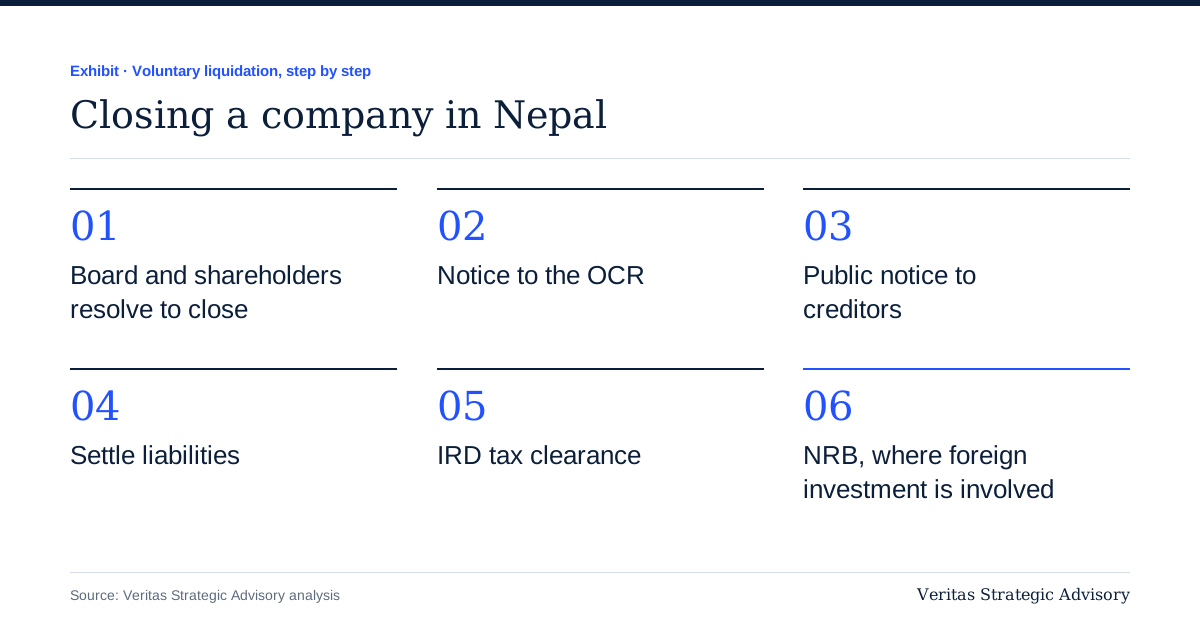
Investors tend to plan the opening of a company in far more detail than its closing. That is costly, because a company that has merely gone quiet stays on the register, and its directors stay answerable for its filings and obligations. Closing correctly is a legal process with its own order of steps, and the order matters more than the speed.
The Three Routes Out
Nepali practice distinguishes three routes. Which one applies depends on the company's financial position, not on how long it has been inactive.
Voluntary liquidation. The shareholders decide to wind up a company that can pay its debts. This sits in the winding-up chapter of the Companies Act, 2063 (Chapter 10; published guides place the voluntary provisions at about sections 126 to 128, but they cite section numbers inconsistently, so check the current Act text before quoting one).
Compulsory (court) winding-up. Used where a company is insolvent or the court orders it. It runs through the High Court under the Insolvency Act, 2063, and the Companies Act's compulsory provision. The court appoints the liquidator.
Deregistration of a dormant company. A simplified, administrative route for a company that never carried on business and has no assets, debts or disputes. No liquidator is involved. Published guides describe slightly different notice requirements for it, so confirm the current checklist with OCR.
A company with real trading history, assets or liabilities should assume it needs full liquidation. The dormant route is not a shortcut for a company that traded and then stopped.
Voluntary Liquidation: The Legal Conditions
Published guides to the Companies Act describe these conditions for a members' voluntary liquidation:
The company can pay its debts, or the directors, after due inquiry, give a written declaration that all debts can be settled within one year of the liquidation resolution.
No compulsory proceedings have begun or are likely.
The shareholders pass a special resolution at a general meeting, which also appoints the liquidator and an auditor and fixes the liquidator's remuneration.
OCR is to be informed of the resolution and the appointments. One guide states a period of seven days; treat that as a working deadline and confirm it against the Act. Where the company is insolvent, the creditors' voluntary route applies instead: the creditors meet and appoint the liquidator, and assets are distributed according to creditor claims, with secured creditors ranking first.
Step by Step
Directors' inquiry and declaration. Establish that debts can be met and record the written declaration.
Special resolution. Pass it at a general meeting; appoint the liquidator and auditor.
Inform OCR. File the resolution and the appointments.
Public notice. Publish the liquidation notice in a national daily, so creditors and others can come forward. The notice period is not fixed in the sources we found; confirm it with OCR.
Realise assets and settle liabilities. Pay creditors, employees and taxes before anything goes to shareholders.
Final accounts and auditor's report. Prepare them to the closing date.
Final general meeting. Approve the liquidator's report and file it with OCR.
Regulator and tax clearances. OCR writes to the relevant regulator for in-principle approval, and tax clearance is obtained from IRD.
Removal from the register. OCR removes the company and instructs the tax office and local body to remove their records; a dissolution notice appears in a national daily.
What the Liquidator Does
The liquidator takes control of the company's affairs. The core duties are to collect and realise assets, pay debts and liabilities, report on what was recovered, paid to creditors and distributed to shareholders, and file that report with OCR together with the auditor's report. In a court winding-up, the liquidator must also file a progress report with the court and OCR within three months of appointment.
Creditors and Priority
Creditors are protected by the order of payment. Secured creditors rank ahead of unsecured ones, and shareholders are paid only from what remains after every liability, including tax and employee dues, has been settled or provided for. In a court winding-up, creditors holding a defined share of the company's debt can themselves apply to the court; the percentages quoted in guides differ, so we do not state one. The detailed ranking among unsecured claims, such as tax, wages and trade creditors, should be read from the Act and the Insolvency Act for the specific case rather than assumed.
Tax Clearance and Closing Tax Registrations
Tax is usually the longest item. Before OCR will finish, IRD must confirm that the company has no outstanding obligations. In practice that means:
Returns. Income tax returns up to the date of closure, and any earlier years that are unfiled, must be filed and assessed.
VAT. All VAT returns filed and VAT dues paid. A VAT-registered company must then apply to cancel its VAT registration; the tax officer's power to cancel where a company is closed or ceases to exist is recognised in published commentary.
TDS. Tax deducted from salary, rent, fees and other payments must have been deposited and the related statements filed.
Penalties and interest. Late-filing fees and interest on unfiled returns form part of the clearance figure.
PAN. Close the PAN and notify the tax office and the ward or local body once OCR has deregistered the company.
We found no reliable published turnaround for IRD clearance, so plan for it to be a gating item and file the backlog first.
Employees and Social Security
Employee dues must be settled before shareholders receive anything. These include final salary, accrued leave, and gratuity or provident fund balances due under the Labour Act, 2074 and the employment contract. Contributions to the Social Security Fund, where the company is enrolled, should be paid up to the last payroll. Keep signed settlement records, because they form part of the closure file. How each entitlement is calculated depends on the contract and the Labour Act, so confirm the figures for each employee.
Foreign-Invested Companies
A company with foreign investment has extra steps, and the sequence is the part clients most often get wrong.
Legal basis. The Foreign Investment and Technology Transfer Act, 2019 gives foreign investors the right to repatriate their investment and earnings, including liquidation proceeds, in convertible currency.
Nepal Rastra Bank (NRB). Repatriation needs NRB approval. Published guides say the application is supported by audited statements, tax clearance and proof of the original investment. An older NRB notice on unlisted shares bases the repatriable value on balance sheet fair value under NFRS 3; we could not confirm whether it is still current.
Department of Industry (DOI). We did not find a published procedure for closing out the foreign investment approval at DOI. Ask DOI directly what it needs before OCR is approached.
Sector regulators. Banks, insurers, telecom and hydropower companies may need their own regulator's approval before closure.
Records and Why Closures Stall
Keep the resolutions, notices, creditor and employee settlement records, final accounts, tax clearance and OCR's removal letter. We could not verify a single statutory retention period covering all of them, so confirm with your tax adviser how long IRD can reopen an assessment, keep tax and accounting records at least that long, and keep the closure file permanently.
Closures usually stall for the same reasons: incomplete books, unfiled prior-year returns, disputed creditors, slow asset sale, tax clearance backlog, pending regulator approvals, and directors or shareholders who cannot be reached to sign. Published guides range from several months to more than a year; the real figure depends largely on how clean the tax position is at the start.
An abandoned company is no shortcut. It stays on OCR's register and IRD's rolls, late-filing fees and interest keep running, and directors remain responsible. Formal liquidation, even when slow, is the only way to end the exposure.

If a company needs to be wound up cleanly, our team of chartered accountants can help with the final accounts, tax clearance and coordination with counsel on the OCR and NRB filings.
*Prepared from published sources, October 2026. General guidance only; confirm against the current text of the Act and with the relevant authority.*