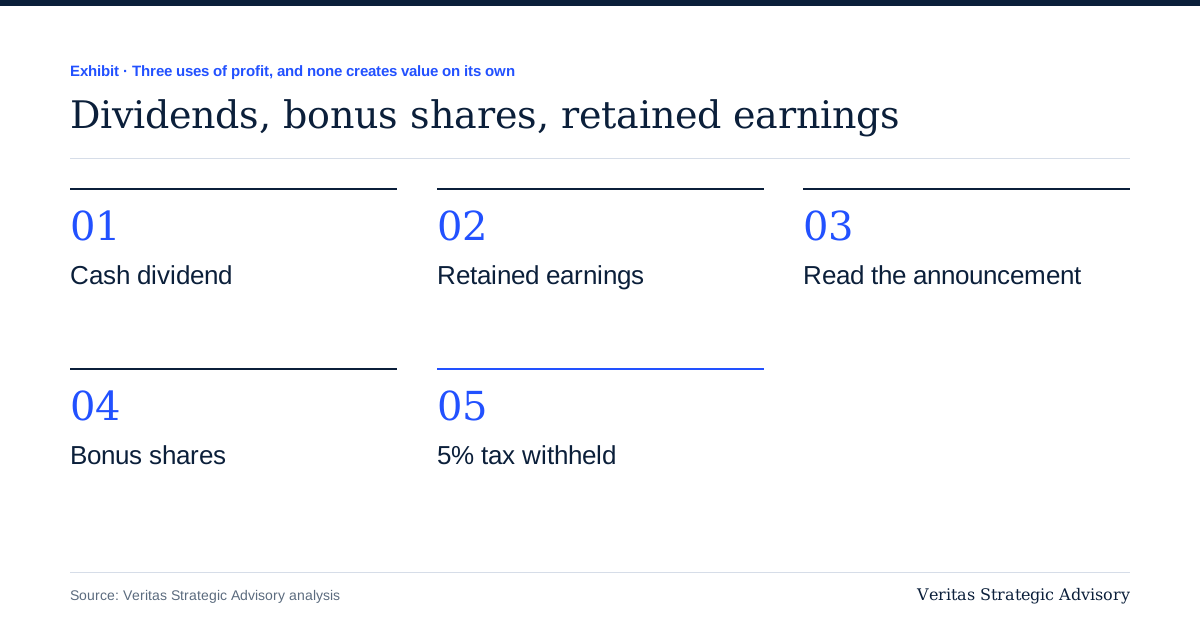
Some issue bonus shares. Some keep everything. Many do a mix.
Most investors read the announcement, see a percentage and form a judgement: "twenty percent bonus, good" or "only five percent cash, disappointing." That percentage tells you very little. What matters is what the company does with the profit, whether the payout is sustainable, and what the tax and valuation consequences are.
This guide explains how to read those announcements. It is general education based on the law as we understand it, not investment advice, and it does not tell you to buy, hold or sell any share.
What a company can do with its profit
After paying corporate tax, a company has three broad choices:
| Choice | What happens | What the shareholder gets |
|---|---|---|
| Pay a cash dividend | After-tax profit leaves the company as cash | Cash, less tax |
| Issue bonus shares | Part of the distributable profit becomes extra share capital | More shares, no cash |
| Retain the earnings | Profit stays in the business | Nothing immediately |
These can be combined. The important point is that none of them creates value by itself. Value comes from what the company earns on the capital it keeps, or what you earn on the cash you receive.
Cash dividends
A cash dividend is a payment of after-tax profit to shareholders. On a share with a face value of NPR 100, a 10% cash dividend normally means NPR 10 per share.
For a Nepal-resident individual, tax is withheld at 5% on the dividend under Section 88 of the Income Tax Act, 2058. For most individual investors this is the final tax on that income. Companies, institutions and non-residents can be treated differently, so check your own position.
| Example: 1,000 shares, NPR 10 per share | Amount |
|---|---|
| Gross dividend | NPR 10,000 |
| Tax withheld at 5% | NPR 500 |
| Net cash received | NPR 9,500 |
When a dividend makes sense, and when it does not
Cash dividends suit holders who need income. They are also useful evidence: in a market where some profits never turn into cash, a steady dividend history shows real cash generation.
A large dividend is not automatically good news. A company with good growth projects should often keep its profit and put it to work. A simple test: can the company earn a higher return on NPR 100 retained than you could earn by receiving and investing it yourself? If the company earns 20% on equity and you would earn 10% elsewhere, retention is better. If the company earns 6%, a payout is better.
Also look at cash, not only profit. A company that pays a dividend by borrowing, cutting needed investment or running down its cash is not being generous. Check the cash flow statement alongside the income statement, and compare the payout ratio (cash dividends divided by net profit) with the company's growth plans.
Bonus shares
A bonus share gives existing shareholders extra shares at no cost, in proportion to their holding. Under Section 179 of the Companies Act, 2063, a company can issue bonus shares out of the amount available for dividend, by a special resolution of the general meeting, and must inform the Office of the Company Registrar before issuing them.
| Example: 20% bonus | Number |
|---|---|
| Shares held | 1,000 |
| Bonus shares received | 200 |
| Shares after the issue | 1,200 |
Your percentage ownership stays the same, because everyone receives shares in proportion. Reserves fall and share capital rises. No new cash comes into the company.
A bonus share is not free money
A bonus issue changes the number of shares, not the value of the business. If a company worth NPR 120 million has 1 million shares and issues a 20% bonus, the share count becomes 1.2 million and the theoretical price falls from NPR 120 to NPR 100.
| Before bonus | After bonus | |
|---|---|---|
| Company value | NPR 120,000,000 | NPR 120,000,000 |
| Shares | 1,000,000 | 1,200,000 |
| Theoretical price per share | NPR 120 | NPR 100 |
The formula is: theoretical price after the bonus = price before the bonus divided by (1 + bonus ratio). You own more shares, but each is a smaller slice of the same company.
Real prices can differ from this result. Sentiment, liquidity and expectations all move prices. But those are market reactions, not value created by the bonus. A price that stays well above the theoretical figure is pricing in something else, such as expected earnings growth.
Why companies issue bonus shares
Affordability and liquidity. A lower price per share can make the stock easier for small investors to trade.
Signalling. It can show management expects earnings to grow. That is a signal, not value.
Capitalising reserves. A balance sheet tidy-up, not a value event.
Giving something without paying cash. This is the less generous reason. A bonus issue costs the company no cash. If a company could have afforded a cash dividend and chose bonus shares, that is a different decision from having no cash to distribute.
How bonus shares are taxed
Bonus shares are treated as a distribution of profit under the Income Tax Act and taxed with a 5% withholding, the same as a cash dividend (Sushil Parajuli, taxation of bonus shares). That created a practical problem: a shareholder received shares but had to find cash to pay the tax.
What changed in November 2025. The Securities Board of Nepal (SEBON) issued the 10th amendment to the Securities Issuance and Allotment Guidelines, adding sub-section (7) to Section 40. Companies must now arrange for the dividend tax on bonus shares to be adjusted and paid by the company from the dividend itself (Sharesansar). SEBON said it acted because some companies delayed crediting bonus shares on the pretext of unpaid tax, following recommendations of the High-level Commission on Economic Reform (myRepublica). This changes who pays and when. It does not change whether tax is due.
Bonus shares from share premium. Be careful here, because it is a common source of wrong advice. Where a company issued shares at a premium, for example in a further public offering, and later issues bonus shares out of that premium, the Constitutional Bench of the Supreme Court held on 14 December 2023 that this is a distribution of dividend other than out of profits under Section 56(3) of the Income Tax Act, and it is taxable (Nitipartners). In other words, the premium itself is a capital receipt when the company receives it, but a bonus issue paid from it is not tax free. If you rely on this, confirm the current position with the company's registrar or a tax adviser before acting.
Retained earnings
Retained earnings are accumulated profit the company has earned and not distributed. They sit in shareholders' equity on the balance sheet. The simple relationship is:
Closing retained earnings = opening retained earnings + net profit after tax - dividends - other appropriations.
Retained earnings are not necessarily cash. They may be tied up in factories, stock, receivables, loans to related parties or other assets. A company can have large retained earnings and very little cash.
Retention is good when it funds productive growth: capacity for a manufacturer, regulatory capital for a bank, working capital for a trading business. It is a warning sign when management hoards cash, invests poorly, or lends to related parties on poor terms.
How to judge retention
| Lens | Question |
|---|---|
| Return on equity | Does the company earn an attractive return on the capital it keeps? |
| Debt | Is it retaining to cut expensive debt, or borrowing heavily while retaining? |
| Cash flow | Do retained earnings eventually show up in operating cash flow? |
| Capital needs | Does the business genuinely need to retain more than an asset-light one? |
| Earnings per share | Has retained profit turned into higher earnings per share over time? |
A useful discipline: for each NPR 100 a company keeps, ask what you received in return. If five years later the answer is "nothing visible," the retention was not productive. If earnings per share grew steadily, it did its job.
Comparing the three choices
| Company action | What you receive | Inside the company | Question to ask |
|---|---|---|---|
| Cash dividend | Cash, less 5% tax | Cash and retained earnings fall | Is the payout sustainable? Could the company reinvest better? |
| Bonus shares | More shares in proportion | Reserves move into share capital | Will future earnings justify the larger share count? |
| Retention | Nothing immediate | Funds stay in the business | Can management reinvest at attractive returns? |
Do not judge a distribution by its headline percentage. A 30% bonus is not automatically better than a 10% cash dividend, and keeping all the profit is not automatically growth-minded.
Dates and mechanics
For a listed company, track these dates:
Declaration. The board or shareholders approve the distribution, subject to legal requirements.
Book closure (record date). Decides who qualifies. If you buy after it, you do not receive the entitlement.
Ex-dividend or ex-bonus date. Buyers from this point normally do not receive the entitlement.
Distribution. Cash is paid or shares are credited.
Tax certificate. The company withholds tax and should give you a certificate.
Under Section 182 of the Companies Act, 2063, dividend must generally be distributed within 45 days of the decision, unless a law prohibits it, the right to the dividend is disputed, or circumstances beyond the company's control prevent it. If it is late, interest at the prescribed rate is payable. If you have not received a declared dividend in time, follow up with the company's registrar.
Buying shares just to collect an announced distribution gives no free benefit. The price usually already includes the distribution, and falls by roughly its value on the ex-date.
Bonus issues also rarely divide evenly. A holder of 1,005 shares at a 15% bonus is entitled to 150.75 shares. Fractional shares are not issued, and companies treat them differently, so check the company's policy.
Common confusions
"A bonus issue makes me richer." Not by itself. More shares do not mean more wealth. Earnings prospects, governance and market valuation do.
"Bonus shares are tax free." No. Bonus shares from profits attract the 5% withholding, and the 2025 SEBON change only moves the payment from you to the company.
"Retained earnings mean the company has cash." Not necessarily. They are an accounting total, not a bank balance.
"A high dividend yield is always attractive." Yield also rises when a share price falls sharply because the business is deteriorating. Compare the dividend with earnings, free cash flow, debt and investment needs.
"Profit means it can pay a dividend." Law, solvency, capital rules for banks and loan covenants can all limit a payout.
A checklist for reading an announcement
The distribution:
Is the dividend covered by earnings and operating cash flow?
Did the company borrow to pay it?
What is the payout ratio?
Is the bonus backed by expected earnings growth, or mainly cosmetic?
Is the bonus issued from profits or from share premium?
Capital allocation:
Does the retained capital earn attractive returns?
Is return on equity consistent with the retention policy?
Are related-party dealings transparent and at market terms?
Is the capital-allocation policy stable from year to year?
Your position:
What are the tax consequences for you as a resident or non-resident?
Do you need income now, or are you investing for long-term growth?
Also read how these choices fit the wider market: the budget made capital gains tax on listed securities final, and the capital market revival plan covers the rules around listed investing.
Frequently asked questions
What is the tax on cash dividends in Nepal?
Generally 5% withholding for a resident individual under Section 88 of the Income Tax Act, 2058, usually final for that income. Other categories of shareholder can differ.
Are bonus shares taxable?
Yes. Bonus shares issued from profits are treated as a distribution and attract the 5% withholding. Since SEBON's November 2025 amendment, the company arranges payment from the dividend. Bonus shares issued from share premium were held taxable by the Supreme Court's Constitutional Bench in December 2023; confirm the current position before relying on it.
Do bonus shares increase my wealth?
Not by themselves. The share count rises and the theoretical price falls in proportion.
How long does a company have to pay a declared dividend?
Generally 45 days under Section 182 of the Companies Act, 2063, with interest if late, subject to three exceptions.
Should I buy before the ex-date?
Buying before it entitles you to the distribution, but the price normally already includes it, so there is no free benefit.
What happens to fractional bonus shares?
They are not issued. Treatment varies by company, so check its policy.
If you also sell shares rather than only receive dividends, see our answers on capital gains tax on shares and property in Nepal.
How Veritas helps
We advise companies on dividend policy, bonus issues and the tax and compliance rules that go with them, and we help shareholders and promoters understand the tax consequences of a distribution. We do not give investment advice on whether to buy or sell a security. See our tax advisory service, or talk to us.
Sources
Income Tax Act, 2058, Section 88
Companies Act, 2063, Section 179 (bonus share)
Companies Act, 2063, Section 182 (dividend)
Sharesansar: SEBON 10th amendment to the Securities Issuance and Allotment Guidelines
myRepublica: SEBON makes listed companies take liability of tax on bonus shares
Sushil Parajuli: taxation of bonus shares in Nepal
Nitipartners: taxation of mergers and acquisitions in Nepal (Supreme Court ruling on share premium)
*This article is general information, not tax, legal or investment advice. Tax rules and regulatory requirements change, and every shareholder's circumstances differ. Speak to a qualified adviser before acting on anything here.*