(ICAN, Federal Budget 2083/84 Highlights) A budget of this size, and this scope of tax restructuring, is rarely read carefully beyond its headline numbers by the businesses it actually affects. This piece reads it the way we read it for our own clients: not "what changed," but "what does this specific change mean for a specific kind of business, and what should management actually do about it before the fiscal year is well underway."
The headline reform: personal income tax
The most significant single change in this budget is not a business tax measure at all, it is the most aggressive reset of personal income tax in a decade. The first slab doubles to NPR 1,000,000, up from the previous NPR 500,000 (single) and NPR 600,000 (married) thresholds. That slab carries only the 1% social security tax, which employees enrolled in the Social Security Fund do not pay separately. In addition, the separate, higher exemption previously available to married couples has been removed in favour of a single unified schedule applying to all resident individuals. The top marginal rate falls ten full percentage points, from 39% to 29%. (Sharesansar)
| Income band (NPR) | Rate |
|---|---|
| Up to 1,000,000 | 1% |
| 1,000,001 – 1,500,000 | 10% |
| 1,500,001 – 2,500,000 | 20% |
| 2,500,001 – 4,000,000 | 27% |
| Above 4,000,000 | 29% |
One unified schedule now applies to every resident individual, replacing the previous separate, higher threshold for married couples.
What this means for business, specifically, is not what most owners assume first. This is a personal tax change, not a corporate tax cut, but it has a direct and immediate business consequence: take-home pay rises across almost every salary band without the employer's payroll cost changing at all. For a business competing to attract or retain staff, particularly mid-level professional and technical staff whose income now falls further inside the lower bands, this is functionally a cost-free improvement in the real compensation the business is able to offer. Payroll and HR functions should recompute net salary illustrations for staff immediately, since take-home pay changes meaningfully at almost every income level, and communicating this proactively is a low-cost, high-goodwill action available to any employer right now.
The removal of the separate married-couple threshold also means payroll systems and salary structuring built around the old dual-threshold logic need to be updated, not assumed to carry over unchanged; a business still calculating withholding against the previous slab structure is both under-serving employees and running a compliance exposure of its own.
Customs restructuring: from eleven tiers to seven
The customs tariff structure has been consolidated from eleven tiers down to seven, alongside a targeted reduction in duties on 273 categories of industrial raw materials, explicitly framed by the Ministry of Finance around a specific principle: raw material duties should sit at least one tariff tier below the corresponding finished-goods duty, at every point in the structure. (Investopaper)
| Customs structure | Tiers |
|---|---|
| Before this budget | 11 |
| After this budget | 7 |
| Raw materials repriced | 273 categories, at least one tier below finished goods |
| Excise duty abolished | 360 goods |
For manufacturers and importers, this is the single most consequential change in the entire budget, and it needs to be modelled line by line, not read as a general policy direction. A manufacturer importing raw materials should immediately recheck the tariff classification and rate for every major input against the new seven-tier structure, since a favourable rate change on a key input can materially improve landed cost and margin, while a business that has not re-run its costing is very possibly still pricing against the old structure and either under-pricing its own margin improvement or, in some product lines, missing an unfavourable reclassification. This is exactly the kind of contribution-margin recalculation covered in our companion piece on 10 financial numbers every business owner should know, applied here to a specific, dated policy trigger rather than a general review.
Excise duty has additionally been abolished entirely on 360 goods, a separate lever from the customs restructuring and one that directly affects the domestic pricing and margin structure for businesses producing or trading in those specific product categories; the affected list needs to be checked item by item against your own product range, since blanket assumptions in either direction, "this affects us" or "this doesn't affect us", are both risky without checking the specific schedule.
VAT: three narrow but real changes
Three specific VAT measures affect distinct, narrow categories of business, and each needs to be checked against whether it applies to you specifically, rather than treated as a general VAT change:
A 10% instant VAT refund on digital payments. This is a demand-side incentive intended to push consumer transactions toward traceable digital payment methods, and it has a direct implication for any retail or consumer-facing business: digital payment acceptance infrastructure, and the ability of point-of-sale systems to correctly process and document the refund, is now a genuine competitive and compliance consideration, not just a customer convenience feature.
A 5% VAT levy on electricity consumption above 50 units. This falls on final consumers, households and businesses alike, using electricity above that threshold. Reports differ on whether the 50 units is measured per month or per consumer, so check your bill. Any energy-intensive operation, manufacturing in particular, should recalculate its effective utility cost under this measure rather than assuming electricity costs are unchanged from the prior year's budgeting baseline.
A 5% VAT on ride-hailing services. A narrow measure, but directly relevant to logistics and delivery-dependent business models that route staff or goods movement through ride-hailing platforms as an operating cost line.
Capital markets: capital gains tax made final
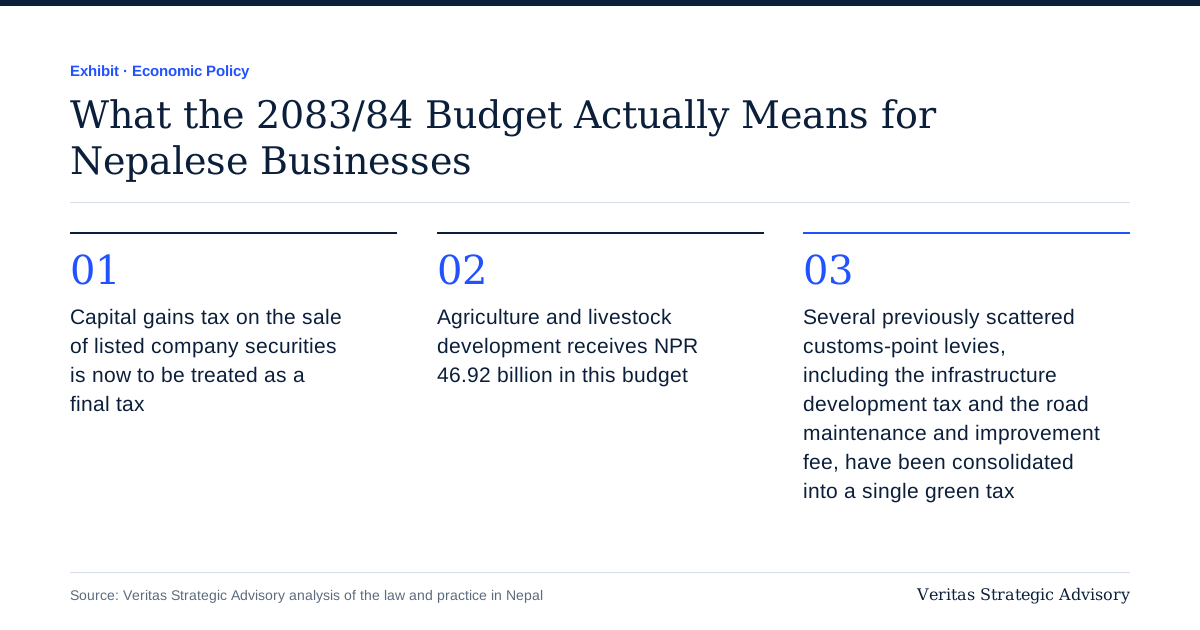
Capital gains tax on the sale of listed company securities is now to be treated as a final tax. (Sharesansar) A "final" tax treatment means the tax withheld or paid on the gain settles the taxpayer's liability on that specific income completely, without further reconciliation or offset against the taxpayer's other income in the annual return. For an investor, this brings certainty and administrative simplicity to the tax treatment of a listed-securities transaction, since the outcome is known and closed at the point of the transaction itself, rather than remaining an open item to be reconciled at year-end alongside other income.
For businesses and business owners who hold listed securities as part of treasury management, or who are considering an IPO or listing as part of a longer-term capital strategy, this measure is worth factoring into that planning specifically: a simplified, final tax treatment on exit is a genuine, quantifiable factor in the relative attractiveness of a public listing compared with staying privately held, alongside the other governance and disclosure considerations that decision already involves.
The macro picture: how the budget is actually structured
Before reading any single sector's provisions, it is worth understanding how the NPR 2,124.34 billion is actually built, because the composition tells you as much as the total figure does. Current (recurrent) expenditure accounts for NPR 1.27 trillion, or 59.8% of the total; capital expenditure, the spending most directly linked to infrastructure and long-term productive capacity, is NPR 431.1 billion, or 20.3%; and financial management, principally debt servicing and financial transfers, takes the remaining NPR 422.24 billion, or 19.9%. (SuryaJyoti Life, Budget 2083/84 Complete Analysis)
On the financing side, the government expects NPR 1.4 trillion from domestic revenue, NPR 61.74 billion from foreign grants, NPR 247 billion from external loans, and NPR 410 billion from domestic borrowing, leaving a fiscal deficit of NPR 657.29 billion to be financed through the combination of foreign and domestic borrowing. The budget targets 7% GDP growth for the fiscal year, with inflation to be held below 6% through coordinated monetary policy and supply-side measures. (The Himalayan Times, Budget FY 2083/84)
| Expenditure composition | NPR (billion) | Share |
|---|---|---|
| Current (recurrent) | 1,270.0 | 59.8% |
| Capital | 431.1 | 20.3% |
| Financial management | 422.24 | 19.9% |
| Total | 2,124.34 | 100% |
| Financing source | NPR (billion) |
|---|---|
| Domestic revenue | 1,400.0 |
| Foreign grants | 61.74 |
| External loans | 247.0 |
| Domestic borrowing | 410.0 |
| Fiscal deficit covered | 657.29 |
Why this composition matters for a business reading the budget, not just an economist: a budget where capital expenditure sits at roughly a fifth of total spending, well below the current expenditure share, signals that a large share of the increase over last year is being absorbed by recurrent costs, salaries, subsidies, debt service, rather than new productive infrastructure. For a business whose growth depends on public infrastructure delivery, roads, transmission lines, industrial corridors, this composition is worth watching against actual capital expenditure execution through the year, since Nepal's capital budget has historically underspent its allocation in past fiscal years; the allocated figure and the amount actually disbursed and spent are frequently two different numbers, and the gap between them is itself a planning risk for any business whose investment case depends on that infrastructure materialising on schedule.
The NPR 657.29 billion deficit, financed substantially through domestic borrowing (NPR 410 billion) alongside external loans (NPR 247 billion), also has a direct, if indirect, business consequence: a large domestic borrowing programme competes with private businesses for the same pool of domestic bank credit and liquidity. This is exactly the dynamic a later perspective in this series will examine in depth; for now, a heavier government borrowing programme in a given year is one more variable business owners should track when assessing how tight or loose credit conditions are likely to be for their own working capital and expansion financing over the year ahead.
Industry policy: startups, SMEs, and a 30-day approval mechanism
The budget's industrial policy introduces support specifically targeted at startups, small and medium enterprises, and export-oriented industries, structured around a "30-day investment approval" mechanism intended to compress the time between an investment decision and formal regulatory clearance, alongside specific incentives for women-led enterprises. A new "Employment Linked Production Zone" is also introduced, aimed at expanding labour-intensive, export-potential agro-processing and light manufacturing. (DNA, Nepal Government Policies & Programs 2083/84)
For an SME or startup, the 30-day approval mechanism is worth testing against your own registration or expansion timeline specifically, not assumed to apply automatically: a stated administrative target and its actual, on-the-ground implementation frequently diverge in the early period after a policy is announced, and a business planning a new investment or facility around this timeline should build in a realistic contingency until the mechanism has a track record, rather than committing critical-path decisions to the stated 30 days from day one.
IT and the digital economy: a genuinely material export incentive
Of every sector-specific measure in this budget, the one carrying the most direct, quantifiable value for an eligible business is the IT sector package: a 50% income tax exemption on IT export earnings, combined with sweat equity granted to IT employees being fully exempt from taxable income. The government has also committed to financial concessions, investment facilitation, co-investment, and tax incentives specifically on research and innovation expenditure for the IT export industry. (Neuralyug, Nepal's 2083/84 Budget: IT Export Rebate)
This is not a marginal adjustment; a 50% exemption on export earnings is a rate change large enough to materially affect the after-tax economics of an IT services or software export business, and it should be modelled explicitly against your current effective tax rate, not treated as a general pro-digital sentiment. A Nepalese IT exporter that has not yet reviewed its structure and export documentation against the specific eligibility conditions for this exemption is very possibly leaving a large, lawful benefit unclaimed. The sweat-equity exemption is equally significant for IT businesses that compensate key technical staff partly through equity rather than cash, since it removes a tax friction that has previously complicated equity-based compensation structures in the sector.
Tourism: infrastructure spending ahead of a stated 2085 target
The tourism sector receives NPR 7.34 billion for culture and tourism and a further NPR 2.93 billion for civil aviation, alongside the announcement of a digital tourism system and formal preparations for a "Visit Nepal 2085" campaign. (Global IME Bank, Budget 2083/84 Key Highlights)
For tourism operators, the practical planning horizon here is roughly a decade out (2085 BS corresponds to 2028/29), which means the near-term action item is less about an immediate demand surge and more about positioning now for the infrastructure and digital tourism system being built toward that target. A hospitality or travel business that engages early with the digital tourism system as it is built, rather than adopting it only once mandated, is better positioned to benefit from the marketing and booking infrastructure the government is investing in over the coming several budget cycles.
Agriculture: a specific, quantifiable capital-grant scheme
Agriculture and livestock development receives NPR 46.92 billion in this budget. Within that allocation, a pilot programme is reported to offer incentive grants of up to 40% to farmers who invest at least NPR 20 million in initial capital, alongside a premium subsidy of up to 80% for agriculture and livestock insurance. A VAT exemption has also been granted on the import of cold storage, packaging, and testing laboratory machinery used in agricultural processing. (Global IME Bank, Budget 2083/84 Key Highlights)
This is one of the more directly actionable, quantifiable measures in the entire budget for a specific category of business: an agri-processing operation considering a cold storage or processing facility investment at or above the NPR 20 million threshold should model the combined effect of the up-to-40% capital grant, the VAT exemption on imported processing machinery, and the insurance premium subsidy together, since stacked, these three measures materially change the investment case for a facility that may not have cleared the return threshold under the prior policy regime. The specific eligibility criteria and application process for the grant and subsidy schemes should be confirmed directly with the Ministry of Agriculture before capital is committed, since pilot programmes of this kind frequently carry caps, sector restrictions, or geographic conditions not fully captured in summary reporting.
Sector allocations at a glance
| Sector | Allocation (NPR billion) | Headline measure |
|---|---|---|
| Agriculture & livestock | 46.92 | Up to 40% capital grant, 80% insurance premium subsidy |
| Culture & tourism | 7.34 | Digital tourism system, Visit Nepal 2085 prep |
| Civil aviation | 2.93 | Infrastructure ahead of tourism target |
| IT export sector | Tax measure, not a direct allocation | 50% income tax exemption on export earnings |
The consolidated "green tax": what it replaces
Several previously scattered customs-point levies, including the infrastructure development tax and the road maintenance and improvement fee, have been consolidated into a single green tax. (Investopaper) For any business that imports goods regularly, this is a genuine simplification worth updating in landed-cost models immediately: a consolidated single levy is easier to forecast and reconcile than several scattered point charges, but only if the costing model has actually been updated to reflect the new single line rather than still carrying the old, now-obsolete separate charges alongside it, which would overstate landed cost.
What this budget means, by business type
Manufacturers and importers face the most immediate, quantifiable action item: re-cost every major raw material input against the new seven-tier customs structure and the reduced rates on the 273 identified raw material categories, and check whether any finished product falls within the 360 goods now exempt from excise duty.
Employers of any size should recompute payroll withholding under the new unified individual tax slabs immediately, and treat the resulting improvement in employee take-home pay as a genuine, communicable benefit in retention and hiring conversations, at no additional cost to the business itself.
Retail and consumer-facing businesses need to assess their digital payment infrastructure against the new instant VAT refund incentive, since a business unable to process it smoothly is at a real disadvantage against a competitor who can.
Energy-intensive operations should rebuild utility cost forecasts to reflect the new VAT on electricity consumption above the 50-unit threshold, rather than carrying forward last year's cost assumptions unchanged.
Business owners with listed shareholdings, or considering a future listing, should factor the final capital gains tax treatment into treasury and capital-strategy planning specifically, as a genuine simplification with quantifiable value.
IT and software export businesses should model the 50% export income tax exemption against current effective tax rate immediately; this is the single largest quantifiable benefit in the entire budget for an eligible business and should not sit unclaimed.
Agri-processing businesses planning a facility above NPR 20 million should model the stacked effect of the capital grant, VAT exemption, and insurance subsidy before finalising any investment decision, and confirm eligibility directly with the Ministry of Agriculture.
Startups and SMEs planning a new registration or facility should test the 30-day approval mechanism against their own timeline with a realistic contingency, rather than building a critical path around the stated target from day one.
The broader pattern worth noting
Read together, rather than line by line, this budget's business-facing measures share a consistent direction: fewer tariff tiers, fewer scattered point levies consolidated into single measures, and a simpler, more predictable personal tax structure. Whatever view one takes of the specific rates chosen, the structural direction, toward fewer, clearer categories rather than many narrow, overlapping ones, is itself a meaningful signal about the compliance environment businesses should expect to operate in over the medium term, and is worth watching for whether it continues in the following budget cycle.
How Veritas helps clients act on a budget like this
Every year, we translate the specific line items relevant to a client's sector into a concrete action list, recosting exercises for manufacturers, payroll updates for employers, treasury planning for listed-security holders, rather than leaving clients to interpret a general highlights document on their own. See our tax advisory and compliance service for how this budget-response review is run each year.
Frequently asked
Do these changes apply from the start of the fiscal year or only once formally enacted through the Finance Act?
Budget proposals are given legal effect through the Finance Act and related notifications following the budget speech; the specific effective date for each measure should be confirmed against the enacted Finance Act and subsequent Inland Revenue Department circulars rather than assumed from the budget speech alone, since implementation timing can vary by measure.
Is the reduced top personal income tax rate likely to be reversed or adjusted in future years?
Tax slabs are set annually through each year's budget and Finance Act, and can be revised in either direction in a subsequent year; businesses should treat the current structure as this fiscal year's operating basis and watch each subsequent budget for further change, rather than assuming permanence.
Sources
ICAN: Highlights of Federal Budget of Nepal FY 2083/84 (2026/27)
Sharesansar: Personal income tax threshold and rate changes
Investopaper: Tax changes in the Budget for FY 2083/84
SuryaJyoti Life: Budget 2083/84 Complete Analysis
The Himalayan Times: Govt unveils Rs 2.12 trillion budget
DNA: Nepal Government Policies & Programs 2083/84
Neuralyug: Nepal's 2083/84 Budget, IT export rebate
Global IME Bank: Budget 2083/84 Key Highlights & Allocation