
Once a company has confirmed it sits within a tier that requires NFRS or NFRS for SMEs, our companion piece on does your company need NFRS covers how that determination is made, the real work begins. First-time adoption is not a bookkeeping adjustment made in a single closing entry. It is a defined project with its own timeline, its own specialist judgment calls, and its own risk of running into an audit deadline unprepared if it is left too late.
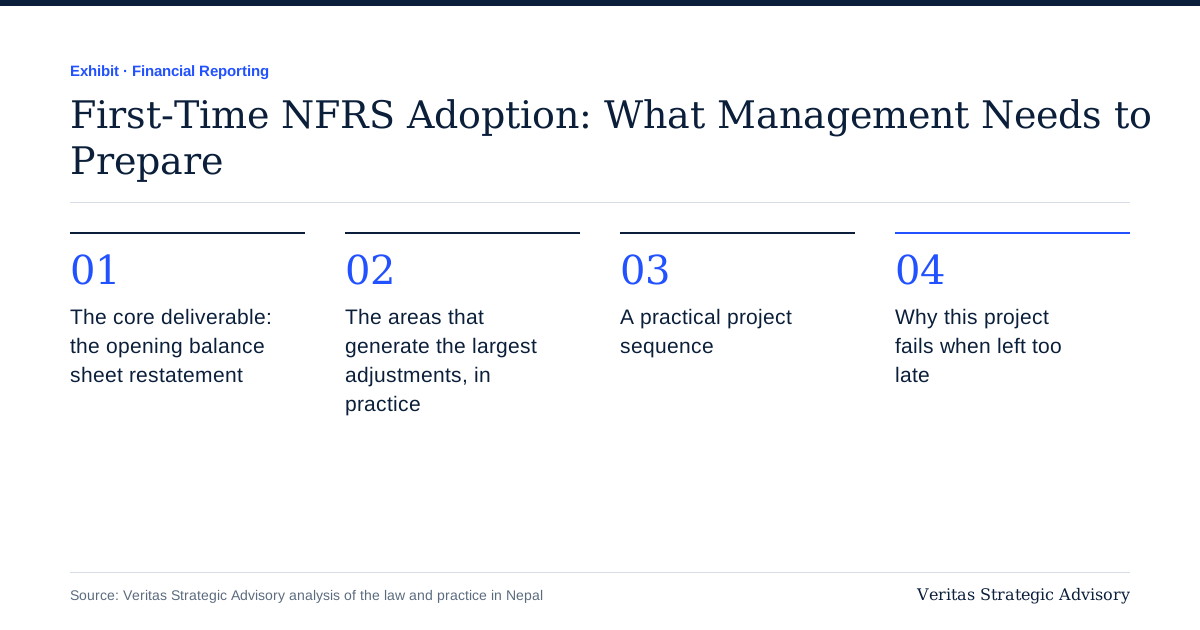
The core deliverable: the opening balance sheet restatement
Every first-time NFRS adoption produces one central artefact: a restated opening balance sheet at the transition date, prepared as if NFRS had always been applied, reconciled item by item against the balance sheet as it stood under the company's previous accounting basis. This reconciliation is not optional detail; it is the document that explains to the board, the auditors, and any lender relying on the financial statements exactly what changed and why, separating a genuine change in the underlying business from a change that is purely an artefact of the new reporting framework.
The areas that generate the largest adjustments, in practice
Fair value measurement of property, plant, and investments. Where NFRS requires or permits fair value rather than historical cost, land, buildings, and investment holdings carried for years at their original purchase price can move substantially on transition, with the movement recognised either through a revaluation reserve or, in some cases, through retained earnings. This is very often the single largest number in the entire reconciliation, and the one most likely to require a qualified external valuation to support.
Deferred tax recognition. Most companies making this transition for the first time have never carried a deferred tax asset or liability on their books. NFRS requires deferred tax to be recognised for timing differences between the accounting treatment and the tax treatment of assets and liabilities, an item that did not previously exist in the company's financial statements and that requires a full review of every timing difference across the balance sheet to calculate correctly.
Lease capitalisation. Leases that were previously treated as a simple monthly expense are brought onto the balance sheet as a right-of-use asset with a corresponding lease liability, calculated as the present value of future lease payments. This changes total assets, total liabilities, and the shape of the profit and loss statement, since what was previously a flat rent expense becomes a depreciation charge plus an interest charge, and it requires management to gather every active lease agreement and its full remaining payment schedule.
Impairment review. Assets, particularly older property, plant, and equipment, and any goodwill on the books from a past acquisition, need to be tested for impairment under NFRS's specific methodology, which can result in a write-down that had not previously been required or considered under the prior framework.
Consolidation, where applicable. If the company controls one or more subsidiaries, first-time adoption is also frequently the point at which group consolidation is properly implemented for the first time, producing a single set of group financial statements rather than standalone entity accounts, itself a substantial technical exercise.
A practical project sequence
Confirm the transition date and the tier, since the transition date determines exactly which balance sheet is being restated and the comparative period the restated figures need to cover.
Inventory every lease, related-party arrangement, and long-term contract across the business; these are consistently where the most time-consuming adjustments are found, and the ones most often missed if the exercise starts from the financial statements alone rather than from the underlying contracts.
Identify every asset that may require fair valuation, and engage a qualified valuer early; valuation work has its own lead time and is frequently the critical path item that determines whether the whole project finishes before an audit deadline.
Build the deferred tax calculation across every identified timing difference, a technical exercise that benefits from being done methodically against a full fixed asset register and tax computation, not estimated.
Prepare the full opening balance sheet reconciliation, presenting the old-basis figure, each specific NFRS adjustment identified by cause, and the restated NFRS figure, for every material balance sheet line.
Brief the board and any lender relying on covenant ratios well before the restated figures are finalised, since profit, equity, and leverage ratios can all move on transition even though nothing about the business's actual cash generation or operations has changed, and a lender caught by surprise by a covenant movement is a preventable, self-inflicted problem.
Why this project fails when left too late
The most common failure mode we see is a company beginning this exercise only once the auditor requests it as part of the year-end audit, at which point the valuation work, the lease inventory, and the deferred tax calculation are all being rushed simultaneously under audit deadline pressure. Each of those three workstreams, done properly, needs lead time that a rushed timeline does not allow, and the quality of the judgment applied, particularly around fair valuation and impairment, tends to suffer measurably when compressed into the final weeks before an audit sign-off is due.
What good preparation looks like
Preparation means starting the lease inventory, the related-party review, and the valuation engagement well ahead of year-end, so that by the time the audit begins, the opening balance sheet reconciliation is already substantially built and simply needs to be reviewed and confirmed, rather than constructed from scratch under time pressure.
How Veritas runs this
We scope a first-time-adoption project against your specific balance sheet from day one, identify the material adjustment areas early enough to bring in specialist valuation input where needed, and build the reconciliation as a document your board and lenders can actually follow. See our NFRS and financial reporting capability for how we structure and sequence this work.
Frequently asked
How long does a first-time adoption project typically take?
It depends heavily on the complexity of the balance sheet, particularly how many assets require fair valuation and how many active leases and related-party arrangements exist, but a project started with reasonable lead time before year-end, rather than at year-end, consistently runs more smoothly and at lower cost than one compressed into the final weeks.
Will our reported profit necessarily go down after adopting NFRS?
Not necessarily in either direction. Fair value adjustments, deferred tax recognition, and lease capitalisation can each move profit or equity up or down depending on the specific facts of the business; the point of the exercise is an accurate, explained restatement, not a predetermined outcome.