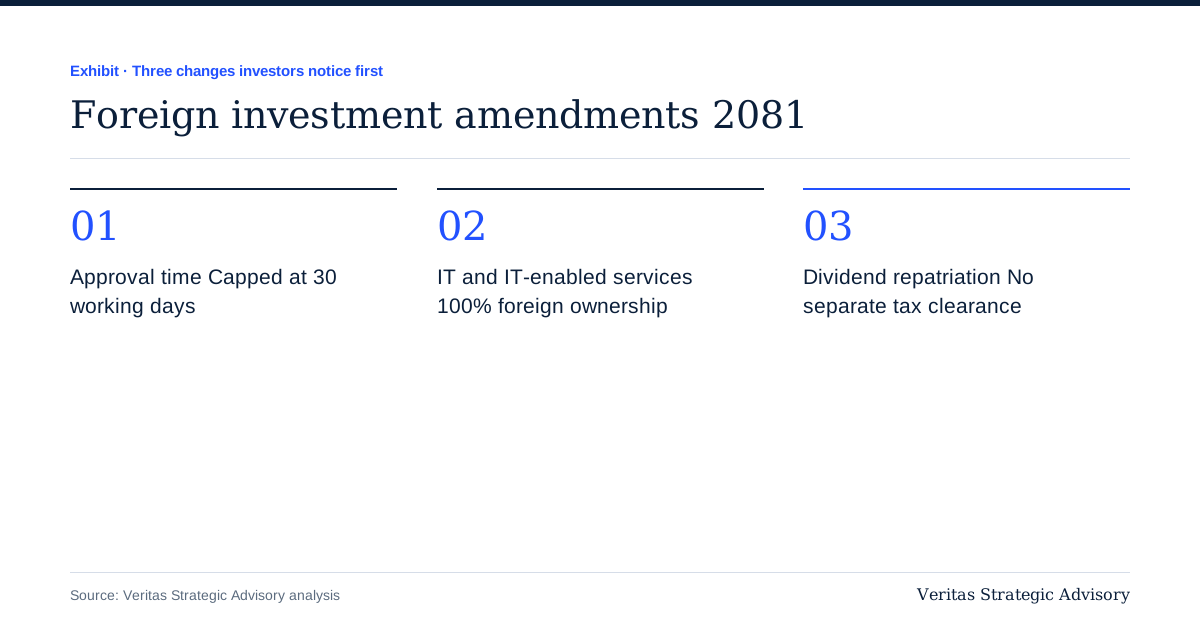

The amendments to the Foreign Investment and Technology Transfer Act, 2075 (FITTA) are best read as a set of specific changes, not a new regime. They came through an ordinance issued on 28 April 2024 (16 Baisakh 2081), on the recommendation of the Council of Ministers. The ordinance was followed by a bill that Parliament passed in mid-2024, and a further Act authenticated on 31 March 2025 continued the work of improving the business and investment environment. Sources differ on which instrument introduced some individual provisions, so confirm the section against the current consolidated text.
What changed in FITTA
Approval authority (Section 17). The Department of Industry (DOI) can now approve any foreign investment under the Act, including investments above NPR 6 billion. Check the current text for whether particular sectors or very large projects still route through the Investment Board under the separate PPP and Investment Act.
Foreign loans (Section 12). An industry with foreign investment no longer needs a recommendation from the Ministry of Industries before borrowing from foreign financial institutions. Project loan or project financing agreements are approved by Nepal Rastra Bank (NRB).
Contract manufacturing (Section 45(1)). The section was replaced. An industry with foreign investment may contract or subcontract with other industries with similar objectives to produce goods or services, or order production from them. Earlier wording restricted this to certain products.
Technology transfer (Section 2(f)). The definition now covers transfers between a domestic industry and a foreign investor, or between a Nepali industry and an overseas entity. It lists patents, designs, trademarks, goodwill, technical specifications, franchises, formulas, processes, user licences, know-how, management and technical services, and reverse engineering.
Technology transfer abroad (new Section 7A). A Nepali industry or company may transfer technology to an overseas entity. Foreign currency received has to be brought into Nepal with NRB permission, and a branch or unit abroad needs DOI permission. A related amendment to the foreign exchange law lets Nepali companies invest the foreign currency earned from such transfers abroad within limits and procedures set by NRB, which amended its bylaws in June 2025.
A sector cap. Foreign investment in ride-sharing is capped at 70 per cent.
Changes to the Industrial Enterprises Act that investors meet
The same ordinance also amended the Industrial Enterprises Act, 2076:
A new start-up category (Section 4A): a new company, firm or partnership using novel technology or concepts, under ten years old, with transactions not exceeding NPR 150 million in any fiscal year. Business Promotion Centres may be set up for start-ups.
Incentives for IT-sector industries with capital investment above NPR 1 billion, and for start-ups, may be granted by the federal, provincial or local level.
Industries permitted to hold land above the landholding ceiling may borrow against 50 per cent of that land to expand, based on a detailed project report.
Air services and cable cars were added as national priority industries.
What the changes did not do
It is as important to know what did not change. The ordinance, as described in published legal summaries, did not alter the minimum investment amount, the sector list (apart from ride-sharing) or the profit repatriation rules. Claims that circulated in 2024 about wholesale liberalisation of retail, shorter exit timelines or broad new caps should be checked against the Act itself rather than assumed.
Implications for investors and existing companies
Timing and route. For large proposals, confirm with the DOI whether it is the approving body for your project under the current text, and what documents it requires.
Funding structure. Project loans from foreign lenders are simpler to approve, but they still need NRB approval of the loan agreement, and the debt-equity position still has to be reported correctly. See our FDI approval guide and our note on why approval is not realisation.
Outsourced production. The wider contract manufacturing rule helps a foreign-invested manufacturer use other industries' capacity, but the contracts still need to be priced and documented. Related-party arrangements are exposed to transfer pricing review.
Existing approvals. Companies with approval letters should check whether a condition in the letter has been overtaken by the new text, and whether an amendment to the approval is needed before using a new freedom.
Technology payments. The new transfer rules allow Nepali firms to earn from technology abroad, but repatriation and reinvestment still run through NRB.

If you want an investment structure or an existing approval checked against the current text, our team of chartered accountants can help you work through the questions.
---
*Prepared from published summaries of the Ordinance to Amend Certain Acts for Investment Facilitation, 2081 (2024) and later amendments, October 2026. General guidance, not legal advice. Confirm each section against the current Act and the Department of Industry's procedures.*