- lawful levers
- 7
- sides of the line: planning and evasion
- 2
- test: survives full disclosure
- 1
- review, not a year-end scramble
- Annual
Every business owner wants to pay the tax they legally owe and not a rupee more, and the confusion in practice is almost never about intent, it is about where exactly the line sits between the two, and about not knowing which lawful levers are actually available before the year has already closed and the option to use them has passed.
Where the line actually is
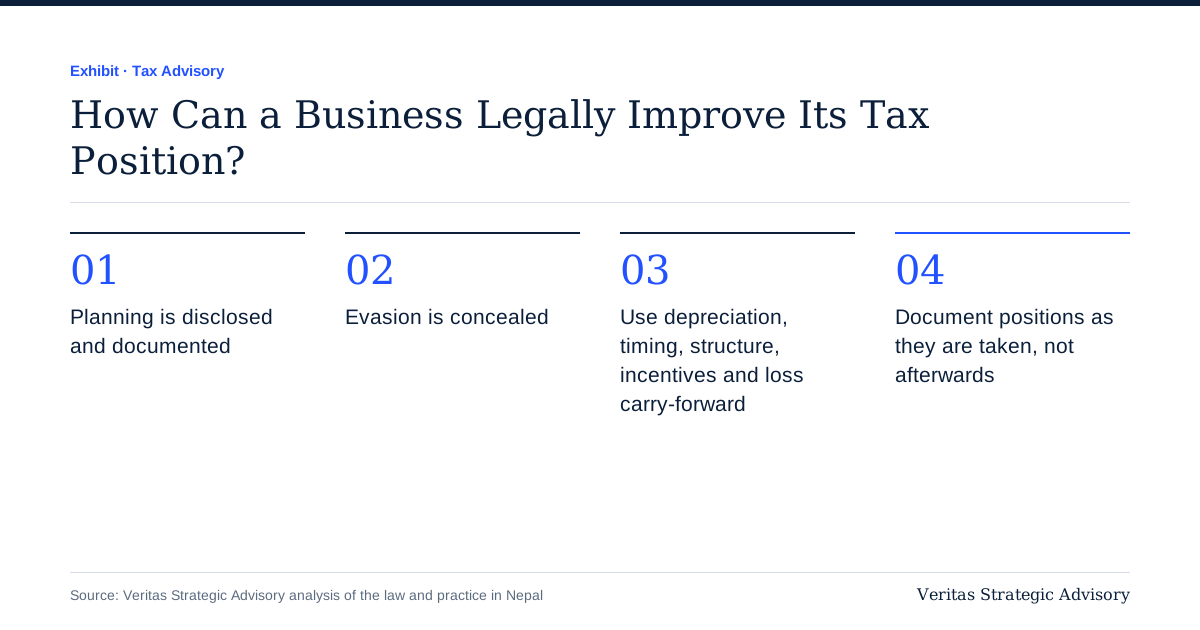
Tax planning is the lawful arrangement of a business's affairs, using deductions, timing, structuring, and incentives that the Income Tax Act, 2058 and related provisions explicitly permit, to arrive at the lowest tax liability the law allows. It is transparent: every position taken is disclosed in the return and supportable with genuine records and a genuine commercial rationale.
Tax evasion is the concealment or misrepresentation of income, expenses, or transactions to reduce a tax liability below what is genuinely owed: unrecorded sales, fictitious expenses, or transactions structured with no purpose other than to disguise the true position from the tax office. It is a criminal and civil exposure, carrying penalty, interest, and reputational consequence far beyond the tax saved.
The practical test that separates the two is simple to state and important to apply honestly: would this position survive full disclosure to the tax office, supported by genuine documentation and a genuine business rationale? A position that only works if it is not looked at closely is not planning; it is exposure waiting to surface, and it surfaces most often exactly when it is least convenient, during a tax audit or an amended assessment, a process we cover in your company received a tax notice: what to do first.
The specific levers available, lawfully
1. Depreciation and asset pooling. The Income Tax Act allows depreciation on business assets according to prescribed rates and pooling methods. Correctly classifying assets into the right pool, and timing capital purchases within the tax year, is a genuine, lawful lever that many businesses under-use simply because the depreciation schedule is treated as a compliance afterthought rather than a planning tool.
2. Timing of income and expenditure. Within the bounds of when income is genuinely earned and expenses genuinely incurred, there is often legitimate flexibility in exactly when a transaction is finalised, a capital purchase committed, or a bonus or provision recognised, that can shift the tax effect between periods lawfully, particularly useful where tax rates, incentive eligibility, or loss positions differ between the periods in question.
3. Business structure. The choice of legal form, and the structuring of group relationships where a business operates through more than one entity, has direct tax consequences. Reviewing whether the current structure is still the most efficient one, particularly after a business has grown well beyond the scale it was originally structured for, is a legitimate and often overlooked planning exercise.
4. Available incentives and exemptions. Nepal's tax law provides specific incentives for certain sectors, activities, and investment types, manufacturing, exports, and special economic zones among them. A business genuinely eligible for an incentive and not claiming it is simply leaving a lawful benefit unclaimed; the planning work here is confirming eligibility correctly and maintaining the specific documentation the exemption requires.
5. Loss carry-forward utilisation. Business losses, correctly computed and documented, can generally be carried forward and set off against future taxable income within the timeframe the law allows. Businesses that have gone through a loss-making period should have this position clearly tracked and ready to apply the moment profitability returns, rather than reconstructing it retroactively.
6. TDS and advance tax planning. Reviewing withholding obligations and advance tax instalment calculations against a realistic current-year estimate, rather than a stale prior-year figure, avoids both the cash flow cost of over-paying advance tax and the interest exposure of materially under-paying it.
7. Related-party and transfer pricing positions. Where a business transacts with related entities, pricing those transactions on a genuine arm's-length basis, properly documented, is both the legally required position and, done correctly, the position least likely to attract adjustment on review.
Why this needs to be an annual discipline, not a year-end scramble
Almost every lever above depends on action taken during the year, a capital purchase timed correctly, a structure reviewed before a major transaction, documentation maintained contemporaneously, not reconstructed after the return has already been filed. A tax position reviewed only once a year, after the year has closed, has already lost access to most of the levers that required a decision during the year itself. This is the same discipline covered in more operational detail in our companion piece on tax health check: 15 things every business should review, run proactively rather than only in response to a filing deadline.
The real cost of getting the line wrong in either direction
Businesses that are too conservative, avoiding every available deduction or incentive out of an abundance of caution, simply pay more tax than the law requires, year after year, a cost that compounds silently and is rarely noticed because it never appears as a specific loss on any statement. Businesses that step over the line into evasion face a different and far more acute cost: penalty, interest, and, in serious cases, prosecution, on top of the original tax due, once discovered. The lawful middle ground, aggressive but fully documented and disclosed planning, is where the genuine, sustainable savings actually sit.
How Veritas approaches this
We review the specific levers above against your actual business and transaction history, build the documentation each position requires as the year progresses rather than reconstructing it afterward, and are explicit with clients about where a position is well within the law versus where it carries genuine risk. See our tax advisory and planning service for how this is run as an ongoing relationship rather than a once-a-year filing exercise.
Frequently asked
Is aggressive tax planning itself risky, even if technically legal?
A position can be legally defensible and still attract scrutiny or an amended assessment; the protection is not the aggressiveness of the position but the quality and contemporaneity of the documentation supporting it. Well-documented, genuinely commercial positions are defensible even under close review.
Can a business change its tax planning approach mid-year?
Many levers, particularly around timing and structure, need to be actioned during the year to have effect for that year; a mid-year review is generally far more useful than waiting until the year has closed, since it still leaves time to act on what the review finds.