- recognised approaches
- 3
- steps in an engagement
- 5
- discounts: illiquidity and minority
- 2
- purpose settled first
- 1
Business owners usually ask "what is it worth?" at a specific moment: bringing in an investor, buying out a partner, planning succession, or selling. Each situation can produce a different answer, because valuation is not a single formula. It is a judgment, built from a defined method and applied to a specific purpose. This article sets out how a practitioner approaches it for a private company in Nepal, including the places where data is thin and the numbers have to be argued rather than looked up.
Start with purpose, date and standard of value
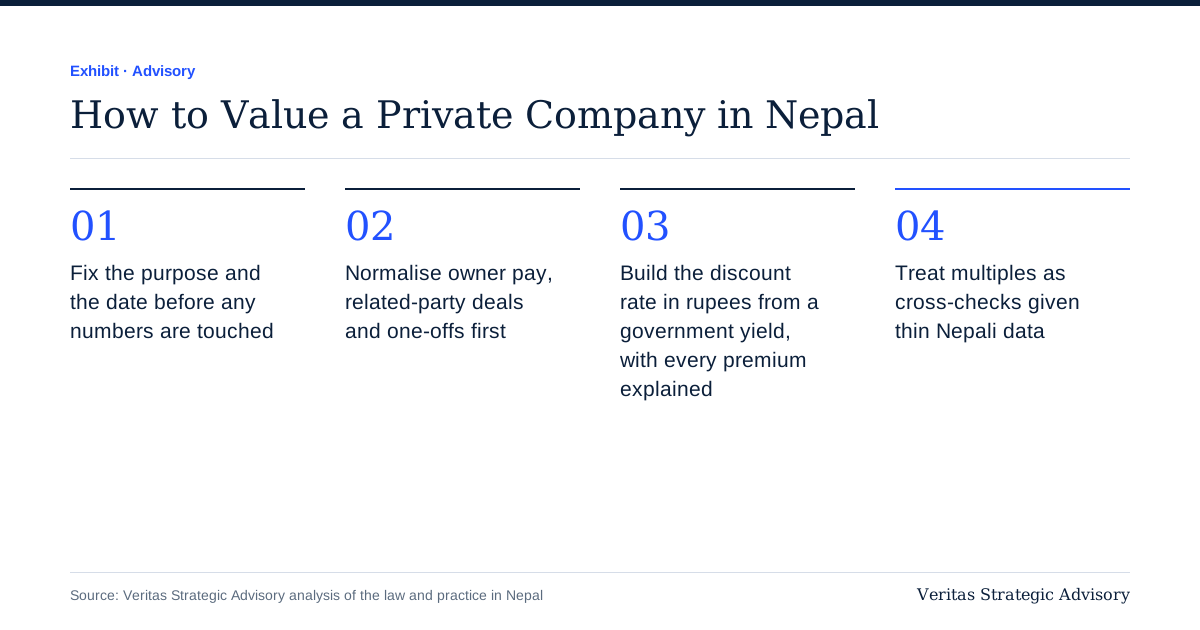
Before any number is touched, fix three things.
Purpose. A valuation for a share transfer between family members, one for an incoming investor, one for a partner buy-out and one for a tax filing can legitimately differ, because the assumptions being tested differ.
Valuation date. Value is a snapshot. Balance sheet, net debt and market conditions must all be as at one stated date. A common error is using a year-end balance sheet with a later forecast and a different date's interest rates.
Standard of value. Fair value under NFRS 13 (which follows IFRS 13) is the price in an orderly transaction between market participants at the measurement date. That is not the same as the value to one particular buyer, or a negotiated price. State which one you are measuring.
Any report worth relying on states all three on its first page.
Normalise earnings before anything else
Every approach starts from earnings or cash flow, so errors here flow through everything. Typical adjustments in a Nepali private company:
Owner compensation reset to a market salary for the work actually done, up or down.
Related-party transactions (rent, loans, purchases, management fees) repriced to arm's-length terms.
One-off items such as a litigation settlement, an asset sale gain or an unusual write-off removed.
Non-operating assets (idle land, investments, loans to directors) taken out of earnings and valued separately, then added back to the value of the operating business.
Accounting basis. If the accounts were prepared under a simplified or inconsistent basis, restate them on the framework a buyer would expect. See does your company need NFRS.
Also look at the quality of revenue and tax position: undisclosed liabilities, disputed assessments and unfiled returns reduce value dollar for dollar, so they belong in the analysis, not in a footnote.
Income approach: discounted cash flow
Forecast free cash flow to the firm (operating profit after tax, plus depreciation, less capital expenditure and the increase in working capital) for an explicit period, usually five years, then add a terminal value for the years beyond. Discount everything at a rate reflecting the risk of those cash flows.
Illustrative worked example. All figures are illustrative and in NPR million; they describe no real company.
Free cash flow, years 1 to 5: 100, 110, 120, 128, 135.
Discount rate: 18 per cent. Long-term growth after year 5: 5 per cent.
Present values at 18 per cent: 84.7, 79.0, 73.0, 66.0 and 59.0, total about 361.8.
Terminal value at end of year 5: 135 x 1.05 / (0.18 - 0.05) = 141.75 / 0.13 = about 1,090.4. Discounted five years (divide by 1.18 to the fifth power, 2.2878) gives about 476.6.
Enterprise value: 361.8 + 476.6 = about 838.4.
Two lessons from the arithmetic. First, the terminal value is about 57 per cent of the total, so the answer depends mostly on the long-term growth and discount rate, not on the next five years of detail. Second, moving the discount rate from 18 to 20 per cent (with growth unchanged) cuts the terminal value from about 1,090 to 945 before discounting, a large swing from a two-point change. Always show a sensitivity table of discount rate against growth, and a range, not a point.
DCF suits businesses with forecastable cash flow. For a young or volatile business, the forecast is the weakest link, and the report should say so.
Building the discount rate for a Nepali company
The discount rate must match the currency and risk of the cash flows. If forecasts are in rupees, the rate is a rupee rate. A practical build-up for the cost of equity:
Risk-free rate. Use the yield on Government of Nepal securities of a maturity close to the cash-flow horizon: Treasury bills for short horizons, development bonds for longer ones. Published data (CEIC, citing IMF) put the five-year government bond yield at 6.50 per cent in March 2026. Rates move with each auction, so take the yield from Nepal Rastra Bank's debt-management auction results as at your valuation date, not from a report.
Equity risk premium. There is no deep local market history to measure it, so practitioners usually start from a mature-market premium and add a country-risk premium, with the source and date disclosed. This is a judgment; show it explicitly.
Beta. Derived from listed comparables (often regional or global, since few Nepali listed companies are close matches) and re-levered for the target's capital structure.
Size premium. Small companies carry more risk than the market premium captures.
Company-specific premium. Customer concentration, key-person dependence, weak controls, regulatory exposure. Document each reason; do not use it as a plug.
Currency. If you value in rupees from a dollar-based build-up, adjust for the expected inflation difference. Mixing a dollar rate with rupee cash flows overstates value.
Illustrative build-up: risk-free 6.5 + equity premium 6.0 (beta 1.0 assumed) + size 3.0 + company-specific 2.5 = 18.0 per cent. These components other than the risk-free yield are illustrative. For a company with meaningful debt, blend this with the after-tax cost of debt at target gearing (a weighted average cost of capital).
Market approach: multiples and transactions
The market approach applies a multiple (EV/EBITDA, price/earnings, sometimes EV/revenue) from comparable companies or transactions to the subject's normalised metric.
The Nepal problem. Private deals are rarely disclosed, there is no deal database, and the listed market is dominated by banks, insurers and hydropower companies, which are poor comparables for most trading or services businesses. Practical responses:
Use listed Nepali peers only where the business genuinely matches (a listed bank for a finance company, a listed hydropower company for a hydro project), and say so.
Use regional or global listed multiples and adjust for size, growth, liquidity and country risk, with the adjustment explained.
Use the company's own history: previous share issues or transfers, if arm's length and recent.
Use the market approach as a cross-check on DCF, not as the primary anchor, and state the implied multiple from your DCF. In the example, 838.4 against year-1 cash flow is an obvious sense check: ask whether that multiple is believable for the sector.
A multiple from a different currency, country or size band is a starting point, not an answer.
Asset approach
Restate each asset and liability to fair value, then subtract liabilities. This suits holding companies, real estate and investment vehicles, loss-making businesses where liquidation is realistic, and as a floor for operating businesses. Points to watch: land and buildings at current market value rather than historical cost; inventory and receivables at recoverable amounts; intangible assets only where they can be identified and supported; contingent liabilities and deferred tax. For an operating company, the asset approach usually understates value because it ignores earning power, and goodwill appears only in the other methods.
From enterprise value to a price per share
This is where many reports go wrong. Work through the bridge in order:
Enterprise value from the chosen approach(es).
Less net debt at the valuation date: borrowings, accrued interest, finance leases, less cash. Treat debt-like items (overdue taxes, unpaid dividends, employee obligations, deferred consideration) as debt.
Adjust for normal working capital. If the balance sheet carries more or less working capital than the business needs, the difference is a price adjustment, not an operating cash flow.
Add non-operating assets valued separately.
Equity value (100 per cent, marketable, controlling basis).
In the example, with illustrative net debt of 120: 838.4 - 120 = 718.4 equity value. Then apply stake-specific adjustments:
Control versus minority. A DCF built on management's plan reflects a controlling basis. A minority holder cannot set dividends, strategy or exit, so a minority discount may apply. If the multiples came from listed minority prices, a control premium may be needed instead. Decide which direction applies to your inputs.
Marketability. Private shares cannot be sold on an exchange. An illiquidity discount may be applied; support it with reasoning (expected time to sell, restrictions in the articles or shareholders' agreement), not a convention.
Do not double count. Do not add a size premium to the discount rate and then discount again for the same risk.
In the example, an illustrative 20 per cent combined discount on a minority stake gives 718.4 x 0.80 = about 574.7 for the whole equity, with the holder's share taken proportionally. Treat the 20 per cent as a placeholder, not a benchmark.
Where the valuation is used
Share transfer or gift. Tax and registration treatment depends on the value used. Published practitioner summaries state that capital gains tax on share disposals under the Income Tax Act, 2058 depends on who sells and whether the shares are listed (for example 10 per cent for resident individuals on unlisted shares and 15 per cent for resident companies), and that bargain-price transactions can attract tax on the shortfall to fair market value. I could not verify the exact cost and value rules from the Act itself; confirm the current rates and valuation rules with the Inland Revenue Department before relying on them.
Investor round. Pre-money value, dilution and the investor's rights drive the outcome as much as the headline number. A cap table and clear share classes under the Companies Act matter here.
Foreign investment. Foreign investment is governed by the Foreign Investment and Technology Transfer Act, 2019, with approval through the Department of Industry. Whether and how an independent valuation is required for a particular route (share purchase, in-kind contribution, technology transfer) should be confirmed with the authority and current regulations.
Partner buy-out. Check the shareholders' agreement or articles first; many specify a formula or valuer. If not, agree the purpose, date and valuer before the numbers.
Financial reporting. Impairment tests, business combinations and investment accounting use fair value concepts under NFRS 13, with specific disclosure and hierarchy requirements.
What an engagement involves
Scoping: purpose, date, standard of value, stake being valued.
Information request: historical financial statements, management accounts, forecasts, cap table, material contracts, tax status.
Normalisation: sustainable, arm's-length earnings and a clean balance sheet.
Method selection and application: chosen approaches, discount-rate build-up, sensitivities, cross-checks.
Report: methodology, assumptions, bridge from enterprise value to equity, adjustments and a range, not a single unsupported number.
See our business valuation service, or if the valuation is part of a wider transaction, our financial due diligence service.

If you are weighing a share transfer, an investor round or a partner buy-out and want a reasoned range rather than a round number, our team of chartered accountants can help.
*Prepared from published sources and standard valuation practice, October 2026. General guidance, not a valuation opinion.*